Showing posts with label Vikki Law. Show all posts
Showing posts with label Vikki Law. Show all posts
Thursday, January 10, 2013
Gender and the Prison Industrial Complex
Gender and the Prison Industrial Complex from Because We Must on Vimeo.
Excellent panel: Gender and the Prison Industrial Complex from Because We Must on Vimeo. Gender and the Prison Industrial Complex: Towards a Queer, Trans and Feminist Abolition Politic A wonderful thought provoking panel by Eric Stanley, Dean Spade, Ralowe Ampu, and Vikki Law.


Monday, September 3, 2012
Vikki Law on race, gender, and justice.
Excellent essay by Vikki Law, author of Resistance Behind Bars: The Struggles of Incarcerated Women.
The second edition is about to be released, and will include the story
of the resistance to exploitation and abuse of prisoners at Martori
Farms in Arizona. AIDS activist/former political prisoner Laura
Whitehorn writes the introduction.

-------from TRUTH-OUT.org---------
No Justice When Women Fight Back
Friday, 31 August 2012 00:00By Victoria Law,
Truthout | News Analysis
What do a nineteen-year-old lesbian from New Jersey, a 23-year-old trans woman in Minneapolis and a 31-year-old mother in Florida have in common? All three were attacked, all three fought back and all three were arrested. All three are currently in prison while their attackers remain free. Oh, yes, and all three are black women.
Marissa Alexander is a 31-year-old mother of three. She is also a survivor of violence at the hands of her ex, Rico Gray. In 2009, Alexander obtained a restraining order against Gray. Learning that she was pregnant, she amended it to remove the ban on contact between her and Gray while maintaining the rest of the restraining order.
On August 1, 2010, nine days after Alexander had given birth to their daughter, Gray attacked her in her own home. "He assaulted me, shoving, strangling and holding me against my will, preventing me from fleeing all while I begged for him to leave," Alexander recounted in an open letter to supporters.
Alexander escaped into the garage, but realized that she had forgotten the keys to her truck and that the garage's door opener was not working. She retrieved her gun, which was legally registered, and re-entered her home to either escape or grab her cell phone to call for help. "He came into the kitchen ... and realized I was unable to leave ... he yelled, 'Bitch I will kill you!' and charged toward me. In fear and a desperate attempt, I lifted my weapon up, turned away and discharged a single shot in the wall up in the ceiling." Gray called the police and reported that Alexander had shot at him and his sons. Alexander was arrested and charged with aggravated assault with a deadly weapon.
Alexander attempted to invoke Stand Your Ground, but a pre-trial judge ruled that she could have escaped her attacker through the front or back doors of her home. During her trial, the jury was not allowed to see several letters, written by Gray's former wives, girlfriends and in-laws, that recounted his history of abuse, including pistol-whippings, beatings, stripping them of their clothing and super-gluing door locks on them. Several letters also recounted instances in which Gray called the police after he had attacked them, claiming that they had attacked him. (In one instance, Gray stabbed himself with a fork and asked his younger son to tell the police that his girlfriend had done it.) In a sixty-six page deposition, Gray admitted to abusing all five of the women with whom he had children, including Alexander.
Instead of taking these facts into consideration, prosecutor Angela Corey added Florida's 10-20-LIFE sentencing enhancement, mandating a 20-year minimum sentence when a firearm is discharged.
Not an Anomaly: Race, Gender and the Justice System
Alexander's case is not an anomaly. Other women of color have defended themselves only to find the legal system more eager to prosecute and punish them than their assailants.
In August 2006, nineteen-year-old Patreese Johnson and six friends from Newark, New Jersey, took the train to New York's West Village, a neighborhood historically known for its LGBTQ friendliness. As the women walked down the street, they were sexually propositioned by a man named Wayne Buckle. Buckle followed them, threatening to rape them and then physically attacked, choking one, ripping hair from their scalps and spitting on them. The women defended themselves and, at some point, were assisted by two unknown men. During the altercation, Buckle was stabbed. The women were arrested while the men left the scene.
All seven were black lesbians. In addition, three were masculine-appearing. "Their treatment [by the media and legal system] has been reflective of what they look like," noted one supporter who needed to remain anonymous for fear of reprisals at work. Johnson agrees, writing recently, "Me being black and young, the jury, judge and DA's minds was already made up." (Letter, July 18, 2012.)
Police refused to credit the women's statements, those of other witnesses and, ultimately, that of Buckle himself, who stated that the two men were responsible for stabbing him. Both the media and the prosecution framed them as a "lesbian wolf pack" and "killer lesbians." Both media and prosecution also played on racialized fears around gang violence: Although none of the women had ever been in conflict with the law, media and prosecutors described them as a "gang." In addition, neither the judge nor the prosecutor differentiated between the charge of "gang assault" (two or more people acting in concert to cause injury) and gang membership.
Three of the women accepted plea bargains and served six months; the remaining four - Venice Brown, Terrain Dandridge, Renata Hill and Patreese Johnson - became known as the New Jersey Four; they pled not guilty. They received sentences ranging from three-and-a-half to eleven years in prison.
Upon appeal, charges against Dandridge were dismissed while Brown and Hill were granted a retrial and subsequently accepted plea agreements. Johnson's sentence was reduced from eleven to eight years. She remains in prison today. Dwayne Buckle was never arrested nor charged for attacking the women.
As reported last year in Truthout, 23-year-old CeCe McDonald, a young black transgender woman, and her friends were walking to the grocery store in Minneapolis when she was first verbally harassed, then physically attacked by the white patrons standing outside a bar. During the attack, a bar patron smashed a glass into McDonald's face, slicing her cheek. As more people joined in the attack, Dean Schmitz, who had instigated the verbal harassment, was stabbed and later died in the hospital. McDonald was arrested and charged with second-degree murder. The woman who smashed glass into McDonald's face was never arrested or charged.
During pre-trial motions, the judge ruled against McDonald's ability to introduce evidence showing that the attack against her was motivated by her race and gender identity: Both Schmitz's swastika and his three previous convictions for violent assault were ruled inadmissible. The judge also refused to allow an expert witness to testify about the pervasive and systemic violence faced by trans people on a daily basis. (Letter from CeCe McDonald, July 19, 2012.)
Faced with second-degree murder charges, a hostile court and the possibility of twenty to forty years, McDonald pled guilty to second-degree manslaughter due to negligence and was sentenced to forty-one months in prison. "She [also] has to pay for her attacker's funeral," noted Billy Navarro of the Minnesota Transgender Health Coalition and a member of her support committee. (Interview, July 26, 2012.)
These cases - and their verdicts - reflect an all-too-common reality in the United States: When women, particularly women of color, defend themselves, they often find themselves assaulted twice - first by their attacker, then by the legal system. The zealous prosecution, as well as the lack of charges against their attackers, reflects the pervasive and socially sanctioned violence against women, particularly women of color and the prevailing notion that women should not fight back. "Me being female, I wasn't supposed to fight back," Johnson noted. (Letter, July 18, 2012.)
"People Were Outraged and Wanted to Get Involved"
Shortly after the New Jersey Four's arrest made headlines, FIERCE (Fabulous Independent Educated Radicals for Community Empowerment), an LGBT youth of color group in the West Village, organized efforts to secure lawyers, raise money for legal expenses, attend the trial, write letters and send care packages to the women while they were in prison. In California, queer people of color formed the Bay Area NJ4 Solidarity Committee, which created a web site to provide up-to-date information about the women's appeals, helped fundraise and stayed in contact with the women throughout their ordeal. Both groups continue to support Patreese Johnson during her incarceration.
In Minneapolis, those who worked with trans youth took note of McDonald's arrest. "It was clear immediately that she needed a lot of support," stated Navarro. Within the first weeks, supporters secured lawyers and formed the CeCe McDonald Support Committee. They publicized the case, gathering over 15,000 signatures and dozens of letters from organizations and prominent individuals worldwide demanding that the charges against McDonald be dropped. They then presented these to the prosecutor's office.
The Committee continues coordinating public support during McDonald's incarceration. Recently, despite McDonald's prescription and court order to receive twenty milligrams of hormones, prison staff were administering only six milligrams. Supporters from around the world flooded the prison with phone calls demanding that McDonald receive the full twenty milligrams, forcing the prison to follow the prescription order.
"The support from everyone everywhere keeps me motivated," McDonald wrote in a recent letter. "It showed that people care not only about these issues that are so easily 'swept under the rug' by society, but about how I am doing and keeping me afloat." (Letter, July 19, 2012.)
Women of Color, Self-Defense and Public Support in the 1970s and Today
In 1974, two men took Inez Garcia from her California home into a nearby alley. There, one man raped her while the other blocked the exit. Garcia later shot and killed the man who had blocked her escape. She was arrested and charged with first-degree murder.
Her case attracted extensive support, especially from those in the women's movements. Many were outraged that Garcia had been arrested while her rapist remained free. Supporters publicized her case at concerts, political meetings, church services and any venues where they might find potential sympathizers. They packed the courtroom, where the judge instructed the jurors not to consider the rape. Garcia was convicted and sentenced to five years to life in prison.
Supporters continued to publicize her case, tying it to the larger issue of a woman's right to defend herself against assault. They approached feminist lawyer Susan Jordan to take over Garcia's defense. Jordan appealed the case and had the conviction reversed because of the judge's instructions not to consider the rape. At the retrial, Jordan made rape an integral part of the case; Garcia was acquitted. "There was a change in consciousness going on in the country. We rode the wave of it," Jordan reflected in a 2007 interview. (Interview with Susan Jordan, June 18, 2007.)
The cases of Marissa Alexander, Patreese Johnson and CeCe McDonald, while more well-known than those of many other women of color trapped in the legal system for fighting back, have not achieved the same level of support that Inez Garcia received three decades earlier. Why not?
"The groups that came together [around the NJ4 case] were grassroots queer groups of color," recalled a supporter. "The larger LGBTQ organizations are fighting for gay marriage, not what youth are going through. And people are scared of women who stand up for themselves and fight back."
Katie Burgess, director of the Trans Youth Support Network and part of McDonald's support committee, has a similar opinion: "CeCe is at the intersection of multiple oppressions. On the local front, we saw people come together around the issue like never before - social workers, insurrectionary anarchists, lawyers, youth, GLBT people of color groups came together and built coalitions. But of course, racism still exists in LGBT communities. Homophobia and transphobia still exist in communities of color. Sometime people don't want to recognize the whole picture." (Interview, July 30, 2012.)
Navarro agrees that racism and transphobia kept many away: "CeCe doesn't get the same level of support because most people see someone that they've been taught to be afraid of, not someone's daughter."
However, both Burgess and Navarros acknowledge that the support McDonald received dramatically affected the outcome of her case. "CeCe being a young African-American trans woman living in poverty made them [the prosecution] think that she didn't have the resources to defend or advocate for herself," Navarro stated. "Not until just before the trial did they realize how much support she had." Navarro also noted that McDonald was offered several plea bargains and, with each plea bargain, the amount of time diminished. (Interview, July 26, 2012.)
Both Johnson and McDonald recognize that support needs to extend beyond their individual cases to address the broader issues of race, class, gender and the justice system: "I would hate to think that the law is going to continue putting our women in prison for defending themselves," Johnson wrote recently. "Support me by making a change, starting with one's self. It's not really about me; it's about women overall." (Letter, July 18, 2012.)
McDonald has similar thoughts: "The real issues are the ones that affect all prisoners. People should get involved in changing policies that keep people in prisons, like exclusion from employment, housing, public assistance," she wrote. "These are just a few things that will keep people out of prisons and lead to the dismantling of these facilities." (Letter, July 19, 2012.)
While the legal process is over for both Johnson and McDonald, Alexander has not given up. Her first husband, Lincoln Alexander and her sister Helena Jenkins, have formed the Committee to Free Marissa Alexander. Groups and individuals have come together in Florida and across the country to continue the campaign for her freedom.
As seen with CeCe McDonald and the New Jersey Four, support can make a difference. As McDonald stated, one month after her sentencing, "I didn't let this incident diminish me. Instead, it made me grow mentally, emotionally and spiritually. Not just for myself, but for my friends, families and supporters who tell me that my struggle against discrimination and me defending myself give them hope and motivation to be strong, to fight for their beliefs and to be the people they want to be instead of hiding or conforming. So this isn't just for me, it's for all of us!" (Letter, July 19, 2012.)

Boston, 2012
Thursday, February 16, 2012
Occupy Prisons: Injustices Behind Bars.
A reminder from activist and author Vikki Law that the outrageous mistreatment that some members of the Occupy Movement have experienced of late in the way of police violence has always been a common part of life for people in many communities...

Memorial mural for women who have died from suicide or neglect
in the custody of the Arizona Department of Corrections under
ADC Director Chuck Ryan and Gov Jan Brewer.
FEB 20
PRISONS AND JAILS NEAR YOU.
----from counterpunch.org----
“Manhandled, arrested, cuffed, searched, and locked away in the Tombs” is how AlterNet described
the story of protester Barbara Schneider Reilly, who spent 30 hours in
jail after being arrested at an Occupy Wall Street-related protest in
October 2011.
Reilly reported: “During the long, cold night in the Tombs, at some point we asked a female officer if we could have some blankets. ‘We have no blankets.’ Some mattresses since we were 12 or so people? ‘We have no more mattresses.’ Some change in exchange for dollar bills so we could call parents and loved ones? (The one public telephone in the cell would only take coins.) ‘It’s against regulations.’ Some soap? ‘Maybe we’ll come up with some soap.’ After no, no, no to every reasonable request, we wound up with a small jar of soap. Distressing is hardly the word for a culture of willful neglect and the exercise of what power those officers held over us for those 30 hours.”
While Reilly’s experience was horrific, it is only a sliver of the atrocities that over 114,000 women in prisons and jails must endure on a daily basis. When the article first appeared, I printed it out and circulated it to several currently incarcerated women and asked how Schneider’s weekend compared to their own realities.
“It’s always great to see stories like Barbara Schneider’s published. It’s important that as many people as possible spread the word about jails, prisons, incarceration and our justice system,” wrote RJ, a woman who had been incarcerated in Colorado. “As a prisoner myself, Schneider’s descriptions are definitely familiar: Thousands of people experience similar processes every day, many for years on end. Each time a story of incarceration is shared, I hope we think of ALL who are in jail/prison. Regardless of what has led to our arrest and whether we have been held for ten hours, ten years, not yet, or never, the same oppressive system contains us. We all are offered dehumanization and brutality in the name of order, rehabilitation, deterrence or justice.”
“Her experience was just a tip of the iceberg,” wrote Terrina, another woman incarcerated in Colorado. “I am, by no means, trying to minimize her experience because incarceration is horrible for anyone that goes through it. However, she was blessed that she was somewhere that the spotlight was being shined on. Can you imagine how the forgotten people feel? The ones with no family, no support, no organization standing behind them?”
Terrina describes what the process is like for those entering the prison system:
When someone arrives at DW, you’re stripped, photographed, poked, prodded, asked a bunch of questions that seem to have no bearing on your actual crime or personal situation (although the answers do chart out a path for your life in DOC), and given a piece of dry stale cake to eat. Yes cake. And that is it for the day. When you take into account that the prisoners are awake and traveling before 6am, without food or drink, from the county jail, and scared, anxious and unsure of the upcoming events, not being fed until 6pm is an awfully long time.
The women are placed in the first living unit. Although it is called a LIVING unit, you would think it is more like a kennel. The women are allowed out of their cell for one hour a day. At that time, they have to shower, use the phone, and try to learn the rules and regulations of their new surroundings without any guidance from the officers. Yes, it is true that there are “Posted Operational Regulations” (PORs) but … Lord forbid that the officers tell the new inmates how to use the telephone, when they are allowed to shower, how to get their medication, if needed, and, if they are pregnant, they are lucky if they are allowed to receive prenatal treatment for the first month that they are here. The women live like animals for at least a month before moving to the next “living” unit. Once they move, they are allowed TWO hours out a day. No classes, one hour a week at the gym, a minimal church, and hopefully by now the new girl has found a decent “old number” that can explain the way of her new world. If not … she’s still shit out of luck.
Unfortunately she still has to deal with the same offices that she’s been around for the first month. At this time, her telephone system should be working. However, the case managers that are supposed to be there to help are not able to explain the phone system, the classes that are available, the jobs that are attainable, or even the canteen that should be purchasable. Three to four weeks later and the confusion begins all over with another “living” unit move. Previously, contact with the other offenders was restricted altogether. Now you are thrown into a space set up like the monkey exhibit at most zoos. It is so overwhelmingly loud and disorganized that many women shut down, get angry, fight, and begin to behave like the animals they are being treated like.
In this new building, the inmate is supposed to automatically know the rules they were never taught, they’re expected to know where to go and when, which sidewalks to walk on at specific times, who they are and aren’t allowed to talk to, and are expected to show up to work on time, usually without knowing that they have even been assigned a job…
Let’s take a moment and discuss the jobs: labor crew, kitchen, laundry … those are the first jobs available. DOC pays 60 cents a day to do the work that keeps the facility running. The majority of inmates MUST pay restitution, which is, of course, taken out of their state pay … so after a full month of working hard, they are able to spend approximately $10.63. The only thing that is free in DOC is one roll of toilet paper a week and one pack of sanitary pads per month. If the inmate has a heavy menstrual cycle and needs more pads, she has to pay $4 to get them. Toothpaste, toothbrush, body soap, a brush or comb, lotion, shampoo, conditioner, hair grease, floss, any hygiene besides one roll of toilet paper a week, the inmate HAS to pay for. Since I have been in prison, the prices of canteen have gone up at least every two to three months. Why hasn’t the rate of our pay? The state is allowed to charge more for the toothpaste, but unable to pay us enough to purchase it? Don’t get caught giving away any hygiene if you are lucky enough to have it because then you can get a write-up for loaning and bartering or unauthorized possession if you don’t have a receipt for the items in your room."
In 1964, peace activist Barbara Deming spent 27 days in jail in Albany, Georgia. Deming and a group of activists had embarked on a Peace Walk from Quebec to Guantanamo, the American army base in Cuba. When the walk reached Georgia, the Peace Walkers found it impossible to demand peace without also demanding the right of all people — black and white — to walk together down any street in any city. In Albany, where the police chief had boasted that he had defeated Martin Luther King non-violently,[5] the group twice attempted to walk through the White section of town; each time, they were arrested and brought to the county jail. Deming was among the group of fifty-four women arrested the second time. Her fellow Peace Walker Yvonne, who spent first 24 days in jail and 27 days the second time, wrote: “If there is anything I have learned by being in jail, it is that prisons are wrong, simply and unqualifiedly wrong.”[6]
Nearly fifty years later, in 2011, Barbara Schneider Reilly ends her account of jail on an optimistic note:
“Society must be changed. They insist on it, and, I hope, will continue to insist. And, not withstanding the difficulties ahead, we will fight for it.”
One hopes that these fights also recognize and include the struggles of people in prison. As RJ states,
Victoria Law is a writer, photographer, mother, and Contributing Author for New Clear Vision. She is the author of Resistance Behind Bars: The Struggles Of Incarcerated Women(PM Press, 2009), the editor of the zine Tenacious: Art and Writings from Women in Prison, and a co-founder of Books Through Bars — NYC. She is currently working on transforming Don’t Leave Your Friends Behind, a zine series on how radical movements can support the families in their midst, into a book.
Notes
[1] Human Rights Watch, All Too Familiar.6.
[2] Jennifer Bagwell, “Barred from View: How Michigan Keeps the Lid on Allegations of Widespread Sexual Abuse Against Female Inmates,” Metro Times: Detroit’s Alternative Weekly, March 24, 1999.
[3] Beth E. Richie and Kay Tsenin, Female Offenders, Pornography and Prostitution, Child Abuse and Neglect, research forum on women and girls in the justice system for the Department of Justice, 1999.
[4] Caroline Wolf Harlow, Prior Abuse Reported by Inmates and Probationers, special report for the U.S. Department of Justice, April 1999, 1.
[5] Barbara Deming, Prisons That Could Not Hold, 6.
[6] Deming, Prisons That Could Not Hold, 36.
Reilly reported: “During the long, cold night in the Tombs, at some point we asked a female officer if we could have some blankets. ‘We have no blankets.’ Some mattresses since we were 12 or so people? ‘We have no more mattresses.’ Some change in exchange for dollar bills so we could call parents and loved ones? (The one public telephone in the cell would only take coins.) ‘It’s against regulations.’ Some soap? ‘Maybe we’ll come up with some soap.’ After no, no, no to every reasonable request, we wound up with a small jar of soap. Distressing is hardly the word for a culture of willful neglect and the exercise of what power those officers held over us for those 30 hours.”
While Reilly’s experience was horrific, it is only a sliver of the atrocities that over 114,000 women in prisons and jails must endure on a daily basis. When the article first appeared, I printed it out and circulated it to several currently incarcerated women and asked how Schneider’s weekend compared to their own realities.
“It’s always great to see stories like Barbara Schneider’s published. It’s important that as many people as possible spread the word about jails, prisons, incarceration and our justice system,” wrote RJ, a woman who had been incarcerated in Colorado. “As a prisoner myself, Schneider’s descriptions are definitely familiar: Thousands of people experience similar processes every day, many for years on end. Each time a story of incarceration is shared, I hope we think of ALL who are in jail/prison. Regardless of what has led to our arrest and whether we have been held for ten hours, ten years, not yet, or never, the same oppressive system contains us. We all are offered dehumanization and brutality in the name of order, rehabilitation, deterrence or justice.”
“Her experience was just a tip of the iceberg,” wrote Terrina, another woman incarcerated in Colorado. “I am, by no means, trying to minimize her experience because incarceration is horrible for anyone that goes through it. However, she was blessed that she was somewhere that the spotlight was being shined on. Can you imagine how the forgotten people feel? The ones with no family, no support, no organization standing behind them?”
Terrina describes what the process is like for those entering the prison system:
When someone arrives at DW, you’re stripped, photographed, poked, prodded, asked a bunch of questions that seem to have no bearing on your actual crime or personal situation (although the answers do chart out a path for your life in DOC), and given a piece of dry stale cake to eat. Yes cake. And that is it for the day. When you take into account that the prisoners are awake and traveling before 6am, without food or drink, from the county jail, and scared, anxious and unsure of the upcoming events, not being fed until 6pm is an awfully long time.
The women are placed in the first living unit. Although it is called a LIVING unit, you would think it is more like a kennel. The women are allowed out of their cell for one hour a day. At that time, they have to shower, use the phone, and try to learn the rules and regulations of their new surroundings without any guidance from the officers. Yes, it is true that there are “Posted Operational Regulations” (PORs) but … Lord forbid that the officers tell the new inmates how to use the telephone, when they are allowed to shower, how to get their medication, if needed, and, if they are pregnant, they are lucky if they are allowed to receive prenatal treatment for the first month that they are here. The women live like animals for at least a month before moving to the next “living” unit. Once they move, they are allowed TWO hours out a day. No classes, one hour a week at the gym, a minimal church, and hopefully by now the new girl has found a decent “old number” that can explain the way of her new world. If not … she’s still shit out of luck.
Unfortunately she still has to deal with the same offices that she’s been around for the first month. At this time, her telephone system should be working. However, the case managers that are supposed to be there to help are not able to explain the phone system, the classes that are available, the jobs that are attainable, or even the canteen that should be purchasable. Three to four weeks later and the confusion begins all over with another “living” unit move. Previously, contact with the other offenders was restricted altogether. Now you are thrown into a space set up like the monkey exhibit at most zoos. It is so overwhelmingly loud and disorganized that many women shut down, get angry, fight, and begin to behave like the animals they are being treated like.
In this new building, the inmate is supposed to automatically know the rules they were never taught, they’re expected to know where to go and when, which sidewalks to walk on at specific times, who they are and aren’t allowed to talk to, and are expected to show up to work on time, usually without knowing that they have even been assigned a job…
Let’s take a moment and discuss the jobs: labor crew, kitchen, laundry … those are the first jobs available. DOC pays 60 cents a day to do the work that keeps the facility running. The majority of inmates MUST pay restitution, which is, of course, taken out of their state pay … so after a full month of working hard, they are able to spend approximately $10.63. The only thing that is free in DOC is one roll of toilet paper a week and one pack of sanitary pads per month. If the inmate has a heavy menstrual cycle and needs more pads, she has to pay $4 to get them. Toothpaste, toothbrush, body soap, a brush or comb, lotion, shampoo, conditioner, hair grease, floss, any hygiene besides one roll of toilet paper a week, the inmate HAS to pay for. Since I have been in prison, the prices of canteen have gone up at least every two to three months. Why hasn’t the rate of our pay? The state is allowed to charge more for the toothpaste, but unable to pay us enough to purchase it? Don’t get caught giving away any hygiene if you are lucky enough to have it because then you can get a write-up for loaning and bartering or unauthorized possession if you don’t have a receipt for the items in your room."
These inhumanities are of the everyday variety for women behind bars. Then there are the other injustices that are all too common in women’s prisons nationwide:
- Health care: Women in prison are more likely to be HIV+ than either men in prison or women who are not in prison. In 2000, women in prison were 60% more likely to have HIV than men in prison. Women in prison are 36 times more likely than women outside to have HIV. In addition, prisons are not likely to have female-specific health care (pregnancy, breast and cervical cancer screenings, GYN services, etc) and so women’s health needs often go untreated.
- Parenting: More than 80% of women in prison are mothers to children under the age of eighteen. Because of the ways in which parenting is gendered, when a mother goes to prison, she is far less likely to have a co-parent, partner or family member who is willing and able to take care of her children. As a result, children of imprisoned mothers are five times more likely to end up in foster care than children of incarcerated fathers. This statistic became even more devastating in 1997 when Congress passed the federal Adoption and Safe Families Act (ASFA). Under the Act, if a child has been in foster care for fifteen of the past 22 months, the state has to automatically begin terminating legal custody. Only three states make exceptions for parents who are in prison. If a mother is fortunate enough to maintain the legal rights to her child(ren), the distance of the prison from her home community makes it less likely that she will ever receive a visit from her child. More than 50% of mothers in prison reported never having received a visit from their children.
- Sexual Assault: In 1996, Human Rights Watch released All Too Familiar, a report documenting sexual abuse of women prisoners throughout the United States. The report, reflecting the organization’s two-and-a-half years of research, found that sexual assaults, abuse and rape of women prisoners by male staff members were common and that women who complained incurred write-ups, loss of “good time” accrued toward an early parole and/or prolonged periods in disciplinary segregation.[1] Little has changed in many prisons since the report’s release in 1996. Title VII of the Civil Rights Act of 1964 prohibits gender discrimination in employment, giving both male and female guards the right to gender-neutral employment in prisons housing prisoners of the opposite gender. Male staff members have been placed in female facilities with little to no training on cross-gender supervision and no procedures for investigating or disciplining staff sexual misconduct. In Michigan and other states, untrained male officers were assigned to positions in which they were able to walk, unannounced, into areas where women dress and undress, shower, and use the toilet. Male guards have also been given the task of performing body searches on prisoners, which includes patting down women’s breasts and genital areas. They also transported women to medical care and were required to observe gynecological and other intimate medical procedures.[2] It was not until incarcerated and formerly incarcerated women won a class-action lawsuit were restrictions on male access put into place.
- Abuse and battering: More than half of women in state prisons and jails report having experienced physical and/or sexual abuse.[3] Women are three times more likely than men to have been physically and/or sexually abused prior to incarceration.[4]
In 1964, peace activist Barbara Deming spent 27 days in jail in Albany, Georgia. Deming and a group of activists had embarked on a Peace Walk from Quebec to Guantanamo, the American army base in Cuba. When the walk reached Georgia, the Peace Walkers found it impossible to demand peace without also demanding the right of all people — black and white — to walk together down any street in any city. In Albany, where the police chief had boasted that he had defeated Martin Luther King non-violently,[5] the group twice attempted to walk through the White section of town; each time, they were arrested and brought to the county jail. Deming was among the group of fifty-four women arrested the second time. Her fellow Peace Walker Yvonne, who spent first 24 days in jail and 27 days the second time, wrote: “If there is anything I have learned by being in jail, it is that prisons are wrong, simply and unqualifiedly wrong.”[6]
Nearly fifty years later, in 2011, Barbara Schneider Reilly ends her account of jail on an optimistic note:
“Society must be changed. They insist on it, and, I hope, will continue to insist. And, not withstanding the difficulties ahead, we will fight for it.”
One hopes that these fights also recognize and include the struggles of people in prison. As RJ states,
“When we hear and tell our stories, we must think of the abuse that is churning behind the razor wire at that moment. When we are released, or when we greet our friends outside the gates, we must think of the person who is already waiting to fill the vacant bed. We must imagine what it will take to disable this corrupt industry with its devastating methods that are carried out under the lie of ‘bettering society.’ We must not turn our backs on each other!”Spurred on by prison justice organizers, people in the various Occupy movements are beginning to realize this and are calling for a National Occupy Day in Support of Prisoners on Monday, February 20, 2012. There will be actions across the nation. To find out about the nearest one, go to: http://occupy4prisoners.org/actions/.
Victoria Law is a writer, photographer, mother, and Contributing Author for New Clear Vision. She is the author of Resistance Behind Bars: The Struggles Of Incarcerated Women(PM Press, 2009), the editor of the zine Tenacious: Art and Writings from Women in Prison, and a co-founder of Books Through Bars — NYC. She is currently working on transforming Don’t Leave Your Friends Behind, a zine series on how radical movements can support the families in their midst, into a book.
Notes
[1] Human Rights Watch, All Too Familiar.6.
[2] Jennifer Bagwell, “Barred from View: How Michigan Keeps the Lid on Allegations of Widespread Sexual Abuse Against Female Inmates,” Metro Times: Detroit’s Alternative Weekly, March 24, 1999.
[3] Beth E. Richie and Kay Tsenin, Female Offenders, Pornography and Prostitution, Child Abuse and Neglect, research forum on women and girls in the justice system for the Department of Justice, 1999.
[4] Caroline Wolf Harlow, Prior Abuse Reported by Inmates and Probationers, special report for the U.S. Department of Justice, April 1999, 1.
[5] Barbara Deming, Prisons That Could Not Hold, 6.
[6] Deming, Prisons That Could Not Hold, 36.
Wednesday, January 25, 2012
Women's health in prison: Breast Cancer Behind Bars
The following article was just published on Truthout by Vikki Law, author of "Resistance Behind Bars: The struggles of incarcerated women," and editor of Tenacious, a national zine written by and for women in prison.
In light of some of the distressed correspondence I've been receiving
lately from women at Perryville prison complaining of serious medical
neglect, I'll be making a point of researching and posting more on
women's health in prison here in coming weeks.
In the meantime, for a first-person account on women's health care in Arizona state prisons, see Sue Ellen Allen's book "The slumber party from hell."
Thank you for this, Vikki. Can't wait for this state to finally be sued. What they've done to our people is criminal.
----from Truthout---
Breast Cancer Behind Bars: How a Prison Sentence Can Become a Death Sentence
Wednesday 25 January 2012
by:
Victoria Law, Truthout
.
Imagine finding a lump in your breast. Imagine that your efforts to
schedule a medical check-up are stymied and you have to wait weeks, if
not months, for that initial exam. In the meantime, the lump continues
to grow. Imagine that, when you finally do see a doctor, you are told
that you have breast cancer. When you walk out of the office, you are
locked into your prison cell with no more information or sympathy than
when you walked in. This is the daily reality for women in prison.
In 2006, a Department of Justice (DOJ) study found that women in prison
are at significantly greater risk for cancer than their male
counterparts. Out of every 10,000 incarcerated women, 831 had cancer,
compared to 108 per 10,000 men. Of those, 91 of every 10,000 women behind bars reported having had or currently having breast cancer. Given that 114,979 women were behind bars at the end of 2009, this would mean that over 1,000 women have had or currently have breast cancer.
Despite these numbers, prevention, screening, diagnosis, care, pain
alleviation and rehabilitation for breast cancer remain virtually
nonexistent in prisons. In 1998, a study at an unnamed Southern prison
found that, although many were at high risk because of family histories,
women were not provided with a clinical breast exam, information or
basic education on self-examination upon admittance. Seventy percent of
women who should have had mammograms under standard medical procedure
had never been tested. [Williams, Roma D, Terry D. Mahoney, and R. M.
Williams, Jr, "Breast Cancer Detection Among Women Prisoners in the
Southern United States," Family & Community Health 21.3 (1998):
32.] Even women who enter prison already diagnosed with cancer must
fight to receive lifesaving medical care.
Fifty-two-year-old Margaret DeLuca had already been diagnosed with
stage 3A breast cancer and undergone a left-breast mastectomy before
arriving at Clinton Correctional Facility in New Jersey. "She knew
exactly what she needed, but was unable to get it," stated Bonnie
Kerness, a human rights advocate and coordinator of the American Friends
Service Committee's (AFSC) Prison Watch Project, who helped DeLuca
fight for proper medical care. Their advocacy resulted in incremental
improvements in DeLuca's medical care but did not change the prison's
health care system. [Interview with Bonnie Kerness, December 28, 2011]
Like DeLuca, 57-year-old Sue Ellen Allen entered Arizona's Estrella
Jail with a diagnosis of breast cancer (hers was Stage 3B). She had also
undergone six sessions of chemotherapy and was awaiting a mastectomy.
Two and a half months later, she was awoken at midnight, then
handcuffed, shackled and transported to another jail. At 9 AM, she was
moved to the hospital for the mastectomy.
"I am locked in a room alone, freezing. I ask for a blanket. No, they
snarl. Why is everyone so nasty?" she recounted. "I haven't eaten in
twenty hours, I haven't slept, I'm freezing and facing surgery alone."
After the mastectomy, Allen should have begun chemotherapy, but the jail
delayed it to avoid shouldering the costs. Allen did not receive
chemotherapy until she was transferred to the Perryville prison three
months later.
The chemotherapy made Allen sick.
"On my way back to my yard, I collapse, vomiting. A guard comes and
asks if I can walk the three blocks to medical. There are no
wheelchairs." Allen collapsed and vomited twice while walking to the
medical unit. Staff watched her, but the only acknowledgment she
received about her condition was when a sergeant asked, "What's the
issue, Allen?"
Allen made it to the medical unit, where she continued to vomit into a
wastebasket. The prison's doctor was not available to administer the
shot that would stop Allen's vomiting. Allen continued to vomit for an
hour. "Even the nurse is frustrated. She says there is no other
emergency. He's doing paperwork." When the doctor arrived an hour later,
Allen recounts, he was obviously irritated. "He acts like I'm faking
and reluctantly administers the shot. Eventually, I am sent back to my
room alone. I am dismissed."
Allen underwent three more chemo treatments. "Despite the rigid
schedule, never is the medication ready on time, nor is the newly
discovered chemo diet ready. I have to spend my sickest days walking to
Medical, begging for what I'm missing. When I'm supposed to be healing,
I'm worn out battling for proper treatment."
Allen is one of the more fortunate; she survived the ordeal. When
36-year-old Christina found a lump in her breast in April 2002,
Perryville's medical staff ignored her concerns. By the time she was
taken to the hospital in September, the lump had grown so large that the
hospital skipped the chemotherapy and performed an immediate
mastectomy. By then, however, the cancer had already spread to her other
breast. Christina died the next year, three months after being released
from prison. "If her cancer had been diagnosed and treated when she
discovered her lump, maybe she'd still be alive," Allen wrote.
While breast cancer survivors and advocates outside prison would be
horrified at these obstacles and delays, Allen received relatively
prompt treatment under what passes as current standards for prison
health care. Sherrie Chapman, a woman incarcerated in California, waited
much longer.
In 1985, Chapman, who had a family history of breast cancer, found a
lump in her right breast. She alerted the prison's doctor, who dismissed
her concerns. Chapman persisted in demanding that the lump be further
examined. In 1994, when the lumps were visibly protruding from her right
breast, she finally received a mammogram. The radiologist at the
outside hospital found "extremely dense breast parenchyma" and
recommended a follow-up mammogram within one year. Chapman was unable to
convince the prison's medical department that she needed the follow-up
mammogram until late 1994. This time, the radiologist recommended
immediate follow-up tests. The prison's doctor, however, refused to
order a biopsy, ultrasound or fine needle aspiration. The prison labeled
her a "drug seeker" for her repeated requests for something stronger than Motrin for the pain in her breast.
In 1995, Chapman was examined by a different prison doctor, who
immediately ordered a biopsy. By that time, the cancer had spread to
both breasts and metastasized in her neck, forcing her to undergo two
mastectomies. Post surgery, guards signed her out against medical advice
to return her to the prison. Staff ignored chemotherapy appointments.
In addition, her uterus began to hemorrhage. Medical staff allowed her to bleed for 18 months before performing a hysterectomy. In
2000 and 2001, Chapman discovered other growths in her neck and
shoulder areas. The prison doctor's response? "You've just got swollen
glands. Don't worry; they're not cancerous."
Chapman appeared before the parole board in June 2002. The board
rejected her and admonished her to use the self-help available in the
prison, ignoring the fact that, by then, she was too ill to participate
in groups that required regular attendance. She died on December 12,
2002, at the age of 45, under the custody of the California Department
of Corrections and Rehabilitation (CDCR), with a prison guard posted in
her room.
Women have not quietly accepted this gross medical neglect and failure.
They have attempted to advocate for themselves and draw attention to
the issue. In California, Chapman testified before the legislature about
the dangerous medical care in the state's women's prisons. She also
filed a lawsuit against the CDCR and the prison doctor for ignoring her
initial complaints about painful breast lumps. Chapman won and was
awarded a $350,000 settlement.
Her efforts also led to several magazine articles exploring the
failures of the prison health care system to address the needs of those
battling cancer. [See: "A Cancer Grows,"
in The Nation, and A. Clay Thompson, "Cancer in the Cells," San
Francisco Bay Guardian February 24, 1999 (not available online)]
Breast cancer survivors imprisoned in other states have had less
success in finding advocates and attorneys to help them push for change.
Allen wrote letters to numerous lawyers, all of whom declined to file
suit. "Most firms don't have the resources to fight the state," she
noted.
Allen did not allow the lack of legal support to deter her from trying
to change the culture of prison indifference and isolation. Recognizing
that each woman battled both breast cancer and the prison's
life-threatening and indifferent medical care, Allen began a cancer
support group. The process of starting such a group would be simple
enough on the outside, but behind bars, nothing is ever straightforward.
"It took me a year of begging," Allen recounted, "but I finally got
permission." The group, which quickly grew to include 14 other women,
met once a month with an outside volunteer from the American Cancer
Society.
Allen remembered that women were initially reluctant to attend: "They
didn't expect anyone to help them or care. They didn't know how to talk
about their fears." The support group provided them with a space to talk
- and to vent. "There is no place in prison to vent," said Allen. The
volunteer also brought information about cancer, enabling the women to
understand the protocols and procedures of cancer treatment and to know
what questions to ask. Given that women are told nearly nothing about
their illnesses, treatments and recuperation, such information is
invaluable. [Interview with Sue Ellen Allen, December 27, 2011]
Looking back, she notes that, with the exception of Christina, all of
the support group members were white. Although white women are more
likely to get breast cancer (125 per every 100,000), African-American
women are not far behind, with 116 per 100,000 diagnosed. Latinas, who
make up the largest proportion of Arizona's women's prison population, have a rate of 91 per 100,000. Given these statistics, Allen wonders how many women of color remain undiagnosed.
Although Allen was unable to find an attorney or legal group to help
file suit against the Arizona Department of Corrections, other
prisoners' attempts to change the prison's medical care system over the
years finally sparked outside action. In October 2011, Prison Law
Office, a legal advocacy group for prisoners nationwide, sent a letter
to Arizona Corrections Director Charles Ryan. The letter listed dozens
of specific allegations of deliberate indifference to prisoners' health
needs and asked Ryan to agree to a court injunction to address problems
as a way to avoid a lawsuit in federal court. On November 17, 2011,
Arizona's Department of Corrections signed an agreement to investigate
the medical claims. Prison Law Office and the American Civil Liberties
Union (ACLU) of Arizona agreed to delay any lawsuit for three months.
In New Jersey, DeLuca reached out to the AFSC to help her advocate for
the care she needed. "It was a partnership between inside and out, which
is often the most effective way to obtain change," Kerness remembered.
Although their efforts did not improve the overall quality of prison
medical care, it did have a ripple effect within the circle of women
around DeLuca. Through her example, other women became aware of the
power of advocacy and their ability to help outside supporters advocate
on their behalf. [Interview with Bonnie Kerness, December 28, 2011]
Sadly, many women battling breast cancer and other serious medical
issues lack outside support. Breast cancer survivors and advocates need
to recognize that, for women with breast cancer and other
life-threatening illnesses, a prison sentence may mean a sentence to
death by neglect. Then they need to speak out and take action to help
women inside successfully fight for their lives.
Tuesday, June 28, 2011
Wal Mart, Women's Resistance, and Martori Farms

I've posted here and there already about Martori Farms and the news I was receiving from Perryville prisoners regarding the work conditions, but Vikki Law managed to unpack it, put it all into the larger context of women's resistance, and make sense of the women's complaints in a way I hadn't quite been able to. So, for those of you interested in the Martori Farms prison labor situation here in Aguila, Arizona, this is the best summary we have of it.
If you're interested in doing some organizing around these issues, please contact Vikki Law, as she's picking up the slack on this while I'm out with family matters. Vikki compiles the zine Tenacious for women prisoners, and can be reached at:
Victoria Law
PO Box 20388
Tompkins Square Station
New York, NY 10009
or e-mail: vikkimL@yahoo.com
She's on-line at her blog: Resistance Behind Bars, and you can order her book about women's resistance to the prison industrial complex through PM Press. Thanks again for this, Vikki...and to Truth-out for putting it up there.------------------------
Martori Farms: Abusive Conditions at a Key Wal-Mart Supplier
Friday 24 June 2011
by: Victoria Law
Truthout | News Analysis
Truthout | News Analysis

In 1954, an 18-year-old black woman named Eleanor Rush was incarcerated at the state women's prison. She was placed in solitary confinement for six days.
On the seventh day, Rush was not fed for over 16 hours. After 16 hours, she began yelling that she was hungry and wanted food. In response, the guards bound and gagged her, dislocating her neck in the process.
Half an hour later, Rush was dead.
The next morning, when the other women in the prison gathered in the yard, another woman in the solitary confinement unit yelled the news about Rush's death from her window. The women in the yard surrounded the staff members supervising their activities and demanded answers about Rush's death. When they didn't get them, the women - both the black and the white women - rioted.
The riot lasted three and a half hours, not stopping until Raleigh, North Carolina, police and guards from the men's Central Prison arrived.
The women's riot brought outside attention to Rush's death. As a result:
- The State Bureau of Investigation ordered a probe into Rush's death rather than believing the prison's explanation that Rush had dislocated her own neck and committed suicide.
- Until that point, nothing in the prison rules explicitly prohibited the use of improvised gags. After the riot and probe, the State Prisons director explicitly banned the use of gags and iron claws (metal handcuffs that can squeeze tightly).
- The prison administration was required to pay $3,000 to Rush's mother. At that time, $3,000 was more than half the yearly salary of the prison warden.
- The prison warden, who had allowed Rush to be bound and gagged, was replaced by Elizabeth McCubbin, the executive director of the Family and Children's Service Agency. Her hiring indicated a shift from a punitive model toward a more social service/social work orientation.
The women themselves testified that they had rioted to ensure that Rush's death was not dismissed and that the circumstances would not be repeated.
Fifty-five years after Rush was killed in solitary confinement, Marcia Powell, a mentally ill 48-year-old woman incarcerated at the Perryville Unit in Arizona, died. The Arizona Department of Corrections (ADC) has more than 600 of these outdoor cages where prisoners are placed to confine or restrict their movement or to hold them while awaiting medical appointments, work, education, or treatment programs. On May 20, 2009, the temperature was 107 degrees. Powell was placed in an unshaded cage in the prison yard. Although prison policy states that "water shall be continuously available" to caged prisoners and that they should be in the cage for "no more than two consecutive hours," guards continually denied her water and kept her in the cage for four hours. Powell collapsed of heat stroke, was sent to West Valley Hospital where ADC Director Charles Ryan took her off life support hours later.
The ensuing media attention over Powell's death caused the ADC to temporarily suspend using these cages. Once the media attention faded, the ADC lifted the suspension.(1)
Abuses at Perryville have continued. The ADC has sent its prisoners to work for private agricultural businesses for almost 20 years.(2) The farm pays its imprisoned laborers two dollars per hour, not including the travel time to and from the farm. Women on the Perryville Unit are assigned to Martori Farms, an Arizona farm corporation that supplies fresh fruits and vegetables to vendors across the United States (Martori is the exclusive supplier to Wal-Mart's 2,470 Supercenter and Neighborhood Market stores).(3) According to one woman who worked on the farm crews:
They wake us up between 2:30 and three AM and KICK US OUT of our housing unit by 3:30AM. We get fed at four AM. Our work supervisors show up between 5AM and 8AM. Then it's an hour to a one and a half hour drive to the job site. Then we work eight hours regardless of conditions .... We work in the fields hoeing weeds and thinning plants ... Currently we are forced to work in the blazing sun for eight hours. We run out of water several times a day. We ran out of sunscreen several times a week. They don't check medical backgrounds or ages before they pull women for these jobs. Many of us cannot do it! If we stop working and sit on the bus or even just take an unauthorized break we get a MAJOR ticket which takes away our "good time"!!!
We are told we get "two" 15 min breaks and a half hour lunch like a normal job but it's more like 10 minutes and 20 minutes. They constantly yell at us we are too slow and to speed up because we are costing $150 an acre in labor and that's not acceptable.
The place is infested with spiders of all types, scorpions, snakes and blood suckers. And bees because they harvest them. On my crew alone, there are four women with bee allergies, but they don't care!! There are NO epinephrine pens on site to SAVE them if stung.
There's no anti venom available for snake bites and they want us to use Windex (yes glass cleaner) for scorpion stings!! INSANITY!!! They are denying us medical care here.(4)
Although Martori Farms contracts with the local fire departments to provide medical attention for injuries on the farm, farm supervisors do not always allow women to stop work when they need medical care. When "N" complained of chest pains, the farm representative refused to allow her to stop working. The next day, an hour after returning to work, she began experiencing chest pains. The farm representative told her, "Come on, the big bosses are here. You'll be in trouble if you stop. It's not break time. Work, work, work." "N" complied, working while in pain, until the break. She resumed working for another half hour before she experienced even more severe pains: "I have a steady deep dull pain with sharp stabbing pains periodically ... Then all of a sudden, I can't even lift the hoe in the air. My arms are no longer strong enough. By now, the chest pains are so bad it's knocking the wind out of me. I'm straight seeing stars. I tell our substitute boss officer Sanders I can't do it no more. I'm having really bad chest pains. I can't even lift the hoe anymore." The man accused her of faking these pains, but allowed her to stop working. While the woman was receiving medical attention, another farm representative stated, "Oh, so now they're gonna start faking fucking heart attacks to not work. Great."(5)
In addition, the prison has sent women to work on the farms regardless of their medical conditions. "N" was sent to West Valley Hospital where an emergency room doctor ordered that she be exempt from the farm work crew and any other physical exertion for three to four days. However, when "N" was returned to the prison, the nurse told her that they could not honor the doctor's order and ordered her back to work.
Another woman concurs. "There was one woman that is on oxygen, in a wheelchair, has an IV line and cancer that they sent to the gate to work on the farm ... The captain asked if she could stand. She said yes. His reply was if you can stand, you can farm. She told him no and was issued a disciplinary ticket."(6)
The women have not accepted these abuses quietly. They have launched complaints to prison administrators:
"Women have made their complaints on inmate letters and verbally to the lieutenant, sergeant, captains, deputy warden, counselors, supervisors and the major. Their solution was to give us an extra sack lunch and agree to feed us breakfast Saturday mornings. UGH!! Really ... food is not what we were asking for. Though being fed on Saturdays is nice. Yah! They were not feeding us Saturdays because that's a day Kitchen opens late because they give brunch on weekends. No lunch, so we were getting screwed! But as of this past Saturday they said they would feed us before work! Let's see how long it lasts."
Women have also stood up to unfair demands from the bosses at the farm. One woman recounted:
On Wednesday I go to work ... it's the second day in a row we are doing weeds. [I'm] up to my chest trying to weed to save a minimal amount of watermelon plants. Needless to say, the work was excessively hard - to put it mildly. So I must confess the day before I was "on one," so to speak. My haunted mind was lost in the past and so I was just trucking through the weeds, plowing them down, not even connecting with my physical exertion and pain. So the next day I was completely exhausted and physically broke down!! I was in so much pain because the day before I did like double the work everyone else did. So anyways, the M Farm representative was pushing me so hard trying to get me to produce the same results as the day before ... [He] has everyone at minimum teamed up helping each other plow through these weeds. Well everyone but me that is. I repeatedly asked him to give me a partner. I kept telling him that I was in pain. I also went as far as to tell him that I don't think I can do this anymore, to PLEASE give me a partner also. His response was "No. You're strong. You can do it by yourself." I told him not true; I over-exerted myself yesterday because I was going through some things. Now I'm hurt and need help.... He thought my pleas were funny. I hated to degrade myself and plea so I stopped and continued.
After "N" had finished her assigned row, the farm representative demanded that she finish weeding two other rows that had been abandoned. When she again requested a weeding partner, stating that she was in pain, the representative replied, "When you get to the end, I'll think about it."
By this time, all the girls are finishing their rows because they're all teamed up with 2 or three girls per row. Except me. So there are only two whole rows left on the field by now and he already placed six girls per row. That's twelve women on two rows. And I can't even get one helper. That's RIDICULOUS ... I tell him "Mariano all joking aside, all the others are finishing. Can I please get a helper?" He tells me "Seriously, no joking. When you get to the end, I'll think about it." At that point I'm pretty upset and broke down. I looked at him and said "Is that right?" I paused staring at him waiting for him to stop his male chauvinist domination games or whatever he's playing. When he didn't say anything, but just stared. I told him, "Fine Mariano I'm done. I can't do this anymore. I'm hurt and struggling through this. After what happened to me before I would think you would provide me help when I need it. Since you won't look out for my health and well-being, I will. Someone has to. I'm done for today. I'm going to sit on the bus."
The supervisor demanded that she return to work, threatening to call the prison to have disciplinary tickets written up. She refused.
At this point I'm so angry that this jerk would make me lose everything because I'm not submissive and I don't obey him like the women back in Mexico do that I admit I blew up and acted unprofessional. I told him "Mariano, Fuck you and your tickets. Go write them if you want. In fact I'll write them for you to make sure you get the facts straight."...
At this point the two women who were on the bus got all riled up and were yelling, "That's not fair. She's your best worker and you're going to punish her with tickets!!!" "She's hurt I heard her asking for help all day!" "We've been sitting on the bus for over an hour and we're not getting tickets, why is she the only one getting a ticket?"(7)
Not only did "N" stand up for herself, but the other women defended her actions at the risk of being ticketed as well. Their combined efforts ensured that "N" was not issued a ticket in retaliation for standing up for herself.
Women have also alerted outside advocates and activists about these inhumane conditions, again at great risk to themselves. If not for their courage in speaking out, the outside world would remain unaware of the exploitation and abuse on the farm.
While the women both endure and challenge these abuses, those outside prison gates remain largely unaware of their struggles. Those involved in social justice organizing need to recognize that prisons and prison injustices are exacerbations of the same social issues in the outside world and recognize that these struggles intersect. Safe from the retaliation of prison authorities, outside organizers and activists can and should raise their voices and take action to help the women inside challenge and ultimately stop these abuses.
Footnotes:
1. As of April 15, 2010, these cages (or "temporary holding enclosures") remain in use. Arizona Department of Corrections, Department Order Manual, Department Order 704: Inmate Regulations.
2. Nicole Hill, "With Fewer Migrant Workers, Farmers Turn to Prison Labor," Christian Science Monitor, August 22, 2007. Reprinted here.
3. Press release, "16-Year Relationship Between Wal-Mart and Arizona Business Grows, Thrives," September 7, 2007. The 2470 figure is as of August 1, 2007.
4. Letter from "N," dated April 24, 2011.
5. Letter from "N," dated April 24, 2011
Tuesday, March 8, 2011
Prison Abolition and Resisting Gender Violence.

International Women's Day
Blessings and thanks to our good comrades at Angola 3 News for this.
Blessings and thanks to our good comrades at Angola 3 News for this.
------------------------
Friday, 12 November 2010 11:21
Victoria Law is a longtime prison activist and the author of the 2009 book, Resistance Behind Bars: The Struggles of Incarcerated Women (PM Press). Law’s essay “Sick of the Abuse: Feminist Responses to Sexual Assault, Battering, and Self Defense,” is featured in the new book, entitled "The Hidden 1970s: Histories of Radicalism," edited by Dan Berger.
In this interview, Law discusses her new article, which provides a history of radical feminist resistance to the criminalization of women who have defended themselves from gender violence. Furthermore, Law presents a prison abolitionist critique of how the mainstream women’s movement has embraced the US criminal justice system as a solution for combating violence against women.
Previously interviewed by Angola 3 News about the torture of women in US prisons, Law is now on the road with the Community and Resistance Tour.
Angola 3 News: In your essay “Sick of the Abuse,” you write that “a woman’s right to defend herself (and her children) from assault became a feminist rallying point throughout the 1970s.” You focus on the four separate stories of Yvonne Wanrow, Inez Garcia, Joan Little, and Dessie Woods. All four women were arrested for self-defense and their cases received national attention with the support of the radical women’s movement. Can you briefly explain their cases and why they were so important for the women’s liberation movement of the 1970s?
Victoria Law: Yvonne Wanrow was an American Indian mother of two living in Washington State in the 1970s. In 1972, her 11-year-old son was grabbed from his bike by William Wesler, a known child molester. He escaped and fled to the house of a family friend named Shirley Hooper, whose 7-year-old daughter had been raped by Wesler earlier that year. When Hooper called the police, they refused to arrest Wesler.
Understandably shaken, Hooper called Yvonne Wanrow and asked her to spend the night. Wanrow, who was 5 foot, 4 inches, and had recently broken her leg, brought her gun. At five in the morning, Wesler came to their house. When he refused to leave, Wanrow went to the front door to yell for help. She turned around to find Wesler, who, at 6 foot 2, was towering over her. She shot and killed him.
At her first trial, the judge instructed the jury only to consider what had happened at or immediately before the killing. This omitted (1) Wesler’s record as a sex offender; (2) Wesler’s assault on Hooper’s 7 year old; (3) His attempted assault on Yvonne’s son
Wanrow was convicted of murder and sentenced to 25 years.
However, various groups and people involved in the women’s movement and the American Indian movement had taken up her cause. They recognized that a woman had the right to defend herself and her family from assault. They held events that raised awareness, educated people, and tied her case into issues of violence against women and the systemic violence against Native people in the US. They also raised funds for her legal defense, which enabled her to have a better defense than she might have been afforded otherwise.
As a result, in 1977, the Washington State Supreme Court granted her a new trial, partially on the basis that the jury should have considered ALL relevant facts when considering self-defense. At her new trial in 1979, Wanrow pled guilty to reduced charges & received a suspended sentence, 5 years’ probation and 1 year of community service. The court decision also established that that women’s lack of access to self-defense training and to the “skills necessary to effectively repel a male assailant without resorting to the use of deadly weapons” made their circumstances different from those of men.
Two years later, in 1974, Inez Garcia shot and killed the man who had blocked her escape from rape. She was arrested and charged with 1st degree (or premeditated) murder. Like Wanrow, her cause was taken up by the women’s movement, which organized teach-ins and fundraisers and galvanized popular support with the recognition that women had the right to defend themselves against rape.
During her first trial, the judge did not allow testimony about the rape as part of the evidence. After her conviction, the women’s movement continued to rally on her behalf and hired feminist attorney Susan Jordan to take over her defense.
Two years later, an appeals court reversed her conviction because the trial judge had instructed the jury not to consider the rape.
During the re-trial, Susan Jordan challenged potential jurors about their preconceptions of rape, making the assault an integral part of the case from the beginning. Garcia was acquitted. The entire jury agreed that the rape and threat of further harm were adequate provocation for Garcia’s action.
That same year, Joan Little, a black woman and the only female prisoner in North Carolina’s Beaufort County Jail, killed Clarence Alligood, a sixty-two-year-old white male guard, after he had entered her cell, threatened her with an ice pick and forced her to perform oral sex. Little was charged with first-degree murder which, in North Carolina, carried a mandatory death sentence.
Again, there was a HUGE outpouring of support from various movements, including people and groups in the women’s liberation and Black Liberation movements as well as more mainstream groups. During her trial, Little’s defense exposed the chronic sexual abuse and harassment endured by women in the jail and prison system. Countering the prosecution’s argument that Little had enticed Alligood into her cell with promises of sex, the defense team called on women who had previously been held at the jail. They testified that Alligood had a history of sexually abusing women in his custody.
Little herself testified about Alligood’s assault.
After seventy-eight minutes of deliberation, a jury acquitted Little, establishing a precedent for killing as a justified self-defense against rape.
Dessie Woods was a Black woman in Georgia who shot and killed a man who tried to rape her and her friend while they were hitchhiking. She was sentenced to 22 years. Black nationalist women took up the case of Dessie Woods, framing it as a case of colonial violence. Radical (White) feminists also took up her cause and used it as a way to challenge white feminists to examine not only sexism and patriarchy but also racism and colonialism.
However, unlike the cases of Little, Wanrow and Garcia, the larger White feminist movement(s) did not rally to her cause.
Even though she did not have the massive outpouring of support as the other three women, the prolonged support that she did have eventually won Woods her freedom in July 1981. A lawyer from the People’s Law Center challenged the use of circumstantial evidence and the use of a special prosecutor (hired by the dead man’s family). The U.S. Court of Appeals determined that there had been insufficient evidence to convict and imprison her.
The first three cases were groundbreaking in that they established legal precedents stating that women had a right to defend themselves (and their children) from sexual assault. In the case of Inez Garcia, her lawyer Susan Jordan extended the legal interpretation of “imminent danger” beyond the immediate time period, thus laying the groundwork for battered women’s defense - that a woman who kills her abuser is acting in self-defense even if she is not under attack at that time.
A3N: What impact did activism have in these four cases?
VL: The activism and organizing around those four cases enabled the women to have better legal defenses than they would have otherwise been afforded. For example, $250,000 was raised for Joan Little’s defense. Almost $39,000 was spent on social scientists who devised an “attitude profile survey:” designed to detect patterns of (racial) prejudice. The defense used their findings to win a change of venue from conservative/racist Beaufort County to Raleigh, which was key in her acquittal. Without the money garnered by supporters, Joan Little, a poor Black woman, would never have been able to have that kind of legal support. Instead, she would have been convicted and executed.
A3N: How are things different today, in 2010?
VL: We don’t see the same outpouring of support for women arrested for self-defense today. We can look at the case of the New Jersey Four, who are four Black lesbians arrested and incarcerated for defending themselves against a homophobic attack on the street. Their case has garnered support from groups working around incarcerated women’s issues and queer issues, but it hasn’t been taken up as widely as, say, the case of Joan Little or even Dessie Woods. Women who are incarcerated for defending themselves against partner violence receive even less public attention and support.
A3N: Shifting our focus to the issue of domestic violence, you write that the early women’s shelters formed by the radical women’s movement in the 1970s “utilized the self-help methods, egalitarian philosophies, and collective structures that had developed within the women’s liberation movement, striving to be democratic alternatives in which women had the space to safely communicate, share experiences, examine the root causes of the violence against them, and begin to articulate a response. However, these efforts received nowhere near the amount of attention, publicity, and support that the women’s movement paid to Wanrow, Garcia, Little, and Woods.”
Why do you think these projects, as well as court cases where women defended themselves from intimates, did not receive the attention they deserved?
VL: Then (and now), people saw battering as a “personal” issue and were reluctant to get involved. Some felt that marriage (or partnership) somehow condoned abuse. Others felt that this was not an issue that a movement could be built on. Perhaps it was also recognized that the issue could divide a movement. After all, when reading histories of revolutionary groups during the 1960s and 1970s, we see that abuse and misogyny often went unaddressed.
A3N: What did these radical activists identify as the “root causes” of violence against women were? What is your personal opinion regarding these root causes?
VL: Radical activists identified society’s misogyny and patriarchy as root causes of violence against women. They pointed out that women are most often the ones who are attacked and abused because they are often the ones with less power (both physically and in terms of resources).
I strongly agree with this analysis and feel that only when we radically transform societal attitudes around gender and power will we be able to have a world without gendered violence.
A3N: The number of battered women’s shelters grew (by 1982, there were an estimated 300-700 shelters nationally), but you write that “the increased interest in the issue by those who did not identify with the women’s liberation movement resulted in a watering down of the radical feminist analyses that led to the first refuges for battered women. These emerging institutions emphasized providing services without analyzing the political context in which abuse occurred. There was a shift from calling for broad social transformation to focusing on individual problems and demanding greater state intervention.”
How do you think this watering down and shift towards greater state intervention has since played out in later decades, leading up to today?
VL: Today, abuse is treated as an individual pathology rather than a broader social issue rooted in centuries of patriarchy and misogyny. Viewing abuse as an individual problem has meant that the solution becomes intervening in and punishing individual abusers without looking at the overall conditions that allow abuse to go unchallenged and also allows the state to begin to co-opt concerns about gendered violence.
For example, 29 states have some form of mandatory arrest policy in a DV call. There is also the possibility of dual arrests (in which both parties are arrested). In addition, many states now have “no-drop prosecution” in which the District Attorney subpoenas the battered spouse to testify with threats of prosecution if she recants or refuses.
The shift towards greater state intervention has also resulted in resources such as battered women’s shelters mirroring some of these same abusive practices (such as isolating the survivor). It also ignores ways in which the state inflicts violence upon women. I would greatly recommend the INCITE! anthology, entitled The Color of Violence, which explores various aspects of violence against women.
A3N: If you were dialoguing with those sectors of today’s anti-violence movement that embrace the criminalization approach, what are the key points you would make in arguing that prisons are not the answer? What do you think is the best way to reduce and prevent violence against women both inside and outside prisons?
VL: The threat of imprisonment does not deter abuse; it simply drives it further underground. Remember that there are many forms of abuse and violence and not all are illegal. It also sets up a false dichotomy in which the survivor has to choose between personal safety and criminalizing/imprisoning a loved one.
Arrest/imprisonment does not reduce, let alone prevent, violence. Building structures and networks to address the lack of options and resources available to women is more effective. Challenging patriarchy and male supremacy is a much more effective solution (although not one that funders and the state want to see).
A3N: Can you please tell us about recent cases of women who are facing charges or have been wrongly convicted for defending themselves?
VL: There’s the case of the New Jersey Four, whom I mentioned above.
There’s also Sara Kruzan, a 31-year-old woman incarcerated at the California Institution for Women. When Sara was 11, she met a 31-year-old man named G.G. who molested her and began grooming her to become a prostitute. By the age 13, she began working as a child prostitute for G.G. and was repeatedly molested by him. At age 16, Sara was convicted of killing him. She was sentenced to prison for the rest of her life despite her background and a finding by the California Youth Authority that she was amendable to treatment offered in the juvenile system.
There’s been a letter-writing campaign to the governor urging clemency. Sara is also up for resentencing and needs letters of support. The Campaign for the Fair Sentencing of Youth and the California Coalition for Women Prisoners (CCWP) are working on publicizing and garnering support for her case. However, we’re not seeing a fraction of the support from women’s or other non-prison groups that the cases of Wanrow, Garcia and Little received in the 1970s even though you would think that her story would provoke widespread outrage and calls for release.
I recently received an e-mail from CCWP about Mary Shields, a domestic violence survivor incarcerated for nineteen years on a seven-to-life sentence for attempted murder. This past September, Mary was found suitable for release by the Board of Parole Hearings. In 2006, the Parole Board had also found Mary “suitable for release” but rescinded its decision after Governor Schwarzenegger recommended against release. This time around, the governor has until January (when his term will be up) to either let the Board's decision stand or recommend that it be reversed and so CCWP is calling for people to send letters supporting Mary’s release.
A3N: Anything else to add?
VL: I want to remind readers that if we’re not coming up with solutions to gender violence, then the fall-back becomes relying on prisons and policing to keep women (and other vulnerable people) safe. It is also imperative to support women incarcerated for killing their abusers as well as to support battered women on the outside and to remember that abuse isolates people.
We should be working to end violence against women without strengthening government control over women’s lives or promoting incarceration as a solution to social problems.
Check out all the embedded links here:
http://angola3news.blogspot.com/2010/11/resisting-male-violence-and-prison.html
--Angola 3 News is a new project of the International Coalition to Free the Angola 3. Our website is http://www.angola3news.com where we provide the latest news about the Angola 3. We are also creating our own media projects, which spotlight the issues central to the story of the Angola 3, like racism, repression, prisons, human rights, solitary confinement as torture, and more.
Sunday, November 14, 2010
Community and Resistance, and Anarchy.
(I make post cards out of these photos and send them to media, politicians, bureaucrats, and resistance fighters to draw more attention to the cause...seems to be working so far.)

coming in from the 202 and Light Rail. Phoenix, 11/13/2010.

Intersection: Washington and Fourth Ave.
Sandra Day O'Conner Federal Courthouse, Phoenix. 11/13/2010.
I did plenty of advertising, but it looks like I actually failed to post the notice of today's Community and Resistance tour event at the Burton Barr Library, 2:30pm, with Jordan Flaherty (Katrina, Jena Six) and "Resistance Behind Bars' author Vikki Law. Here's a link to the Angloa 3 Newsletter's recent interview with Vikki.
I'll try to be better about this next time.
Chalking and clowning in front of Sandra Day O'Conner Federal Courthouse, Phoenix. Ringed by names of the dead. Phoenix, 11/13/2010.


The photos for this post all came from the gathering of anarchists before the Neo-Nazis arrived at the Sandra Day O'Connor Courthouse yesterday. Two demonstrators were arrested at the Anti-fascist counter protest to the Nazis, one reportedly targeted as he was leaving for throwing rocks at police during the action. The other was accused of throwing rocks at the Neo-Nazis. I chalked, as you can see, but left before the action started to head off to ASPC-Tucson. Stay tuned: nazi protest coverage is being posted to phoenixanarchist.org.

Two of my favorite revolutionaries protesting racism and fascism.
Sandra Day O'Conner Federal Courthouse. Phoenix, 11/13/2010.
Sandra Day O'Conner Federal Courthouse. Phoenix, 11/13/2010.
Subscribe to:
Posts (Atom)








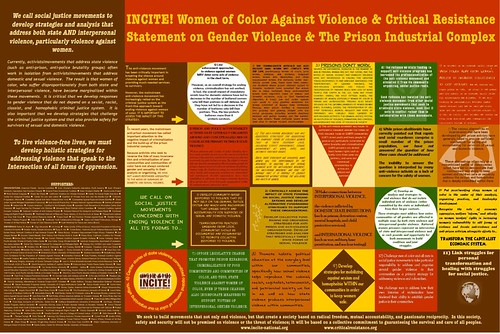










 Posts
Posts