THIS BLOG is NOW RETIRED
I began this blog in May 2009 following the death of Marcia Powell at Perryville State Prison in Goodyear, Arizona. It is not intended to prescribe the path that leads to freedom from the prison industrial complex.
Rather, these are just my observations in arguably the most racist, fascist, militaristic state in the nation at a critical time in history for a number of intersecting liberation movements. From Indigenous resistance to genocidal practices, to the fight over laws like SB1070 and the ban on Ethnic Studies, Arizona is at the center of many battles for human rights, and thus the struggle for prison abolition as well - for none are free until all are. I retired the blog in APRIL 2013.
Visit me now at Arizona Prison Watch or Survivors of Prison Violence-AZ
Rather, these are just my observations in arguably the most racist, fascist, militaristic state in the nation at a critical time in history for a number of intersecting liberation movements. From Indigenous resistance to genocidal practices, to the fight over laws like SB1070 and the ban on Ethnic Studies, Arizona is at the center of many battles for human rights, and thus the struggle for prison abolition as well - for none are free until all are. I retired the blog in APRIL 2013.
Visit me now at Arizona Prison Watch or Survivors of Prison Violence-AZ
BLOG POSTS
Showing posts with label occupy movement. Show all posts
Friday, November 9, 2012
Gibbons: Occupy and the Beast.
Day of the Dead Prisoners 2012
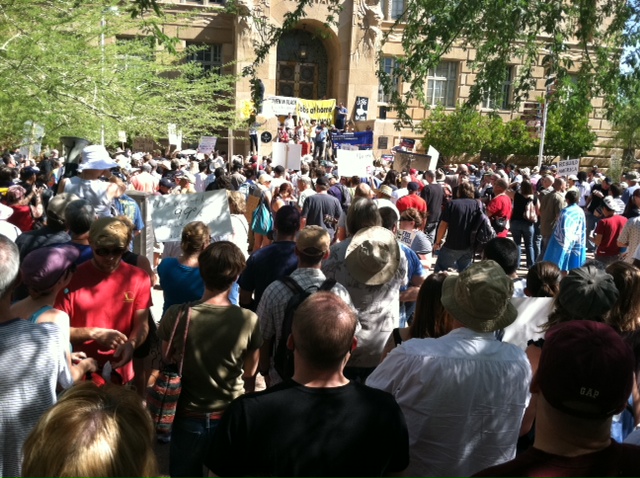
Maricopa County Superior Courthouse, Phoenix , AZ
---------------------------
The
United States has just 5 percent of the world's population and over 20
percent of its prisoners. Since 1980 alone, America's prison population
has quadrupled. While this enormous prison population, as well as its
deep racial biases, should be of concern to anyone, prisons should be of
particular concern to the Occupy movement.
Since
Occupy first exploded onto the scene, many within the political
establishment and mainstream media have criticized occupiers
alternatively for a lack of demands and for embracing too many seemingly
unrelated demands. In spite of this confusion among those who are the
self-appointed gatekeepers of political discourse, most people have
understood Occupy as being a movement concerned with corporate influence
over government, economic inequality and the economic crisis at large.
It is precisely for those reasons that Occupy should be concerned about
America's penal population (which is not to say that many Occupy groups
and occupiers are not).
The
current regime of mass incarceration is very much tied to the emergence
of the neoliberal state in America. The neoliberal state demands
stability for the market, but ultimately generates instability with its
generation of surplus populations and lack of social resources. This
means that while neoliberalism seeks to limit state intervention in the
market and slash social welfare nets in the name of "freedom," it
inevitably results in increased coercion, militarization and
incarceration. And with its desire to subject every aspect of society to
the market, prisons become not just a necessity under neoliberalism,
but a profitable venture. These factors, not an epidemic of criminality,
are the chief causes of mass incarceration in America. Prisons are
therefore very much tied to the larger economic polices that Occupy
opposes.
Only
a small percentage of prisons are private, but the privatization of
prisons represents the worst of corporate profiteering from human
suffering. Stories about private prison companies influencing policy are
plentiful. A judge in Pennsylvania accepted bribes for sending juvenile
offenders to a for-profit prison. Corrections Corporation of America
(CCA) helped draft Arizona's draconian immigration law. Additionally, CCA recently sent a proposal to 48 governors offering to buy prisons as long as the states promised to keep them at 90 percent capacity for 20 years.
Many of the financial institutions that have already gathered the ire of Occupy are profiting from prisons. Wells Fargo,
which received $38 billion from the bank bailout, was also the
second-largest shareholder of GEO Group, a for-profit prison company, though its latest SEC filings show it recently dumped 75 percent of its GEO stock,
a move which occupiers and their allies consider a major victory as
they continue their efforts. In addition to investing in private
prisons, both Goldman Sachs and Merrill Lynch write prison construction
bonds.[1] Even when prisons are not private, Wall Street still finds a way to profit from them.
In
California, general obligation bonds which pledge the full faith of the
state and increase debt must be approved not only by the legislature,
but by popular referendum. While in the past, prison expansion had been
approved by the public, in the early 1980s, after lobbying from private
financial firms, the state legislature changed the status of prison
bonds to lease revenue bonds. Lease revenue bonds were previously
reserved only for education and allowed the state to borrow money with
the debt staying off the record, and thus, not subject to the ballot
initiative. Such bonds were also tax-exempt.[2]
Many Occupy activists have already started to make these connections. Both Occupy DC and Occupy Portland have targeted Wells Fargo over their investments in private prisons. Occupy Baltimore protested
the construction of a new youth jail. Additionally, a prison-focused
group, Occupy 4 Prisoners, has formed. What's important is not only that
Occupy embraces America's prison problem as a cause, but is clear in
linking it to its larger agenda of resisting unchecked corporate power
and structural economic problems.
Notes
Chip
Gibbons is a progressive writer and activist whose writings can be
found on his blog, Exiting Emerald, and have been featured on
Counterpunch. He holds a bachelor of arts in political studies and
history from Bard College and is currently a JD candidate at American
University Washington College of Law.
Wednesday, September 12, 2012
Criminalizing dissent: Occupying Secret Service Space.
As the anniversary of the Occupy Movement Approaches, remember there are new laws designed to thwart us all...HAR 347 is but one.
Spring has sprung, the grass is riz . . . and the Occupy movement is about to ramp up again. Activists recently announced a general strike for May 1, and protests are expected at the NATO summit on May 20
in Chicago. Later, of course, we can expect demonstrations in
connection with the Republican National Convention in Tampa in late
August and the Democratic National Convention in Charlotte in early
September.
Last month, I wrote about a then-little known bill designated H.R. 347 and titled the "Federal Restricted Buildings and Grounds Improvement Act of 2011." The law, signed by the president in mid-March, expands an existing statute that criminalizes certain activity in and around areas that are restricted by the Secret Service.
Given the approaching protests, it may be worth providing a more detail on how exactly the law works, and what protesters can expect. Preliminarily, it's important to define one particular term in the law: "restricted buildings or grounds." These are specific geographic zones that have been designated by the Secret Service, and can be located under H.R. 347 in three places:
Under the existing statute, four types of activities were illegal with respect to these zones, and remain so under the new law:
You'll notice that "knowingly" is in quotation marks above. This is
one of the two major changes to existing law (the other is the
extension of the statute to the White House and VP's residence).
Previously, the law required someone to act "willfully and knowingly."
This is the state of mind the government has to prove you had to
establish your guilt (the "intent standard"). "Willfully and knowingly"
means that you need to know you're committing a crime. "Knowingly"
just means you need to be aware you're in a restricted zone, but not
necessarily that it's unlawful.
(Incidentally, the punishment can be relatively severe. If you commit the offense with a weapon or if you cause injury (a felony), it can carry a maximum sentence of 10 years in prison and a fine of $250,000. Otherwise, the maximum is one year in prison and a fine of up to $100,000.)
There are a couple of other details worth noting to understand the full scope of the law. First, the Secret Service does not just protect the president and vice president. Rather, the agency has the responsibility for protecting the president, vice president and their immediate families; former presidents, vice presidents and certain family members; certain foreign dignitaries; major presidential and vice presidential candidates (within 120 days of an election); and other individuals as designated by a presidential executive order. If any of these individuals are temporarily visiting a location, this law kicks in.
Also, lots of attention has been paid to the National Special Security Events, which include things like presidential inaugurations, nominating conventions and even large spectacles like the Super Bowl. The Department of Homeland Security has massive discretion (which in and of itself is a problem) to designate one of these events as an NSSE based on things like the expected number of attendees and the presence of dignitaries.
So, what does this mean for lawful protesters? The honest answer is we simply don't know yet. These zones will hopefully occupy (no pun intended) a very small footprint at the three types of locations covered by the law. Also, these areas must be clearly identified to prevent protesters from inadvertently violating the law (or else they can't form the required intent). That said, the provision covering disruptions in or near the secure zones is of concern and could be misused to stifle lawful protest; same with the entrance/exit provision. These were already in the law, but the "knowingly" change could make them easier to abuse.
So far, we haven't seen any evidence that H.R. 347 specifically is being deployed aggressively by the Secret Service to tamp down on protests by Occupy or anyone else. That said, with the coming of spring 2012 and the November election, protest activity is undoubtedly going to grow rapidly. We'll be vigilant at the ACLU for any abuse, misuse or overuse, and we urge anyone who knows of any arrests or prosecutions under the new law to let us know.
Learn more about protestors' rights:
Ready to Occupy? What You Need to Know about H.R. 347, the "Criminalizing Protest" Law
By Gabe Rottman, Legislative Counsel
ACLU Washington Legislative Office
11:35am April 26, 2012
Last month, I wrote about a then-little known bill designated H.R. 347 and titled the "Federal Restricted Buildings and Grounds Improvement Act of 2011." The law, signed by the president in mid-March, expands an existing statute that criminalizes certain activity in and around areas that are restricted by the Secret Service.
Given the approaching protests, it may be worth providing a more detail on how exactly the law works, and what protesters can expect. Preliminarily, it's important to define one particular term in the law: "restricted buildings or grounds." These are specific geographic zones that have been designated by the Secret Service, and can be located under H.R. 347 in three places:
• The White House or the vice president's residence.
• A building or area where any individual under Secret Service protection is visiting.
• A building or area at which a National Special Security Event (or "NSSE") is taking place (more on that in a second).
• A building or area where any individual under Secret Service protection is visiting.
• A building or area at which a National Special Security Event (or "NSSE") is taking place (more on that in a second).
• You cannot "knowingly" enter or remain in a restricted zone without lawful authority.
• You cannot "knowingly" engage in "disorderly or disruptive" conduct in or near a restricted zone. A prosecutor would have to show, however, that you intended to disrupt government business and that your conduct actually did cause a disruption. Troublingly, the term "disorderly or disruptive conduct" is undefined.
• You cannot "knowingly" block the entrance or exit of one of these restricted zones. Again, however, the prosecutor would have to show that you did so with the intent to disrupt government business.
• Finally, you cannot "knowingly" engage in an act of physical violence against person or property in one of these restricted zones.
• You cannot "knowingly" engage in "disorderly or disruptive" conduct in or near a restricted zone. A prosecutor would have to show, however, that you intended to disrupt government business and that your conduct actually did cause a disruption. Troublingly, the term "disorderly or disruptive conduct" is undefined.
• You cannot "knowingly" block the entrance or exit of one of these restricted zones. Again, however, the prosecutor would have to show that you did so with the intent to disrupt government business.
• Finally, you cannot "knowingly" engage in an act of physical violence against person or property in one of these restricted zones.
(Incidentally, the punishment can be relatively severe. If you commit the offense with a weapon or if you cause injury (a felony), it can carry a maximum sentence of 10 years in prison and a fine of $250,000. Otherwise, the maximum is one year in prison and a fine of up to $100,000.)
There are a couple of other details worth noting to understand the full scope of the law. First, the Secret Service does not just protect the president and vice president. Rather, the agency has the responsibility for protecting the president, vice president and their immediate families; former presidents, vice presidents and certain family members; certain foreign dignitaries; major presidential and vice presidential candidates (within 120 days of an election); and other individuals as designated by a presidential executive order. If any of these individuals are temporarily visiting a location, this law kicks in.
Also, lots of attention has been paid to the National Special Security Events, which include things like presidential inaugurations, nominating conventions and even large spectacles like the Super Bowl. The Department of Homeland Security has massive discretion (which in and of itself is a problem) to designate one of these events as an NSSE based on things like the expected number of attendees and the presence of dignitaries.
So, what does this mean for lawful protesters? The honest answer is we simply don't know yet. These zones will hopefully occupy (no pun intended) a very small footprint at the three types of locations covered by the law. Also, these areas must be clearly identified to prevent protesters from inadvertently violating the law (or else they can't form the required intent). That said, the provision covering disruptions in or near the secure zones is of concern and could be misused to stifle lawful protest; same with the entrance/exit provision. These were already in the law, but the "knowingly" change could make them easier to abuse.
So far, we haven't seen any evidence that H.R. 347 specifically is being deployed aggressively by the Secret Service to tamp down on protests by Occupy or anyone else. That said, with the coming of spring 2012 and the November election, protest activity is undoubtedly going to grow rapidly. We'll be vigilant at the ACLU for any abuse, misuse or overuse, and we urge anyone who knows of any arrests or prosecutions under the new law to let us know.
Sign the letter: Respect protestors' rights to free speech
Learn more about protestors' rights:
Saturday, February 18, 2012
Occupy4Prisoners: Souls on Ice - Mumia Abu-Jamal.
from the Occupy4Prisoners movement:
Statements from People in Prisons for February 20th –
National Occupy Day in Support of Prisoners
image from freedom archives
----Mumia Abu-Jamal---
Souls on Ice
(Col.writ. 2/2/23) @’12 Mumia Abu-Jamal
When I heard of the call, just raised in Oakland, California, to “Occupy the Prisons”, I gasped.
It was not an especially radical call, but it was right on time.
For prisons have become a metaphor; the shadow-side, if you will, of America, With oceans of words about freedom, and the reality that the U.S. is the world’s leader of the incarceration industry, its more than time for the focused attention of the Occupy Movement.
It’s past time.
For the U.S. is the world’s largest imprisoner for decades, much wrought by the insidious effects of the so-called ‘drug war’—what I call, “the War on the Poor”.
And, Occupy, now an international movement, certainly has no shortage of prisons to choose from. Every state, every rural district, every hamlet in America has a prison; a place where the Constitution doesn’t exist, and where slavery is all but legalized.
When law professor, Michelle Alexander, took on the topic, her book, the New Jim Crow, took off like hotcakes – selling over 100,000 in just a few months.
And where there are prisons, there is torture; brutal beatings, grave humiliations, perverse censorship–and even murders—all under a legal system that is as blind as that statue which holds aloft a scale, her eyes covered by a frigid fold of cloth.
So, what is Occupy to do?
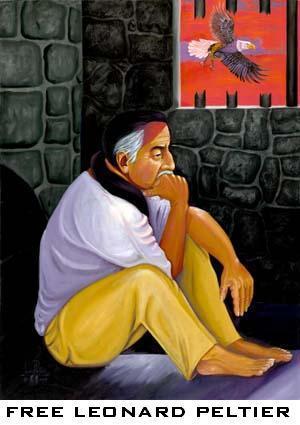
Initially, it must support movements such as those calling for the freedom of Lakota brother Leonard Peltier, the MOVE veterans of August 8th, 1978, the remaining two members of the Angola 3: Herman Wallace and Albert Woodfox, Sundiata Acoli, Russell “Maroon” Shoatz, and many other brothers and sisters who’ve spent lifetimes in steel and brick hellholes.
But, the Occupy Movement must do more.
As it shifted the discussion and paradigm on economic issues, it must turn the wheel of the so-called ‘Criminal Justice System’ in America, that is in fact, a destructive, counter-productive, annual $69 billion boondoogle of repression, better-known by activists as the Prison-Industrial-Complex.
That means more than a one-day event, no matter how massive or impressive. It means building a mass movement that demands and fights for real change, and eventually abolition of structures that do far more social damage than good.
It means the abolition of solitary confinement, for it is no more than modern-day torture chambers for the poor.
It means the repeal of repressive laws that support such structures.
It means social change—or it means nothing.
So let us begin—Down With the Prison Industrial Complex!
Thursday, February 16, 2012
Occupy Prisons: Injustices Behind Bars.
A reminder from activist and author Vikki Law that the outrageous mistreatment that some members of the Occupy Movement have experienced of late in the way of police violence has always been a common part of life for people in many communities...
Memorial mural for women who have died from suicide or neglect
in the custody of the Arizona Department of Corrections under
ADC Director Chuck Ryan and Gov Jan Brewer.
FEB 20
PRISONS AND JAILS NEAR YOU.
----from counterpunch.org----
by VICTORIA LAW
February 14, 2012
“Manhandled, arrested, cuffed, searched, and locked away in the Tombs” is how AlterNet described
the story of protester Barbara Schneider Reilly, who spent 30 hours in
jail after being arrested at an Occupy Wall Street-related protest in
October 2011.
Reilly reported: “During the long, cold night in the Tombs, at some point we asked a female officer if we could have some blankets. ‘We have no blankets.’ Some mattresses since we were 12 or so people? ‘We have no more mattresses.’ Some change in exchange for dollar bills so we could call parents and loved ones? (The one public telephone in the cell would only take coins.) ‘It’s against regulations.’ Some soap? ‘Maybe we’ll come up with some soap.’ After no, no, no to every reasonable request, we wound up with a small jar of soap. Distressing is hardly the word for a culture of willful neglect and the exercise of what power those officers held over us for those 30 hours.”
While Reilly’s experience was horrific, it is only a sliver of the atrocities that over 114,000 women in prisons and jails must endure on a daily basis. When the article first appeared, I printed it out and circulated it to several currently incarcerated women and asked how Schneider’s weekend compared to their own realities.
“It’s always great to see stories like Barbara Schneider’s published. It’s important that as many people as possible spread the word about jails, prisons, incarceration and our justice system,” wrote RJ, a woman who had been incarcerated in Colorado. “As a prisoner myself, Schneider’s descriptions are definitely familiar: Thousands of people experience similar processes every day, many for years on end. Each time a story of incarceration is shared, I hope we think of ALL who are in jail/prison. Regardless of what has led to our arrest and whether we have been held for ten hours, ten years, not yet, or never, the same oppressive system contains us. We all are offered dehumanization and brutality in the name of order, rehabilitation, deterrence or justice.”
“Her experience was just a tip of the iceberg,” wrote Terrina, another woman incarcerated in Colorado. “I am, by no means, trying to minimize her experience because incarceration is horrible for anyone that goes through it. However, she was blessed that she was somewhere that the spotlight was being shined on. Can you imagine how the forgotten people feel? The ones with no family, no support, no organization standing behind them?”
Terrina describes what the process is like for those entering the prison system:
When someone arrives at DW, you’re stripped, photographed, poked, prodded, asked a bunch of questions that seem to have no bearing on your actual crime or personal situation (although the answers do chart out a path for your life in DOC), and given a piece of dry stale cake to eat. Yes cake. And that is it for the day. When you take into account that the prisoners are awake and traveling before 6am, without food or drink, from the county jail, and scared, anxious and unsure of the upcoming events, not being fed until 6pm is an awfully long time.
The women are placed in the first living unit. Although it is called a LIVING unit, you would think it is more like a kennel. The women are allowed out of their cell for one hour a day. At that time, they have to shower, use the phone, and try to learn the rules and regulations of their new surroundings without any guidance from the officers. Yes, it is true that there are “Posted Operational Regulations” (PORs) but … Lord forbid that the officers tell the new inmates how to use the telephone, when they are allowed to shower, how to get their medication, if needed, and, if they are pregnant, they are lucky if they are allowed to receive prenatal treatment for the first month that they are here. The women live like animals for at least a month before moving to the next “living” unit. Once they move, they are allowed TWO hours out a day. No classes, one hour a week at the gym, a minimal church, and hopefully by now the new girl has found a decent “old number” that can explain the way of her new world. If not … she’s still shit out of luck.
Unfortunately she still has to deal with the same offices that she’s been around for the first month. At this time, her telephone system should be working. However, the case managers that are supposed to be there to help are not able to explain the phone system, the classes that are available, the jobs that are attainable, or even the canteen that should be purchasable. Three to four weeks later and the confusion begins all over with another “living” unit move. Previously, contact with the other offenders was restricted altogether. Now you are thrown into a space set up like the monkey exhibit at most zoos. It is so overwhelmingly loud and disorganized that many women shut down, get angry, fight, and begin to behave like the animals they are being treated like.
In this new building, the inmate is supposed to automatically know the rules they were never taught, they’re expected to know where to go and when, which sidewalks to walk on at specific times, who they are and aren’t allowed to talk to, and are expected to show up to work on time, usually without knowing that they have even been assigned a job…
Let’s take a moment and discuss the jobs: labor crew, kitchen, laundry … those are the first jobs available. DOC pays 60 cents a day to do the work that keeps the facility running. The majority of inmates MUST pay restitution, which is, of course, taken out of their state pay … so after a full month of working hard, they are able to spend approximately $10.63. The only thing that is free in DOC is one roll of toilet paper a week and one pack of sanitary pads per month. If the inmate has a heavy menstrual cycle and needs more pads, she has to pay $4 to get them. Toothpaste, toothbrush, body soap, a brush or comb, lotion, shampoo, conditioner, hair grease, floss, any hygiene besides one roll of toilet paper a week, the inmate HAS to pay for. Since I have been in prison, the prices of canteen have gone up at least every two to three months. Why hasn’t the rate of our pay? The state is allowed to charge more for the toothpaste, but unable to pay us enough to purchase it? Don’t get caught giving away any hygiene if you are lucky enough to have it because then you can get a write-up for loaning and bartering or unauthorized possession if you don’t have a receipt for the items in your room."
In 1964, peace activist Barbara Deming spent 27 days in jail in Albany, Georgia. Deming and a group of activists had embarked on a Peace Walk from Quebec to Guantanamo, the American army base in Cuba. When the walk reached Georgia, the Peace Walkers found it impossible to demand peace without also demanding the right of all people — black and white — to walk together down any street in any city. In Albany, where the police chief had boasted that he had defeated Martin Luther King non-violently,[5] the group twice attempted to walk through the White section of town; each time, they were arrested and brought to the county jail. Deming was among the group of fifty-four women arrested the second time. Her fellow Peace Walker Yvonne, who spent first 24 days in jail and 27 days the second time, wrote: “If there is anything I have learned by being in jail, it is that prisons are wrong, simply and unqualifiedly wrong.”[6]
Nearly fifty years later, in 2011, Barbara Schneider Reilly ends her account of jail on an optimistic note:
“Society must be changed. They insist on it, and, I hope, will continue to insist. And, not withstanding the difficulties ahead, we will fight for it.”
One hopes that these fights also recognize and include the struggles of people in prison. As RJ states,
Victoria Law is a writer, photographer, mother, and Contributing Author for New Clear Vision. She is the author of Resistance Behind Bars: The Struggles Of Incarcerated Women(PM Press, 2009), the editor of the zine Tenacious: Art and Writings from Women in Prison, and a co-founder of Books Through Bars — NYC. She is currently working on transforming Don’t Leave Your Friends Behind, a zine series on how radical movements can support the families in their midst, into a book.
Notes
[1] Human Rights Watch, All Too Familiar.6.
[2] Jennifer Bagwell, “Barred from View: How Michigan Keeps the Lid on Allegations of Widespread Sexual Abuse Against Female Inmates,” Metro Times: Detroit’s Alternative Weekly, March 24, 1999.
[3] Beth E. Richie and Kay Tsenin, Female Offenders, Pornography and Prostitution, Child Abuse and Neglect, research forum on women and girls in the justice system for the Department of Justice, 1999.
[4] Caroline Wolf Harlow, Prior Abuse Reported by Inmates and Probationers, special report for the U.S. Department of Justice, April 1999, 1.
[5] Barbara Deming, Prisons That Could Not Hold, 6.
[6] Deming, Prisons That Could Not Hold, 36.
Reilly reported: “During the long, cold night in the Tombs, at some point we asked a female officer if we could have some blankets. ‘We have no blankets.’ Some mattresses since we were 12 or so people? ‘We have no more mattresses.’ Some change in exchange for dollar bills so we could call parents and loved ones? (The one public telephone in the cell would only take coins.) ‘It’s against regulations.’ Some soap? ‘Maybe we’ll come up with some soap.’ After no, no, no to every reasonable request, we wound up with a small jar of soap. Distressing is hardly the word for a culture of willful neglect and the exercise of what power those officers held over us for those 30 hours.”
While Reilly’s experience was horrific, it is only a sliver of the atrocities that over 114,000 women in prisons and jails must endure on a daily basis. When the article first appeared, I printed it out and circulated it to several currently incarcerated women and asked how Schneider’s weekend compared to their own realities.
“It’s always great to see stories like Barbara Schneider’s published. It’s important that as many people as possible spread the word about jails, prisons, incarceration and our justice system,” wrote RJ, a woman who had been incarcerated in Colorado. “As a prisoner myself, Schneider’s descriptions are definitely familiar: Thousands of people experience similar processes every day, many for years on end. Each time a story of incarceration is shared, I hope we think of ALL who are in jail/prison. Regardless of what has led to our arrest and whether we have been held for ten hours, ten years, not yet, or never, the same oppressive system contains us. We all are offered dehumanization and brutality in the name of order, rehabilitation, deterrence or justice.”
“Her experience was just a tip of the iceberg,” wrote Terrina, another woman incarcerated in Colorado. “I am, by no means, trying to minimize her experience because incarceration is horrible for anyone that goes through it. However, she was blessed that she was somewhere that the spotlight was being shined on. Can you imagine how the forgotten people feel? The ones with no family, no support, no organization standing behind them?”
Terrina describes what the process is like for those entering the prison system:
When someone arrives at DW, you’re stripped, photographed, poked, prodded, asked a bunch of questions that seem to have no bearing on your actual crime or personal situation (although the answers do chart out a path for your life in DOC), and given a piece of dry stale cake to eat. Yes cake. And that is it for the day. When you take into account that the prisoners are awake and traveling before 6am, without food or drink, from the county jail, and scared, anxious and unsure of the upcoming events, not being fed until 6pm is an awfully long time.
The women are placed in the first living unit. Although it is called a LIVING unit, you would think it is more like a kennel. The women are allowed out of their cell for one hour a day. At that time, they have to shower, use the phone, and try to learn the rules and regulations of their new surroundings without any guidance from the officers. Yes, it is true that there are “Posted Operational Regulations” (PORs) but … Lord forbid that the officers tell the new inmates how to use the telephone, when they are allowed to shower, how to get their medication, if needed, and, if they are pregnant, they are lucky if they are allowed to receive prenatal treatment for the first month that they are here. The women live like animals for at least a month before moving to the next “living” unit. Once they move, they are allowed TWO hours out a day. No classes, one hour a week at the gym, a minimal church, and hopefully by now the new girl has found a decent “old number” that can explain the way of her new world. If not … she’s still shit out of luck.
Unfortunately she still has to deal with the same offices that she’s been around for the first month. At this time, her telephone system should be working. However, the case managers that are supposed to be there to help are not able to explain the phone system, the classes that are available, the jobs that are attainable, or even the canteen that should be purchasable. Three to four weeks later and the confusion begins all over with another “living” unit move. Previously, contact with the other offenders was restricted altogether. Now you are thrown into a space set up like the monkey exhibit at most zoos. It is so overwhelmingly loud and disorganized that many women shut down, get angry, fight, and begin to behave like the animals they are being treated like.
In this new building, the inmate is supposed to automatically know the rules they were never taught, they’re expected to know where to go and when, which sidewalks to walk on at specific times, who they are and aren’t allowed to talk to, and are expected to show up to work on time, usually without knowing that they have even been assigned a job…
Let’s take a moment and discuss the jobs: labor crew, kitchen, laundry … those are the first jobs available. DOC pays 60 cents a day to do the work that keeps the facility running. The majority of inmates MUST pay restitution, which is, of course, taken out of their state pay … so after a full month of working hard, they are able to spend approximately $10.63. The only thing that is free in DOC is one roll of toilet paper a week and one pack of sanitary pads per month. If the inmate has a heavy menstrual cycle and needs more pads, she has to pay $4 to get them. Toothpaste, toothbrush, body soap, a brush or comb, lotion, shampoo, conditioner, hair grease, floss, any hygiene besides one roll of toilet paper a week, the inmate HAS to pay for. Since I have been in prison, the prices of canteen have gone up at least every two to three months. Why hasn’t the rate of our pay? The state is allowed to charge more for the toothpaste, but unable to pay us enough to purchase it? Don’t get caught giving away any hygiene if you are lucky enough to have it because then you can get a write-up for loaning and bartering or unauthorized possession if you don’t have a receipt for the items in your room."
These inhumanities are of the everyday variety for women behind bars. Then there are the other injustices that are all too common in women’s prisons nationwide:
- Health care: Women in prison are more likely to be HIV+ than either men in prison or women who are not in prison. In 2000, women in prison were 60% more likely to have HIV than men in prison. Women in prison are 36 times more likely than women outside to have HIV. In addition, prisons are not likely to have female-specific health care (pregnancy, breast and cervical cancer screenings, GYN services, etc) and so women’s health needs often go untreated.
- Parenting: More than 80% of women in prison are mothers to children under the age of eighteen. Because of the ways in which parenting is gendered, when a mother goes to prison, she is far less likely to have a co-parent, partner or family member who is willing and able to take care of her children. As a result, children of imprisoned mothers are five times more likely to end up in foster care than children of incarcerated fathers. This statistic became even more devastating in 1997 when Congress passed the federal Adoption and Safe Families Act (ASFA). Under the Act, if a child has been in foster care for fifteen of the past 22 months, the state has to automatically begin terminating legal custody. Only three states make exceptions for parents who are in prison. If a mother is fortunate enough to maintain the legal rights to her child(ren), the distance of the prison from her home community makes it less likely that she will ever receive a visit from her child. More than 50% of mothers in prison reported never having received a visit from their children.
- Sexual Assault: In 1996, Human Rights Watch released All Too Familiar, a report documenting sexual abuse of women prisoners throughout the United States. The report, reflecting the organization’s two-and-a-half years of research, found that sexual assaults, abuse and rape of women prisoners by male staff members were common and that women who complained incurred write-ups, loss of “good time” accrued toward an early parole and/or prolonged periods in disciplinary segregation.[1] Little has changed in many prisons since the report’s release in 1996. Title VII of the Civil Rights Act of 1964 prohibits gender discrimination in employment, giving both male and female guards the right to gender-neutral employment in prisons housing prisoners of the opposite gender. Male staff members have been placed in female facilities with little to no training on cross-gender supervision and no procedures for investigating or disciplining staff sexual misconduct. In Michigan and other states, untrained male officers were assigned to positions in which they were able to walk, unannounced, into areas where women dress and undress, shower, and use the toilet. Male guards have also been given the task of performing body searches on prisoners, which includes patting down women’s breasts and genital areas. They also transported women to medical care and were required to observe gynecological and other intimate medical procedures.[2] It was not until incarcerated and formerly incarcerated women won a class-action lawsuit were restrictions on male access put into place.
- Abuse and battering: More than half of women in state prisons and jails report having experienced physical and/or sexual abuse.[3] Women are three times more likely than men to have been physically and/or sexually abused prior to incarceration.[4]
In 1964, peace activist Barbara Deming spent 27 days in jail in Albany, Georgia. Deming and a group of activists had embarked on a Peace Walk from Quebec to Guantanamo, the American army base in Cuba. When the walk reached Georgia, the Peace Walkers found it impossible to demand peace without also demanding the right of all people — black and white — to walk together down any street in any city. In Albany, where the police chief had boasted that he had defeated Martin Luther King non-violently,[5] the group twice attempted to walk through the White section of town; each time, they were arrested and brought to the county jail. Deming was among the group of fifty-four women arrested the second time. Her fellow Peace Walker Yvonne, who spent first 24 days in jail and 27 days the second time, wrote: “If there is anything I have learned by being in jail, it is that prisons are wrong, simply and unqualifiedly wrong.”[6]
Nearly fifty years later, in 2011, Barbara Schneider Reilly ends her account of jail on an optimistic note:
“Society must be changed. They insist on it, and, I hope, will continue to insist. And, not withstanding the difficulties ahead, we will fight for it.”
One hopes that these fights also recognize and include the struggles of people in prison. As RJ states,
“When we hear and tell our stories, we must think of the abuse that is churning behind the razor wire at that moment. When we are released, or when we greet our friends outside the gates, we must think of the person who is already waiting to fill the vacant bed. We must imagine what it will take to disable this corrupt industry with its devastating methods that are carried out under the lie of ‘bettering society.’ We must not turn our backs on each other!”Spurred on by prison justice organizers, people in the various Occupy movements are beginning to realize this and are calling for a National Occupy Day in Support of Prisoners on Monday, February 20, 2012. There will be actions across the nation. To find out about the nearest one, go to: http://occupy4prisoners.org/actions/.
Victoria Law is a writer, photographer, mother, and Contributing Author for New Clear Vision. She is the author of Resistance Behind Bars: The Struggles Of Incarcerated Women(PM Press, 2009), the editor of the zine Tenacious: Art and Writings from Women in Prison, and a co-founder of Books Through Bars — NYC. She is currently working on transforming Don’t Leave Your Friends Behind, a zine series on how radical movements can support the families in their midst, into a book.
Notes
[1] Human Rights Watch, All Too Familiar.6.
[2] Jennifer Bagwell, “Barred from View: How Michigan Keeps the Lid on Allegations of Widespread Sexual Abuse Against Female Inmates,” Metro Times: Detroit’s Alternative Weekly, March 24, 1999.
[3] Beth E. Richie and Kay Tsenin, Female Offenders, Pornography and Prostitution, Child Abuse and Neglect, research forum on women and girls in the justice system for the Department of Justice, 1999.
[4] Caroline Wolf Harlow, Prior Abuse Reported by Inmates and Probationers, special report for the U.S. Department of Justice, April 1999, 1.
[5] Barbara Deming, Prisons That Could Not Hold, 6.
[6] Deming, Prisons That Could Not Hold, 36.
Thursday, February 9, 2012
PHX Class War Council: Occupied with Class
Stole this post from my friend at Fires Never Extinguished: A Journal of the Phoenix Class War Council. Check them out. Good critical analysis of how class is positioned overall in the movement. Worth the long read...especially the passage about Occupy and the police at the end.
This article appears in LBC Books new collection of essays on the Occupy Movement, "Occupy Everything: Anarchists in the Occupy Movement 2009-2011".
Occupied with Class: The Middle Class in the Occupy Movement
By
any measure – unemployment, foreclosures, the rise in food stamp
dependency, homelessness,etc – the US middle class has taken a
beating over the last several years. And although I'm always hesitant
to start an essay off by quoting Zizek, I haven't heard a better
metaphor for both the current economic situation and the shock many
Americans feel at what they see as the death of the “American
Dream” than the iconic scene recounted by Zizek of a cartoon cat
walking over a cliff who proceeds confidently for several paces into
thin air before pausing and looking down. Seeing the gaping chasm
beneath him, it is only then that he begins to fall.
----------------from Fires Never Extinguished-------------------
This article appears in LBC Books new collection of essays on the Occupy Movement, "Occupy Everything: Anarchists in the Occupy Movement 2009-2011".
Occupied with Class: The Middle Class in the Occupy Movement
By
any measure – unemployment, foreclosures, the rise in food stamp
dependency, homelessness,etc – the US middle class has taken a
beating over the last several years. And although I'm always hesitant
to start an essay off by quoting Zizek, I haven't heard a better
metaphor for both the current economic situation and the shock many
Americans feel at what they see as the death of the “American
Dream” than the iconic scene recounted by Zizek of a cartoon cat
walking over a cliff who proceeds confidently for several paces into
thin air before pausing and looking down. Seeing the gaping chasm
beneath him, it is only then that he begins to fall.
After
three decades of neo-liberal attacks, much of what we consider middle
class life is really debt. That is, it is a fantasy, a placeholder
filling in for the stagnation of wages that was the '80s, '90s, and
'00s. Many other anarchist and Marxist authors have pointed this out
(David Graeber and David Harvey come to mind) but it's interesting
how the entire language of debt and crisis has shifted over the years
of the Great Recession. While today the media discusses it in terms
of austerity, sovereign debt and debt to GDP ratios, early on there
was a lot of talk of underwater mortgages and massive credit card
debt owed by individuals to financial institutions. Briefly this
popped into the media consciousness, as the sheer scale of resistance
forced the media to pay attention to the rapidly spreading
underground debt refusal. People walked away from houses, mailed the
keys back to the bank, and stopped paying on their credit cards. Just
as now the occupy movement routinely violates capitalist notions of
public and private property, then there was a similar rejection of
commonly held relationships and debt culpability. Whereas before
default and bankruptcy had been shameful in the popular consciousness
– with bankruptcy services ads run late at night or sandwiched
between afternoon talk shows - all of a sudden everyone was doing it.
In
2009 the New York Times reported that six percent of credit
card debt had been written off by banks. Faced with a population in
revolt, banks and collection agencies were offering large discounts
to customers willing to pay something – anything – of their
outstanding balance. Many of my friends and I participated in this
silent strike, netting massive discounts on the debts we had run up
over many cash-strapped years. For most of us, it wasn't just that
the debts had gotten too high to maintain, but also that credit card
companies had engaged in a series of interest rate increases, often
for petty reasons or no reason at all. Just like the balloon payments
and interest rate hikes on millions of mortgages, our credit cards
were designed to encourage us to miss payments, to accrue fees and,
when it came down to it, to keep us paying large payments for life on
even modest debts.
In
my own case my interest rate jumped from around ten percent to 34.9%
for no reason at all. It was at that moment that I joined the
millions of Americans who had come to the obvious conclusion that,
even if we wanted to, we couldn't repay our debts. That decision, for
the fist time, put us and the banks on the same page. In an odd
congruence, we couldn't pay it off and, given the jacked up interest
rates, the banks obviously didn't want us to either. Interviewed in
that same Times article, Don Siler, chief marketing officer at
a major collection firm said, “You can’t squeeze blood out of a
turnip. The big settlements just aren’t there anymore.”
In
September of 2009, Ann Minch of Red Bluff, California posted a video
to Youtube announcing her debt strike as a call to action nationally.
"There comes a time when a person must be willing to sacrifice
in order to take a stand for what's right," she said. "Now,
this is one of those times, and if I'm successful this will be the
proverbial first shot fired in an American debtors' revolution
against the usury and plunder perpetrated by the banking elite, the
Federal Reserve, and the federal government." Many have
forgotten, but Bank of America interceded directly in her case,
fearing the implications of the debt revolt breaking out into the
open.
This
was a time when the first bailout was fresh in everyone's minds. In
2008, following the collapse of the banks and a popular revolt that
scuttled the first attempt at a bailout, the ruling class suspended
politics during the height of the presidential campaign in order to
flood the financial institutions with taxpayer money. John McCain and
Barack Obama put both their campaigns on hold and flew in a panic to
Washington, forcing a highly unpopular recapitalization bill through
Congress, complete with threats of martial law, collapse, and social
upheaval. It was at the peak of a historic election in which the
first black president stood on the verge of victory, riding on
promises – believed by many very fervently – of hope and change,
that the American ruling class revealed itself for all to see as a
monolith, united in its objectives, and willing to dispel the mirage
of partisanship in defense of its wealth and power. This lesson was
not lost on people, emerging later in the occupy movement's
denunciation of party politics.
In
many ways, as I look back on those early years of the crisis, it
seems to me like those quiet, often individual and isolated acts,
perhaps mentioned briefly to friends and family, and negotiated
through a tactic of refusal, were the true precursors to the Occupy
movement. Millions participated, even as they held onto the fading
hope that Obama would deliver the change they thought he promised.
These people – middle class people primarily – had believed with
some justification that the system would respond to them. Indeed,
even though power clearly resides with a very small capitalist and
political elite, the middle class in America is the foundation of
almost all political and economic argumentation. All mainstream
political arguments must refer back to this mythical and
broadly-defined group at some point. The American ruling class
depends on this fecund soil of middle class identity and ideology to
reproduce the mythology and propaganda that maintains the system
overall, and of course the economy and the profits that go with it.
It is the middle class that votes and consumes.
But
for thirty years the middle class had been reduced to a photoshopped
image quite unlike its former robust self. Debt had replaced wage
growth. Home prices and credit card debt rather than real assets
made up its balance sheet. The suburbs, once a vast retreat to safety
and “normalcy” for the mostly white middle class, began to show
signs of collapse. Like mushrooms, one after another “for sale”
signs and foreclosure stickers spread through the car-friendly
neighborhoods. The official unemployment rate (always an undercount),
doubled in the eleven months between April 2008 and March of 2009.
Overnight the foundations of the middle class vanished for tens of
millions of people. What once seemed like a solid foundation was
revealed to have been rotting for some time, as Americans found
themselves crashing towards the basement in what had seemed like an
impossible reversal of fortune.
It
is in these conditions of 2008 and 2009, when the dream of Obama's
Hope and Change had ended and the crushing reality that politics
would not respond to the drowning-not-waving middle class, awash in a
sea of red, that we see the formation of what would become the Occupy
movement. While anarchists are right to point to predecessors in the
student occupations of 2009, and in the anti-globalization movement
before that, these are merely the origins of the form of the
movement, not the origins of the movement itself. In those movements
the general assemblies, spokescouncils, occupations, and
horizontalism have their origins, and the points of cross pollination
between the young occupy movement and those movements are obvious.
But the occupy movement itself had its birth in the crisis, in the
moment of the cartoon cat looking down after walking off the cliff.
It is a movement with a varied composition, which ranges from
homeless folks to students to anarchists to workers, but more than
anything else it is a movement of a middle class that is rapidly
re-proletarianizing, with a collapsing standard of living and
failing job prospects. In the process, it is finding itself in
unfamiliar territory surrounded by unfamiliar landmarks and
neighbors.
Nevertheless,
vestiges remain of the many biases and privileges that came with
middle class status in the US, and these contradictions play out in
the occupy movement in ways that we can identify. In particular we
see these assumptions – primarily reflected in the bourgeois belief
that the system ought to respond to middle class people – play out
in arguments around nonviolence, the police, and questions of
perception and imagery. Right now, as we enter what may be the end of
the beginning of the occupy movement, we see the formerly middle
class working out its new identity in public for all to see,
contradictions and all. It appears schizophrenic, asserting at the
same time both what it sees as its fundamental right to protest, to
be heard, and to have its grievances ameliorated, and at the same
time finding itself open to new radical ideas and tactics. All this
while also facing down a system that clearly not only no longer
responds to them but actually sends against them the very same
jack-booted thugs that the middle class supported as they cast their
ballots for one law-and-order president after another in the last
three decades.
We
can lay out a few significant features of this middle class state of
mind that have come into play in the occupy movement, at least as I
encountered it in Phoenix (OPhx). First, as I said above, is a real
sense that the system ought to respond to their demands. That, when
it doesn't, the system is broken. Obviously, this simplistic view
ignores the process of exclusion and dislocation central to the
functioning of the system. Nevertheless, this is the view. Likewise,
there is a desire for respectability, for conformity to normal
bourgeois conventions, for example politeness, and a particular kind
of attire. This desire also often manifests as a rejection of
certain affiliations, and an insistence on maintaining or creating a
particular image. Another feature of this ideology is a desire for
order and an adoration of the police. Finally, one of the most
important elements of the middle class view is the tendency to treat
its view of the world and its experiences as normal, and to impose
hegemony on the movement based on this view.
These
are points of conflict in the movement not just because of the ideas
that form “middle class-ness”, but also because likewise
participating in the broader movement are poor people, homeless
people, and political militants -- primarily anarchists-- who have
quite different experiences with cops and politics, and who envision
different constituencies as the optimal target audience for occupy
actions and propaganda. Beyond this, “middle class-ness” in the
US is anchored to whiteness, and this has caused conflicts whenever
white middle class occupiers have attempted to treat their experience
as normative rather than specific and exclusionary, especially around
questions of policing, incarceration and justice. This makes the
occupy movement not only contested terrain, but one in which the
formerly middle class participants seek to impose their dominance
over the rest of it. Always lurking in the dark recesses of the
middle class consciousness is the idea that politics ought to be the
property of the responsible classes, and rubbing up against these
other populations has been the root of many of the conflicts in the
early days of this movement.
All
in all, middle class occupiers are in conflict with themselves. They
operate generally within the safe confines of middle class ideology,
but their class position has collapsed. The question is how this
conflicted identity will play out. With no recovery in jobs or
incomes on the horizon, and therefore no way to reconstitute itself,
is the emergence of a working class or other non-middle class
identity inevitable? Will interaction with radicals, anarchists, poor
and working class people, as well as people of color (who may
challenge many of the basic values of whiteness that constitute
middle class-ness) lead to a radicalization, or a rush to defend the
formerly privileged class position? Obviously many downwardly mobile
occupiers long for a return to the good old days of the American
dream. Meanwhile, the system and all likely political candidates seem
wedded to austerity in one form or another. A political response that
would satisfy them all seems improbable.
Within
the occupy movement, at least its Phoenix derivation, the middle
class tendencies played out in a variety of interesting ways.
Nonviolence, for instance, was always deployed ideologically and
never defined. Most people who used the term “nonviolence” with
regard to the movement seemed to move interchangeably between
“nonviolence”, “nonviolent”, “peaceful”, “pacifist”
and various other terms, treating them as if they all referred to the
same thing. Some did this consciously (politically) and some seemed
to be operating out of the generally privileged and anti-historical
narratives of political movements that middle class people use to
mythologize struggle. Cartoon versions of Gandhi and King got trotted
out regularly, stripped of historical context or even political
content.
Given
its lack of definition, the demand for nonviolence was therefore
applied almost exclusively to militants, and never to police.
Militants are considered to be dangerous because they do not adhere
to the ideological and poorly-defined nonviolence of the middle class
occupiers. As a result of our refusal to toe the line, we are treated
as if violence is our preferred method of struggle, or even our
default setting. Our presence is perceived as dangerous. Indeed, the
participation of anarchists in OPhx was and continues to be a source
of much fear and debate, something police have exploited on several
occasions.
The
debate about the importance of nonviolence has a few main elements.
One is the false history of social change that is so important to the
middle class (people who value stability and predictability above all
else). The collapse of their class position has turned them into
disturbers of public order, and yet at the same time, they value
order and civility as hallmarks (or psychoses) of their suburban
lives and democracy. Tied into this is the belief that the system
would and should pay attention to them if only they could make their
case clearly and non-offensively. For this reason, violence is not
only perceived by the middle class as disruptive and ineffective, but
also as poor strategy. This is reflected in almost every discussion
about nonviolence, as the most common refrain “it looks bad on
tv”. We are not to appear like thugs, like criminals, like we are
out of control or not respectable; all loaded language that points to
middle class perceptions and fears.
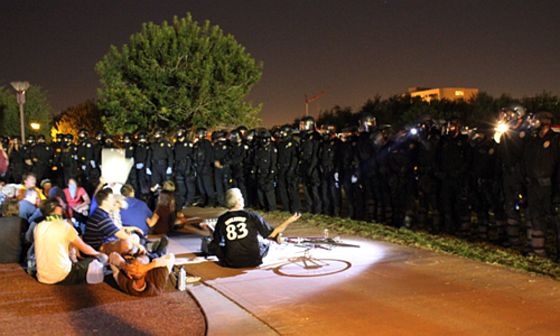
At
one point during the first mass arrest at OPhx, occupiers (sitting on
the ground as riot cops encircled them) began to chant “We love
you!” and “We are peaceful!”, “We are nonviolent!” at the
cops, as if invoking an incantation of middle class desperation. In a
real way what they were saying was, we are not a threat and we are
playing by the rules. This is the old identity expressing itself. But
it's coming up against a hard new reality. Many of these people had
likely never been on the business end of a riot suit, much less been
arrested.
Imagery
and perception played out along the terrain of class as well, with
many middle class occupiers exhibiting a near obsession with how
their fellow occupiers portrayed themselves. In the days before the
actual attempt to take over the park that was initially targeted for
occupation, a Reddit post circulated online which caught the
attention of the middle class elements within OPhx. The post
advocated that occupiers dress well, in suits and other office- or
church-appropriate attire. Supporters of this position claimed that
if we looked good, we would attract more people and that we would
also look sympathetic in the media. In this way, form was valued over
content, which probably isn't surprising for a class that has had the
foundations of its ideology yanked out from under it.
In
the same way that it was alleged that if we appeared respectable we
would be successful, the assumption was that if we looked bad (like
poor people or unemployed people or like people who had been
foreclosed on) then we would lose the support of the media and
therefore of the American people. Dirty clothes and torn t-shirts,
attire (including signs) that evoked anarchism, radicalism, or
homelessness, or a down-trodden or downward trajectory were
repeatedly singled out for being inappropriate.
At
the same time, middle class occupiers treated their assumptions about
who was being appealed to and who would be offended or attracted by
certain attire or messaging as a given, a natural fact beyond
dispute. In a real sense, they were talking about their former
selves, or perhaps their former employers. The idea that perhaps a
movement of the excluded and disempowered might not want primarily to
target middle class people made absolutely no sense to these middle
class occupiers, and their ideal presentation bore a striking
resemblance to a job interview.
In
a media world, driven by the consumption of the middle class, the
middle class naturally has its own image reflected back to them over
and over all day. Middle class-ness is treated as normal and correct
and even as large sections of the middle class found itself abruptly
and increasingly poor or working class, the ideology continued, like
sensations from a phantom limb. Likewise, the point that the media
itself was owned by the 1% and as such had no class interest in
portraying the movement positively (a fact that had been clearly
borne out up to that time by the coverage), was rejected wholesale by
middle class participants, despite the fact that they themselves
broadly felt disappointed and disillusioned by the media. For the
current and former middle class occupiers, the movement was as much
an appeal to conscience as anything else and the main vehicle for
that appeal, initially, was the media.
Beyond
this was the attempt by occupiers to impose on the movement a rigid,
hetero-sexual, anti-subcultural, and white suburban set of standards,
mimicking not so much the promise of the consensus-based general
assemblies that had excited them from far-off Zucotti Square, but
instead functioning more like the neighborhood or homeowners
associations that stifle all threats of diversity or difference in
the far-flung outer developments, now collapsing and emptying at an
astounding rate. This even though their class position had changed
drastically, even if they no longer lived in those suburbs or had
that good job and access to the easy credit that had made it all
possible. This raised the inevitable question of just what kind of
change these people wanted? Was it a break with the old order – the
failure of which had been the motivating factor for so many
participants in the first place – or was it to replicate or shore
up and reconstitute the old middle class life so many had believed
they enjoyed in the decades before the crisis? Was the occupy
movement to be the gravedigger or the defibrillator of the current
order? How deeply had middle class occupiers interrogated the
realities of middle class suburban life?
Whatever
the answer to that question, OPhx inevitably came into conflict with
the police, who were another point of extremely heated debate. At the
beginning and to this day (though less so now than then), a large
majority of people have clung to the notion that cops were part of
the 99%.
In
order to discuss OPhx and the cops we have to temporarily accept the
idea of the 99%, which I think most anarchists believe is a clumsy
and inaccurate way to approach class composition of society. Many in
the occupy movement are in serious danger of reifying what is merely
a sometimes useful, albeit limited, tool, and this comes out nowhere
more obviously than how they talk about cops. In a way, however, it
makes sense that in the US, where almost everyone thinks of
themselves as middle class, when a class analysis finally broke
through to popular consciousness it would be ridiculously broad,
almost uselessly so. Either way, since “the 99%” was the
terminology being used, the discussion remained largely stuck within
it and vulnerable to its many limitations.
Early
on those political militants, working class people, and people of
color who had altogether different experiences and perspectives on
the police, came into direct conflict with those largely middle class
people who asserted that “cops are part of the 99%”. In an echo
of the conversation about image and perception, middle class
occupiers asserted that if we looked respectable, the cops would
treat us that way. Or if we were polite, the cops would have no
reason to attack us. Indeed, looking good, using good language, and
mouthing the movement's poorly-defined mantra of “nonviolence”
were used not only as some talisman of protection, but also
repeatedly deployed as criteria for singling out the dreaded “violent
provocateurs” who haunted the dreams of middle class participants,
agitators they believed were always ready to infiltrate and disrupt,
thus making the movement “look bad” and leading inevitably to
failure. The further one strayed from these core values, the more
likely it was that one would be attacked as an infiltrator. Thus,
these three criteria were used to reinforce middle class hegemony
over the movement.
People
who pointed out that the cops themselves were violent, and that our
relationship to the police was dictated not by our behavior,
appearance, or language but by our relationships to power and
capital, or that police were generally right wing reactionaries who
would dislike us no matter what we did or acted like, got attacked
themselves for being violent. That is, opponents or even mild critics
of the police were labeled violent for maligning the police or
remarking on police violence. This bizarre reaction was perhaps
natural given the fact that most middle class people's contact with
cops up until their participation in the occupy movement was limited
to getting tickets, asking for directions at public events, getting
directed in traffic, getting help after a crime, and generally being
made to feel safe and protected.
Therefore,
police were not perceived at all as violent, but rather as
well-meaning members of the 99%, just doing their jobs, and only
prone to violence when provoked by people who deserved it. With seven
million people in prisons or jails or under state supervision at any
particular moment in the US, only the head in the sand NIMBYism of
the middle class could insist to a movement of the formerly middle
class that a small armed gang that puts so many 99%ers in jail every
year was part of the 99%. And, naturally their weak analysis of the
police led to consternation and surprise amongst middle class
occupiers each time the police broke with the presumed social
contract and resorted to violence and arrests against those perceived
socially as undeserving of such treatment.
So
the question remains. What will become of the formerly middle class
occupier? Many contradictions have yet to work themselves out. It
seems natural that a shift out of the comfy middle class wouldn't
come without its problems. Will the second phase of occupy, with the
election looming ever closer, display a more nuanced and advanced
understanding of American capitalism, politics, power, class and
resistance? One of the most inspiring things about the occupy
movement is its willingness to transgress conventional protest
tactics in surprising ways (even as it reinforces others), its
willingness to be disruptive and take over public and private space
and its (so far) rejection of the dominant politics. It shows a lot
of potential to being a creative, critical and confrontational
movement moving in a general trajectory that ought to make anarchists
happy. But will the former middle class occupiers, ejected so
summarily from their positions of privilege, find a new identity that
reflects their new conditions, or having wakened from the dream
briefly, will they instead seek to roll back over and recapture the
comforting fantasies of days gone by? Right now they are in a sense
doing anarchism without anarchism. But is that good enough?
Subscribe to:
Posts (Atom)