THIS BLOG is NOW RETIRED

I began this blog in May 2009 following the death of Marcia Powell at Perryville State Prison in Goodyear, Arizona. It is not intended to prescribe the path that leads to freedom from the prison industrial complex.

Rather, these are just my observations in arguably the most racist, fascist, militaristic state in the nation at a critical time in history for a number of intersecting liberation movements. From Indigenous resistance to genocidal practices, to the fight over laws like SB1070 and the ban on Ethnic Studies, Arizona is at the center of many battles for human rights, and thus the struggle for prison abolition as well - for none are free until all are. I retired the blog in APRIL 2013.

Visit me now at Arizona Prison Watch or Survivors of Prison Violence-AZ
BLOG POSTS
Showing posts with label terminally ill. Show all posts

Friday, September 10, 2010

Perryville SOS: Critical conditions for seriously ill women.

The following comment was posted to my earlier piece about conditions out at Perryville prison for women- this is specifically referencing San Pedro, which is supposed to be the "medical yard". The concerns enumerated by her are serious and chronic. There are elderly and frail women there, including women with AIDS, cancer, and a host of other illnesses and disabilities.


I can say with confidence that this woman's complaints aren't an exaggeration, nor are they unique to San Pedro (or even to Arizona). I also doubt that any of these issues were addressed when the women of Santa Cruz protested the recent lock-down. I've heard all these things from other women who were/are prisoners at Perryville - including two breast cancer survivors and one woman seeking a compassionate release who's now losing a battle with colon cancer (ironically, given the horrid conditions of her confinement, she was actually written up once for a "grooming violation").


Even the healthy women are at risk in that environment. The notion that people are "well taken care of" behind bars is a popular myth rooted in ignorance and self-serving politics that costs many vulnerable prisoners their lives. And no, they don't all "deserve" to be there in the first place - they certainly don't all need to be there for the sake of public safety - despite the absurd claim in the Fischer report that almost all of the ADC's prisoners are a danger to the rest of us (if you look at that link, check out Professor Mona Lynch's testimony in response, and note how Fischer doesn't differentiate between violent and repeat offenders for the legislature - they're just staving off budget cuts by preventing the early release of ANY prisoners, save a handful of "criminal aliens" the state had deported). My terminally ill friend is an example - she got 5 years from a Pinal County judge as a first time, non-violent offender on a controlled substances charge (she's an addict, of course). Hence the outrage of the author below about "bullshit charges" women are imprisoned for these days - our rate of incarceration has skyrocketed.


San Pedro is a minimum custody level yard - those are women who are low risk enough that they can move freely about the prison, share large dorm areas, and work in the community. When escorted outside of Perryville, they only need one guard to accompany them. So why do they need to be locked up at such an exorbitant expense at all? The average amount we pay per state prisoner in minimum custody in Arizona is about $21,500/year. That's more than twice what our federal government will afford for an elderly or disabled person in the community who is solely dependent on Supplemental Security Income (the state doesn't even supplement that).


Health care costs for prisoners are outrageous, but the quality of health care that prisoners get (if they get it at all) is worse than folks get on AHCCCS, believe it or not. Given that San Pedro is a "medical yard", the author's estimate of the cost of incarceration there may well be accurate, though - for some prisoners it's much higher. Once they finish doing their time (if they survive the experience), we're more than willing to leave them homeless, too, no matter how sick they may be. If they stay homeless too long on parole, they can get violated and thrown back in. That seems awfully twisted to me...


Thank you, to the former prisoner who took the time to send out this SOS for her sisters. She's absolutely right about women getting the worst deal in prison (most of the prisons are fire traps, but I don't hear nearly as much from the men about health hazards as I do from Perryville). Results will be hard to come by - God knows Middle Ground has been working on this for years - but if we can get some key legislators invested and build even a modicum of human rights' protections into Marcia's Law, it might help some of these conditions.


Please feel free to contact me - you or any other family members or former prisoners out there - if you want to work on these concerns with us. We need all the help and eyewitness testimony that we can get.
My number is 480-580-6807; call anytime.

--------------------------------

September 10, 2010 12:41 PM

Anonymous said...

I want someone to fight for the women who are serving time in Perryville Prison. I just did a nine month stint on San Pedro Yard. The place is disgusting, none of the swamp coolers work, its 120 degrees in our cells. The K-9 dogs stays in cages in the air conditioning. We are treated like animals (worse than animals). The sewer systems on both yards over flow, right in front of the kitchens, YUCK! The swamp coolers are filled with pigeon poop, and we breathe that into our lungs. Every bathroom is covered with mold, the walls , the floors, the shower curtains. One of the kitchens on 8 yard has been condemed, and the prison is not supposed to house inmates in there. BUT THEY DO! As soon as the health inspectors come to check stuff out, they leave and they start housing girls back in there AGAIN!.

The medical services on San Pedro is a joke, more than one time I was told to take advil and drink alot of water, and I have blood clots, and fibromyalgia!!!! Ive Heard them tell the same exact thing to the girls right after they have a seizure! The prison is so over full that we are living in squaller, The smoking section is full of fleas, bugs, ROACHES. The Deputy Warden MUSE is useless, Im surprised she even has a job. IF we get lucky to have a community meeting, and ask her a question, she always puts it off on someone else, she is extremely rude, and inconsiderate. AND LLAAZZYY!!

San Pedro is supposed to be a medical yard and i have NEVER seen living conditions like that before.!, and Im not just taking someone elses word for it, I lived there. The prison is so broke , why do we continue to hold so many girls that they cant afford to take care of them. ITS your Tax money to hold girl in disgusting conditions, Why dont you let alot of them go home to there kids. Come on drug charges for there own personal use (GIVE ME A BREAK). It cost tax payers 30-40 thousand dollars a year to hold mothers, daughters, wifes sisters.... FOR SOME BULLSHIT CHARGES...... Dont any of you have better things to do with your money?

Push for the senate bill to lower the 85%, to the 65%, and Fire Deputy Muse, shes not doing one bit of good anyway. Illegal Immigrants had their 85% dropped down to 50%..... The Prison is condemned, and its filthy, if we were the men at the mens prison, wed riot for what we want, but because were women and were more passive , and we dont riot....WE GET THE SHITTY END OF THE DEAL!!!!!!!! HELP!!!!!HEALTH INSPECTORS ARE ALWAYS SHUTTING THINGS DOWN ON OUR YARD! we EAT DAYS OLD LUNCH MEAT EVERY SINGLE DAY FOR LUNCH! food poisoning is common!~

Thursday, July 15, 2010

Brewer's sick, dying, and innocent prisoners: Letter to the Governor.

My note to the Governor today via her website; posting it here, too, just to make sure it isn't lost:

First Name: * Margaret J
Last Name: * Plews
Phone: 480-580-6807
Email: * arizonaprisonwatch@gmail.com
Street: PO Box 20494
City: Phoenix
County: Maricopa
State: AZ
Zip: * 85036
Subject: legal/law *
Topic: Sick, dying, and innocent prisoners, and the Board of Executive Clemency

My friends and I at Arizona Prison Watch are gravely concerned about the number of state prisoners who are dying inside from medical neglect, from homicide, and from their own hand due to the despair of mental illness and incarceration - as well as those succumbing to terminal illness while awaiting compassionate release petitions which we suspect she has no intention of approving, just as Janet didn't. We find that totally unacceptable.

We are particularly concerned right now about the fates of prisoners William Macumber and Davon Acklin. The Board of Executive Clemency recommended Macumber for immediate release last year because they believed him to be innocent: the governor denied his petition, giving no reason. This is incomprehensible, and we'll be initiating a public campaign for his freedom if the governor doesn't take responsibility for acting on the Board of Clemency's recommendations in his case.

You may already be quite familiar with Davon Acklin's mom Julie, who has been trying to save her son's life - also going through the Board of Executive Clemency now. He's sick from hepatitis C and the ADC is refusing to treat him, we believe largely because of his serious mental illness, which appears to be the standard MO. This despite the stipulations of the Americans With Disabilities Act, which we intend to file a complaint about if appropriate care isn't provided to that child, or if he isn't sent home so his mother can get it for him.

We will also be seeking a new CRIPA investigation into the ADC - and possibly the AZDJC - if the other concerns we've raised aren't promptly addressed, and prisoners continue to die at present rates from neglect, abuse, and despair. The one poor child at Adobe Mountain appears to have been bullied to death; there's no excuse for that. Director Branham has, however, been quite gracious in trying to work with us given the limitations of confidentiality laws, so he may have bought some time. The ADC is out of time, however. As far as we're concerned, all of Chuck Ryan's prisoners are her prisoners too, and she bears a great deal of responsibility for their welfare. Criminalized or not, they are still real human beings with loved ones, hopes, and dreams. The state has a duty to protect them while they are in your care.

I do expect a response on these matters by Friday afternoon - our campaign to address them with the community and media will otherwise begin first thing Monday morning. We hear from these families and prisoners all the time - often we receive copies of letters sent to Governor Brewer pleading for assistance. We'll have them crying on the news every night and we'll be coming to her campaign events until the governor either steps in and steps up, or gets voted out. We can be extremely creative about these kinds of things, as can our friends - thousands of whom are already pretty outraged by SB 1070.

I will be looking forward to a reply from your office.

Thank you.


Margaret J Plews,
Arizona Prison Watch
Arizona Juvenile Prison Watch
Hard Time Alliance (Hep C in AZ Prisons)

Thursday, June 24, 2010

Politics of Compassion: TX to AZ.

Kudos to this reporter for caring about this story. We have some compassionate release hang-ups in Arizona that need some journalistic help, too...maybe there's even a student out there who would want to make it an investigative journalism or research project? Let us know. Time is running out for Davon and his fellow prisoners; even he suggests that there are men far more ill than him who need to be going home before they die. Terminal illness was not included in their sentencing; perhaps sentencing judges should be reviewing such things when people apply for compassionate release.

So, keep hounding the governor - we need to let these folks find decent treatment in order to survive their sentences, or release them so they can die at home. Let her know that more than just a few of us care about this - she doesn't strike me much as the "compassionate" type, after all this with SB 1070.

But if she's really into helping the people of Arizona, then this is one small way she can make a huge difference in the lives of folks who have otherwise been disposed of and forgotten by all but their families - if they even still have connections with them, then the suffering generated by denying medical releases to terminally or chronically, severely ill prisoners is exponentially magnified. Everyone, including the state and our communities, hurts from our inability to embrace our own humanity, and find within ourselves the qualities of Mercy and Grace.


And the effects of the ease with which we detach from the pain of our fellow beings trickle down to the next generation...it is not a kind thing to bestow on them, or much of a gift to leave the world: a callous heart.

And it's all politics. Challenge Brewer to have the courage to step up to this issue and do it right. Word is that too many people since Janet have been approved by the Board of Executive Clemency only to die while sitting on the Governor's desk. Is this governor any less a coward than Napolitano was? I hope so.

- Peg

----------------------

Few Texas Inmates Get Released on Medical Parole
by Emily Ramshaw
Texas Tribune
June 3, 2010


A gaunt old man, thick with whiskers and stricken with dementia, writhes under the covers of his bed. Down the hall, doctors monitor elderly diabetics with recently amputated limbs, medicate terminal cancer patients shuffling by with walkers and tether shivering dialysis patients to blood-cleaning machines.


Despite the pacing guards, the handcuffs and the bars on the windows, the geriatric and medical wing at the Estelle Unit in Huntsville looks more like a nursing home than a maximum-security prison.


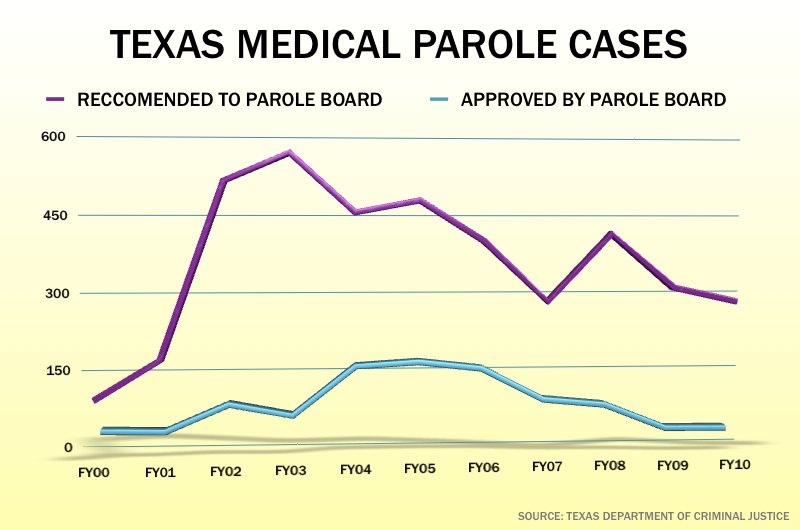
Prison doctors routinely offer up the oldest and sickest of these inmates for medical parole, a way to get those who are too incapacitated to be a public threat and have just months to live out of medical beds that Texas’ quickly aging prison population needs. They’ve recommended parole for 4,000 such inmates within the last decade. But the state parole board, which makes the final decision on “medically recommended intensive supervision,” has only agreed in a quarter of these cases, leaving the others to die in prison — and on the state’s dime.


Texas’ “geriatric” inmates, classified as those 55 and older, make up just 7.3 percent of Texas’ 160,000-offender prison population. But they account for nearly a third of the system’s hospital costs and make three times as many visits to prison medical departments as younger inmates. Elderly inmates have average annual hospitalization costs of $4,700, compared to $765 for inmates under 55. In total, providing inmate medical care costs the state correctional health care system — already facing hundreds of employee layoffs amid a budget shortfall — nearly half a billion dollars a year.


Parole board members say they’re faced with the difficult task of determining whether an inmate is still dangerous and must err on the side of public safety. “You can be sick, have an illness or a disease, and still be a threat,” said board chair Rissie Owens. “Our decisions aren’t based on numbers, on quotas. And we feel like we’re making good decisions.”


But criminal justice and prison funding experts say leaving elderly, terminally ill inmates to waste away behind bars is often unnecessary and exorbitantly expensive. Those costs would be shared with the federal government if the offenders weren’t in state custody.


“These are totally incapacitated inmates, terminally ill inmates, inmates on respirators, who are not paroled at a huge expense to the state and hardship to the inmate’s family because of the nature of a crime they may have committed 20 or 30 years ago,” said Sen. John Whitmire, D-Houston, who chairs the state Senate’s Criminal Justice Committee. “I think it’s largely for political reasons.”


The cost of care


While the total prison population in Texas isn’t growing, it’s quickly aging. The ranks of geriatric inmates are rising by about 6 percent every year, frightening the budget writers who have to figure out how to pay for them. Health care costs are rising too: The average daily medical bill for Texas inmates grows about 4 percent every year — which is low, compared to some states.


The sickest inmates can each cost the state up to $1 million a year in health care costs. If these same inmates were living in nursing homes or hospice facilities, the federal government — through Medicaid — would pay two-thirds of the cost and save Texas taxpayers up to $50 million a year, according to state projections. If the offenders are eligible for Medicare, the feds would pick up the full tab. “We could be transitioning them to some other facility where state taxpayers wouldn’t have to bear the full health care cost,” said Marc Levin, the director of the Texas Public Policy Foundation’s Center For Effective Justice Director, who suggested special nursing homes or hospice centers monitored by parole officers. “It’s a real opportunity to identify some savings without doing anything to endanger public safety.”


But despite the fact that the national one-year recidivism rate for older offenders is miniscule compared to that of younger offenders — 3.2 percent for inmates over 55, compared to 45 percent for inmates between 18 and 29 — an April report by the VERA Institute of Justice, a nonprofit criminal justice policy group, found that the 15 states that allow medical release rarely use it. What stands in the way? Political repercussions, complicated review processes and limited eligibility, the researchers found.


Getting Texas inmates released on medical parole is no easy task. To be eligible for it, an offender can’t be on death row or be serving life without parole, and must be either terminally ill (six months or less to live) or require intensive long-term care, said Dee Wilson, director of the Texas Correctional Office on Offenders with Medical or Mental Impairments. Sex offenders must effectively be in a vegetative state for consideration.


If inmates qualify, the office, in conjunction with the Correctional Managed Health Care Committee, recommends them for medical parole, then submits them to the seven-member Board of Pardons and Paroles for a decision. “It’s all about how long you have to live, and what your prognosis is,” Wilson said. “You can have a terminal illness but still be fully functioning.”


Dying behind bars


The parole board, in turn, relies on a pre-existing condition threshold of sorts. If an inmate with a particular illness commits a crime, Owens said, it’s unlikely he or she will get medical release for that same diagnosis. Some inmates with multiple amputated limbs may look incapacitated, Owens said, but managed to commit their crimes that way. Of the roughly 4,000 inmates prison health officials recommended for medical release in the last decade, the parole board turned down nearly 3,000.


In the last fiscal year alone, more than 440 Texas inmates died in prison. Thirty-one inmates who’d been recommended by medical staff for release died while awaiting the parole board to take up their case; another 26 died after the parole board rejected them for release. Twelve inmates were approved for medical parole but died before they could be sent home.


“There are documented cases where individuals had days or weeks left to live” and were rejected for medical parole, Whitmire said. “I saw no reason why they shouldn’t be paroled so the family could make plans for their funeral.”


Texas is not the only state struggling with skyrocketing prison health care costs and concerns around medical release. Between 1999 and 2007, the number of inmates 55 or older in state and federal prisons grew by more than 75 percent, to 76,000. To date, more than a dozen states have units set aside for elderly inmates; eight have dedicated hospice facilities. Estelle has an impressive medical facility, with a bustling emergency room, high-tech telemedicine equipment and a team of nephrologists that perform 1,800 dialysis treatments a month — sometimes on aggressive or unstable inmates.


“From a medical perspective, I’m comforted that [offenders are] getting a level of care they may not be getting on the street. On the other hand, we’re about to un-employ 363 people,” said Dr. Owen Murray, the chief physician for the University of Texas Medical Branch’s correctional managed care program, which oversees health care for the majority of Texas’ prisoners — and is facing layoffs this summer. “Are there other strategies to reduce our costs? And how do we prevent having to build more expensive units in the future?”


Charles Dill, a 71-year-old offender who started a 20-year sentence in 2000, has been hospitalized multiple times himself for costly heart problems, including getting stents for his carotid arteries. He’s befriended several elderly inmates in Estelle’s geriatric unit, only to watch them die on the ward.


“I’ve seen several of these guys drop over dead,” Dill said, gesturing across a prison dorm room of prosthetic limbs and wheelchairs, adult incontinence products and white-haired men in Coke-bottle glasses. “I guess they completed their sentence.”

Monday, June 21, 2010

Called to Care: Hospice of the Valley.

Hey all,

Called to Care is one of the main ministries addressing the needs of people with disabilities that has been supporting the efforts of the Hard Time Alliance, which is organizing Arizona's Hepatitis C + prisoners/ex-prisoners and their families. They had us give a little presentation at their coordinating meeting a month ago (where they had an awesome main speaker), and were on hand for the Candlelight Vigil last month at the ADC. Robert's also been a real support to my friend and comrade, Julie, who's trying to get either treatment for her son in prison or a pardon / compassionate release so he can get care in the community before the disease progresses further.

Anyway, I don't think these folks would mind if a few of us crashed this meeting in order to address concerns about the terminally ill in prison: is there even hospice space available to release dying prisoners to? Do hospice workers go into Arizona's prisons or jails? Does Hospice of the Valley deal at all with the prisons (like training other prisoners to be end-of-life caregivers, for example)? Are they a resource for the families of elderly and terminally ill prisoners?

I'm sure the rest of you can think of more questions to ask. Do just that - ask questions that concern these issues - wherever you go. In fact, if you can, make a point of going to things like this specifically to engage the rest of the community in a relationship with people dying behind bars: we have to do something about the hang-up on compassionate release (word is, there have been none/few signed by the governor since the Baseline Killer - that means Janet let a lot of sick people die in there who the ADC found eligible and the Arizona Board of Executive Clemency recommended for release).

So, if you have a chance to talk with someone from the American Cancer Society or other patient education/support/advocacy groups, please speak to the issues of compassionate release and hospice care for dying prisoners. If they hear it from several sources, maybe they'll jump in and help.

Thanks again, Robert, for your kindness and solidarity.

------------------from Called to Care---------------------

Dear Friends:
This is a reminder for the Called to Care Coordinating Council meeting, Sunday, June 27, 2010, 12 noon, Anthony Lounge, First Congregational United Church of Christ,1407 N. 2nd Street, Phoenix, potluck, carry-in meal. All are welcome. Sue Bartz, First Church member and Hospice of the valley Patient Insurance Department Coordinator, organized this speaker meeting. She invited Heather Chapple, Community Liaison, Hospice of the Valley, to speak on "The Hospice of the Valley's Senior Placement Service" that helps families find appropriate care for their loved ones at no cost to the family. Check attachment for details. For more information, contact Robert Koth by telephone at: 602-284-4159 or by email at: RobertKoth1@cox.net.


Our speaker, Heather Chapple, is a long-time Valley resident, moving to Arizona from Colorado in 1988, Heather served in the U.S. Navy for four years as an executive assistant at a submarine base in San Diego. She joined Hospice of the Valley in July 2009. She works as a community liaison, giving educational presentations about end-of-life care. Heather graduated from the University of Phoenix in 2008 with a bachelor's degree in education. I hope that you can join us to hear this exceptional speaker.

Blessings,

Robert Koth