THIS BLOG is NOW RETIRED

I began this blog in May 2009 following the death of Marcia Powell at Perryville State Prison in Goodyear, Arizona. It is not intended to prescribe the path that leads to freedom from the prison industrial complex.

Rather, these are just my observations in arguably the most racist, fascist, militaristic state in the nation at a critical time in history for a number of intersecting liberation movements. From Indigenous resistance to genocidal practices, to the fight over laws like SB1070 and the ban on Ethnic Studies, Arizona is at the center of many battles for human rights, and thus the struggle for prison abolition as well - for none are free until all are. I retired the blog in APRIL 2013.

Visit me now at Arizona Prison Watch or Survivors of Prison Violence-AZ
BLOG POSTS
Showing posts with label dying in prison. Show all posts

Thursday, June 24, 2010

Politics of Compassion: TX to AZ.

Kudos to this reporter for caring about this story. We have some compassionate release hang-ups in Arizona that need some journalistic help, too...maybe there's even a student out there who would want to make it an investigative journalism or research project? Let us know. Time is running out for Davon and his fellow prisoners; even he suggests that there are men far more ill than him who need to be going home before they die. Terminal illness was not included in their sentencing; perhaps sentencing judges should be reviewing such things when people apply for compassionate release.

So, keep hounding the governor - we need to let these folks find decent treatment in order to survive their sentences, or release them so they can die at home. Let her know that more than just a few of us care about this - she doesn't strike me much as the "compassionate" type, after all this with SB 1070.

But if she's really into helping the people of Arizona, then this is one small way she can make a huge difference in the lives of folks who have otherwise been disposed of and forgotten by all but their families - if they even still have connections with them, then the suffering generated by denying medical releases to terminally or chronically, severely ill prisoners is exponentially magnified. Everyone, including the state and our communities, hurts from our inability to embrace our own humanity, and find within ourselves the qualities of Mercy and Grace.


And the effects of the ease with which we detach from the pain of our fellow beings trickle down to the next generation...it is not a kind thing to bestow on them, or much of a gift to leave the world: a callous heart.

And it's all politics. Challenge Brewer to have the courage to step up to this issue and do it right. Word is that too many people since Janet have been approved by the Board of Executive Clemency only to die while sitting on the Governor's desk. Is this governor any less a coward than Napolitano was? I hope so.

- Peg

----------------------

Few Texas Inmates Get Released on Medical Parole
by Emily Ramshaw
Texas Tribune
June 3, 2010


A gaunt old man, thick with whiskers and stricken with dementia, writhes under the covers of his bed. Down the hall, doctors monitor elderly diabetics with recently amputated limbs, medicate terminal cancer patients shuffling by with walkers and tether shivering dialysis patients to blood-cleaning machines.


Despite the pacing guards, the handcuffs and the bars on the windows, the geriatric and medical wing at the Estelle Unit in Huntsville looks more like a nursing home than a maximum-security prison.


Prison doctors routinely offer up the oldest and sickest of these inmates for medical parole, a way to get those who are too incapacitated to be a public threat and have just months to live out of medical beds that Texas’ quickly aging prison population needs. They’ve recommended parole for 4,000 such inmates within the last decade. But the state parole board, which makes the final decision on “medically recommended intensive supervision,” has only agreed in a quarter of these cases, leaving the others to die in prison — and on the state’s dime.


Texas’ “geriatric” inmates, classified as those 55 and older, make up just 7.3 percent of Texas’ 160,000-offender prison population. But they account for nearly a third of the system’s hospital costs and make three times as many visits to prison medical departments as younger inmates. Elderly inmates have average annual hospitalization costs of $4,700, compared to $765 for inmates under 55. In total, providing inmate medical care costs the state correctional health care system — already facing hundreds of employee layoffs amid a budget shortfall — nearly half a billion dollars a year.


Parole board members say they’re faced with the difficult task of determining whether an inmate is still dangerous and must err on the side of public safety. “You can be sick, have an illness or a disease, and still be a threat,” said board chair Rissie Owens. “Our decisions aren’t based on numbers, on quotas. And we feel like we’re making good decisions.”


But criminal justice and prison funding experts say leaving elderly, terminally ill inmates to waste away behind bars is often unnecessary and exorbitantly expensive. Those costs would be shared with the federal government if the offenders weren’t in state custody.


“These are totally incapacitated inmates, terminally ill inmates, inmates on respirators, who are not paroled at a huge expense to the state and hardship to the inmate’s family because of the nature of a crime they may have committed 20 or 30 years ago,” said Sen. John Whitmire, D-Houston, who chairs the state Senate’s Criminal Justice Committee. “I think it’s largely for political reasons.”


The cost of care


While the total prison population in Texas isn’t growing, it’s quickly aging. The ranks of geriatric inmates are rising by about 6 percent every year, frightening the budget writers who have to figure out how to pay for them. Health care costs are rising too: The average daily medical bill for Texas inmates grows about 4 percent every year — which is low, compared to some states.
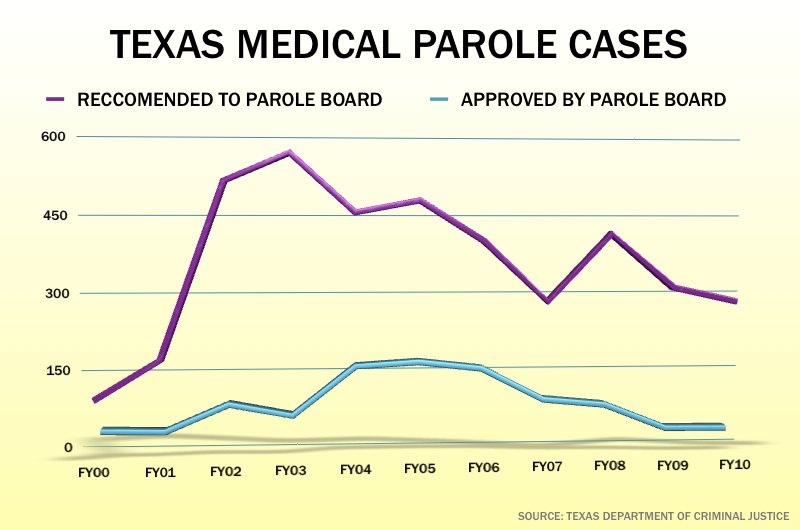

The sickest inmates can each cost the state up to $1 million a year in health care costs. If these same inmates were living in nursing homes or hospice facilities, the federal government — through Medicaid — would pay two-thirds of the cost and save Texas taxpayers up to $50 million a year, according to state projections. If the offenders are eligible for Medicare, the feds would pick up the full tab. “We could be transitioning them to some other facility where state taxpayers wouldn’t have to bear the full health care cost,” said Marc Levin, the director of the Texas Public Policy Foundation’s Center For Effective Justice Director, who suggested special nursing homes or hospice centers monitored by parole officers. “It’s a real opportunity to identify some savings without doing anything to endanger public safety.”


But despite the fact that the national one-year recidivism rate for older offenders is miniscule compared to that of younger offenders — 3.2 percent for inmates over 55, compared to 45 percent for inmates between 18 and 29 — an April report by the VERA Institute of Justice, a nonprofit criminal justice policy group, found that the 15 states that allow medical release rarely use it. What stands in the way? Political repercussions, complicated review processes and limited eligibility, the researchers found.


Getting Texas inmates released on medical parole is no easy task. To be eligible for it, an offender can’t be on death row or be serving life without parole, and must be either terminally ill (six months or less to live) or require intensive long-term care, said Dee Wilson, director of the Texas Correctional Office on Offenders with Medical or Mental Impairments. Sex offenders must effectively be in a vegetative state for consideration.


If inmates qualify, the office, in conjunction with the Correctional Managed Health Care Committee, recommends them for medical parole, then submits them to the seven-member Board of Pardons and Paroles for a decision. “It’s all about how long you have to live, and what your prognosis is,” Wilson said. “You can have a terminal illness but still be fully functioning.”


Dying behind bars


The parole board, in turn, relies on a pre-existing condition threshold of sorts. If an inmate with a particular illness commits a crime, Owens said, it’s unlikely he or she will get medical release for that same diagnosis. Some inmates with multiple amputated limbs may look incapacitated, Owens said, but managed to commit their crimes that way. Of the roughly 4,000 inmates prison health officials recommended for medical release in the last decade, the parole board turned down nearly 3,000.


In the last fiscal year alone, more than 440 Texas inmates died in prison. Thirty-one inmates who’d been recommended by medical staff for release died while awaiting the parole board to take up their case; another 26 died after the parole board rejected them for release. Twelve inmates were approved for medical parole but died before they could be sent home.


“There are documented cases where individuals had days or weeks left to live” and were rejected for medical parole, Whitmire said. “I saw no reason why they shouldn’t be paroled so the family could make plans for their funeral.”


Texas is not the only state struggling with skyrocketing prison health care costs and concerns around medical release. Between 1999 and 2007, the number of inmates 55 or older in state and federal prisons grew by more than 75 percent, to 76,000. To date, more than a dozen states have units set aside for elderly inmates; eight have dedicated hospice facilities. Estelle has an impressive medical facility, with a bustling emergency room, high-tech telemedicine equipment and a team of nephrologists that perform 1,800 dialysis treatments a month — sometimes on aggressive or unstable inmates.


“From a medical perspective, I’m comforted that [offenders are] getting a level of care they may not be getting on the street. On the other hand, we’re about to un-employ 363 people,” said Dr. Owen Murray, the chief physician for the University of Texas Medical Branch’s correctional managed care program, which oversees health care for the majority of Texas’ prisoners — and is facing layoffs this summer. “Are there other strategies to reduce our costs? And how do we prevent having to build more expensive units in the future?”


Charles Dill, a 71-year-old offender who started a 20-year sentence in 2000, has been hospitalized multiple times himself for costly heart problems, including getting stents for his carotid arteries. He’s befriended several elderly inmates in Estelle’s geriatric unit, only to watch them die on the ward.


“I’ve seen several of these guys drop over dead,” Dill said, gesturing across a prison dorm room of prosthetic limbs and wheelchairs, adult incontinence products and white-haired men in Coke-bottle glasses. “I guess they completed their sentence.”

Wednesday, June 16, 2010

Dying inside: The elderly in prison.

Plan to spend about 20 minutes weeping, if you tune into this documentary on aging in US prisons. Thank you, Jeremy Young and Al Jazeera.

----------------------from Al Jazeera----------------------------

Our program has aired and is finally up online—it is titled “Dying Inside: Elderly in Prison”. Here is the link to the show, please let me know your thoughts and feedback:

http://www.youtube.com/watch?v=Xvqj8hgxRfg

If you toggle the settings on you tube from 360 to 720 and you have a strong internet connection the quality of the video is very vivid. Please feel free to share the video with whomever.

Many thanks to all of those people that helped us out along the way….your contributions are greatly appreciated!

Jeremy Young

Al Jazeera English- The Americas

1627 K Street, 11th Floor

Washington, D.C. 20006

Work- 202.496.4543

Cell- 202.651.1632

Monday, February 1, 2010

Justice can also be administered as Mercy.

Got the heads up on this NYT article from the UNSHACKLE List-serve. They are worth subscribing to. I'll follow up with what's happening regarding compassionate release in Arizona soon. Maybe these cases should be sent back to sentencing judges - I bet a lot would reconsider how much time they gave someone if they knew what the outcome would be - even judges in Arizona.

-------------------

Law Has Little Effect on Early Release for Inmates

COXSACKIE, N.Y. — With his swollen legs and a throaty rasp that whistles like a kettle through his broken teeth, Eddie Jones is an unlikely man to make history.

He is 89 and dying, a former loan shark who, at 69, shot another man dead on a Harlem street in what he claimed was self-defense. Now he is serving a sentence of 25 years to life in a prison hospital bed in this upstate town, riddled with heart disease and probably cancer, though his doctors are not certain about the cancer because Mr. Jones has refused most every medical test.

Mr. Jones’s original parole date was in 2015, but he stands to go free in the coming weeks under a new state law that makes chronically as well as terminally ill inmates eligible for early release. Inmates must be deemed physically or cognitively unable to present a threat to society.

The law, passed with the state budget last April, expanded the eligibility list to add those convicted of violent crimes including second-degree murder (like Mr. Jones), first-degree manslaughter and sex offenses, so long as the ailing inmates have served half their time.

But despite fanfare within the corrections field about the humanitarian and financial benefits of compassionate release — New York is one of a dozen states that have expanded, enacted or streamlined programs over the past two years — the policy shift has had minimal effect. Experts attribute this to the fear that freed inmates, no matter how sick, might commit further crimes, as well as to the difficulty of placing dying criminals in nursing homes.

“The problem is, when we start trying to put people out, there are others in the community who are sure we’re trying to make more crime in the community,” said Dr. Lester Wright, chief medical officer for the New York State Department of Correctional Services. “We’re also competing for beds. Some people think my patients aren’t as valuable as other people in society.”

The embrace of compassionate release comes as the nation’s prison population is at a historic high — 1.6 million people as of 2008, according to the Justice Department — compounded by a surge in aging and sick inmates serving longer sentences. In 2008, there were 74,100 inmates age 55 and older, a 79 percent increase from 1999. New York estimates the cost of caring for a gravely ill inmate at $150,809 a year.
Once released, they are usually cared for by family members or placed in nursing homes or hospices, their expenses largely covered by Medicare or Medicaid.

But while the new state guidelines led to a rise in applications for medical parole — 202 inmates last year, compared with 66 in 2008 — they have hardly led to more releases. Mr. Jones would, in fact, be the first freed under the new guidelines (the seven inmates released last year were eligible under the old rules).
The National Conference of State Legislatures said 39 states had compassionate release programs, but many of them also have minimal impact.

In California, where federal judges ordered the state to cut the prison population by 40,000, three people were granted compassionate release last year. In Alabama, where prisons are at double their capacity, four sick inmates were let out on compassionate release in the 2009 fiscal year; 35 other prisoners in Alabama died while their applications were being reviewed.

Since New York adopted medical parole in 1992, at the height of the AIDS crisis, 364 people have been released.

“Medical parole was designed to consider the humanitarian needs of inmates as well as the safety of the community,” said Brian Fischer, commissioner of the State Department of Correctional Services. “Anybody can tell us they want medical parole, but the numbers who qualify are going to be a lot smaller than the ones who want it.”

Advocates for prisoners argue that fear of recidivism is unreasonable, especially for convicts close to death. Corrections officials said during the 18 years the program in New York has been in effect, three medically paroled inmates have ended up back in prison, none for violent crimes.

“Politicians and high-level officials and bureaucrats don’t want to be accused of being soft on crime, even if the prisoners are terminally ill and there’s no possible risk to public safety,” said Robert Gangi, executive director of the Correctional Association of New York, a prison advocacy group. 

Indeed, the release last summer in Scotland of a sick Libyan man convicted in the bombing of an airplane over Lockerbie created an international furor. Last fall, anger over New York’s new law erupted when Gregory Felder, who was convicted of murdering a Radio Shack employee on Long Island in 2004 and is now gravely ill, was considered for parole. (He was turned down; and a legislative loophole that had made him eligible despite having not yet served half his sentence was subsequently closed.)

Other cases have unfolded far from the public glare. Cinderella Marrett, 74, who was caught at Kennedy International Airport in 2007 smuggling cocaine in her girdle — to offset medical expenses, her daughter said — was released in May 2009. Stricken with cancer, she is living in a nursing home in the Bronx.

Since 2005, at least 16 New York inmates have died while waiting for the parole board to decide their fate.

Timothy McGowan, a once-burly high school dropout from Deer Park, N.Y., spent half of his 50 years behind bars for 11 felony convictions, including robbery and second-degree manslaughter. By the time he was thrown back in prison for a parole violation in April 2009, cancer was consuming his lungs, whittling away his body and creeping up his brain stem.

In July, when Mr. McGowan could barely walk, his prison doctors applied on his behalf for compassionate release; his final wish was to have one last cup of tea with his mother in their Long Island home. Instead, he died at the Fishkill Correctional Facility on Nov. 7, two days before the parole board was to hear his case.
Among the prisoners in New York newly eligible but denied release last year was Sergio Black, 38, a former Marine who said he had fought in the first gulf war.

Mr. Black was convicted in 2005 of raping his former companion, which he denied. In 2006, his spinal cord was injured in a prison basketball game. Now a quadriplegic in the Walsh Regional Medical Unit of the Mohawk Correctional Facility in Rome, N.Y., Mr. Black is a “poster boy for medical parole,” according to his lawyer, Stephen Dratch, because it would be difficult for him to commit another physical crime. But the parole board rejected his application, saying Mr. Brown “exhibited little or no insight or remorse for the victim.”

Mr. Jones, the near-nonagenarian and former loan shark known by his hospice aides as the Harlem Knight, was supposed to go before the parole board in December, but the hearing was pushed back twice because the court had not yet sent a transcript from his sentencing. His next scheduled parole date is next month, and he remains bedridden in the hospice at the Coxsackie state prison.

A long-lost niece, Marcy Jones, who lives in Washington, has poured her heart into pushing corrections officials and the governor’s office to grant the parole. She is optimistic enough that she has bought her uncle a new wardrobe and has set up a battery of medical appointments for him.

“Once I get him out, I’m going to advocate for others,” Ms. Jones said. “There are other Uncle Eddies out there.”