THIS BLOG is NOW RETIRED

I began this blog in May 2009 following the death of Marcia Powell at Perryville State Prison in Goodyear, Arizona. It is not intended to prescribe the path that leads to freedom from the prison industrial complex.

Rather, these are just my observations in arguably the most racist, fascist, militaristic state in the nation at a critical time in history for a number of intersecting liberation movements. From Indigenous resistance to genocidal practices, to the fight over laws like SB1070 and the ban on Ethnic Studies, Arizona is at the center of many battles for human rights, and thus the struggle for prison abolition as well - for none are free until all are. I retired the blog in APRIL 2013.

Visit me now at Arizona Prison Watch or Survivors of Prison Violence-AZ
BLOG POSTS
Showing posts with label board of executive clemency. Show all posts

Saturday, July 17, 2010

An Atrocity of Justice: Imprisoning the Innocent.

Just received this from a friend in the innocence movement. The New York Times published this over a month ago, too. We have way too many innocent people imprisoned in Arizona:
---------------------------

Governor Rebuffs Clemency Board in Murder Case
June 14, 2010
Adam Liptak

New York Times


WASHINGTON — Ronald Kempfert was a young boy in 1975 when his father was sent to prison for murder, and they had no contact for 28 years. Then, in 2003, Mr. Kempfert heard from a lawyer who had been looking into the case. “Your father is innocent,” said the lawyer, Larry A. Hammond. “And we’re pretty sure your mother framed him.”

That would seem a lot to digest, but Mr. Kempfert, 42, said he felt no hesitation. “My reaction was that it didn’t surprise me,” he said. “She’s my mother, and I love her. But I think she’s capable of anything.”

Mr. Kempfert is now certain that his father, William Macumber, is innocent. Arizona’s clemency board, citing Mr. Kempfert’s “very moving testimony” and saying there had been “a miscarriage of justice,” unanimously recommended last year that Mr. Macumber be freed.

But Mr. Macumber remains in prison, and Gov. Jan Brewer has refused to explain why.

The case against Mr. Macumber began in 1974 as his marriage was disintegrating. His wife, Carol, who worked in the local sheriff’s office, went to her superiors with a surprising story. Her husband, she said, had recently confessed to the unsolved murders of a young couple shot to death a dozen years before, in 1962, in the open desert north of Scottsdale, Ariz.

Largely on the strength of his former wife’s testimony, Mr. Macumber was convicted and sentenced to life without the possibility of parole.

But the jury did not hear a significant piece of evidence.

In 1967, five years after the murders in the desert, a drifter named Ernesto Valenzuela was charged with a similar double homicide. He told his lawyer that he had also killed the couple in the desert.

“He was just making a point about bragging about the people he killed,” the lawyer, Thomas W. O’Toole, said. “He was a cold-blooded killer who relished committing the murders.”

Mr. O’Toole, who went on to serve 24 years as a state judge, said his client was dead serious about claiming responsibility for the 1962 murders. “There is no doubt in my mind that Ernesto Valenzuela committed those crimes,” Mr. O’Toole said.

For years, Mr. O’Toole kept his client’s secret, as he was required to do by the canons of legal ethics. But after Mr. Valenzuela was himself killed in prison in 1973, and with the permission of Mr. Valenzuela’s mother, Mr. O’Toole offered to testify at Mr. Macumber’s trial.

The judge refused to let the jury hear from Mr. O’Toole, saying his account was unreliable hearsay. The judge also excluded testimony from a second lawyer and a psychiatrist who had heard similar confessions from Mr. Valenzuela.

The jury did hear about two kinds of physical evidence — a partial palm print and bullet casings — that prosecutors said connected Mr. Macumber to the killings.

Mr. Kempfert said he believed that his mother had done more than lie.

“I can fully see how my mother could have set him up and framed him,” Mr. Kempfert said. “She had access to the evidence. She was doing fingerprint courses at the time.”

Last year, the five members of the Arizona Board of Executive Clemency unanimously recommended to Ms. Brewer that Mr. Macumber be released after 35 years in prison “to correct a miscarriage of justice.”

But Ms. Brewer rejected the board’s recommendation without explanation in November. It is possible that politics played a role in her decision; Ms. Brewer, a Republican who became governor last year, is running for a full term in November.

“She denied the application right after she announced that she was running for governor,” said Katherine Puzauskas, a lawyer with the Arizona Justice Project at the Sandra Day O’Connor College of Law at Arizona State University. The project, which was founded by Mr. Hammond and works to overturn wrongful convictions, has represented Mr. Macumber since 2000.

There is little political upside to granting clemency, but there is a substantial risk, as Mike Huckabee learned when a man whose sentence he commuted as governor of Arkansas in 2000 killed four police officers last year.

P. S. Ruckman Jr., a political science professor at Rock Valley College in Rockford, Ill., has been fuming about Ms. Brewer’s handling of the Macumber case. “I have been following state clemency for 30 years,” Mr. Ruckman said, “and this is easily, easily, the most disturbing. It’s borderline despicable.”

“Common-sense notions of justice should compel a governor to provide an explanation for imprisoning a man deemed innocent by an official board created to make such judgments,” he added. “You don’t imprison a man for no reason.”

A spokesman for the governor said Ms. Brewer had reviewed the case thoroughly, but he provided only boilerplate concerning her reasoning.

“Every executive clemency case is carefully scrutinized as the governor balances the very real and important concepts of public safety, justice and mercy,” the spokesman, Paul Senseman, said in an e-mail message.

Mr. Macumber is 74 and in failing health, with heart problems and arthritis, and the threat he poses to public safety is not obvious.

But Mr. Macumber’s former wife, now known as Carol Kempfert, said he was a dangerous sociopath who deserved to die in prison. She denied making up his confession and tampering with the evidence used to convict him.

It is her former husband, she said, who is a pathological liar. “I was in law enforcement for almost 20 years, and no one came close to being able to manipulate like Bill,” she said. “This man could sell water to a drowning person.”

Mr. Macumber, she said, would have said anything to save their marriage.

For instance, she said, he once falsely claimed to have a heart condition. “He intimates that if I hang around long enough, he’ll die and I’ll get the insurance money,” she said. “Well, I hung around, and he didn’t die.”

Then he threatened to kill himself. “If you’re going to do it, go outside” she recalled telling her husband. “I don’t want blood on the walls.”

In the course of a half-hour conversation, Ms. Kempfert accused Mr. Macumber of terrible and disturbing crimes beyond the killings in the desert. Asked if he deserved clemency, she said, “Absolutely not.”

“Actually,” she added, “I think he’s lucky. If he had been caught sooner, he would have gotten the death penalty.”

Ms. Kempfert and her son no longer speak. Ronald Kempfert, who took his stepfather’s last name when he was a child, is in the process of changing it back to Macumber.

Brewer leaves innocent man to die.

This is so wrong. This man will be 75 years old on August 31st; he's been in prison since he was 40. He could easily be my father - or anyone of us - and will die there for the governor's "personal reasons" if we don't step up and act. There's nothing personal about it - she's supposed to be a professional serving the public when making decisions about pardons and compassionate release. That's why she gets paid. This article came out a month ago, and William sits there still today.

Putting this into context: imagine what a court would say if I kidnapped someone, held them hostage for 35 years, and left them to die in a hole in the desert? They'd send a SWAT team to the rescue if he was still alive, and say that what I did was criminal, not "personal", then send
me to prison for life - or even order my execution if he died.

And what else could they do? If I admitted my crime with no explanation, and was allowed to go free, instead, the judge or jury responsible would not only be raked over the coals, they may well be lynched. Arizonans don't like that kind of impudence - be it from a cold-blooded killer or an indifferent, self-interested career politician. Is there really any difference?

Don't be mistaken: whether perpetrated by a private citizen or an agent of the state, incarceration is violence, and false imprisonment is a serious crime.
William was recommended for release by the AZ Board of Executive Clemency on May 8, 2009. This innocent man has already spent almost half of his life doing hard time - he shouldn't do another day. It isn't costing Brewer a dime to leave him there - we pick up the tab, but William's the one who really pays the price.

Whatever your political persuasion (the more Republicans the better), please show some support to the family: take just 10 minutes and write to Governor Brewer's office asking for a public explanation to the voters and taxpayers of AZ, then save and send a copy to WREX, either snail mail or email. Cc it to the Capitol Times, the Arizona Republic, and the Phoenix New Times, while you're at it. We need to do a full court press, so you might as well send one to the Goddard campaign HQ - he may well be the next governor this falls to.

The address to the tv station is:

WREX (NBC Channel 13)
PO Box 530
Rockford, IL 61105

Their newsroom phone number is 815-335-2710. The email there is news@wrex.com.


William's contact information is:

William Macumber (#033867)
ASPC-Douglas, Mohave Unit
PO Box 5002
Douglas, AZ 85608

Anyone is free to write him a letter to tell him that you're working on this, too.

Help free prisoner Macumber. Please don't let him die inside.

--------------------------------

Rockford man fights to get his brother out of Arizona prison

Jun 15, 2010 5:08 PM

By Katie Nilsson

ROCKFORD (WREX) - An Arizona man with Rockford ties is still in prison for a crime the Clemency Review Board there says he didn't commit. William Macumber was sent to prison in 1975, part of his family lives in Rockford now and is fighting for his release.

Macumber's brother Robert and his wife have lived in Rockford for the last four years. They're trying to figure out why Arizona Governor Jan Brewer denied the recommendation from the Clemency Board for William's release. They say she's never given them a reason for it. "She was quoted as saying it was a personal reason that she had no comment and to this day we have no idea what the personal reason is."

William Macumber was convicted of killing two people in an Arizona desert back in 1975. He was sent to prison for life without the possibility of parole. Macumber's denied involvement in the killings and his family thinks William's ex-wife set him up. "My father and I both looked at all the evidence in the trial first hand at the sheriff's office and there was nothing in there that really could have convicted Bill. It was basically on his wife's testimony."

She worked for an Arizona Sheriff's Department and testified William told her he killed the couple. But according to the Clemency Board who reviewed the case last year, another man Ernesto Valenzuela told his lawyer he did it. In a letter Clemency Board Chairman and Executive Director Duane Belcher wrote to Governor Brewer, the board also agreed some of the testimony wasn't reliable and neither was the evidence presented at his trial. That's why the board unanimously recommended Macumber be released because they say he's innocent. "It's a very rare thing for them to recommend clemency, and it's even more rare, it's freakishly rare for them to recommend clemency on the grounds of innocence," says Rock Valley College Professor and clemency expert P.S. Ruckman, Jr. He thinks the governor owes the Macumber family an explanation for her denial.

Ruckman thinks Brewer's lack of response to the case may be political as she's running for re-election. "We just had that Mike Huckabee scenario a couple months back and Huckabee took a big beating for that, I think unfairly. But he did commute a sentence on the base of a recommendation by a parole board and the person 10 or 15 years later murdered some police officers. I wouldn't identify that as a cause of Brewer's hesitancy, but I would say it's a factor."

I tried calling Governor Brewer's office for comment, but no one called back.

---------------------------------

Hang in there, William and Robert. You aren't alone.

Thursday, June 24, 2010

Politics of Compassion: TX to AZ.

Kudos to this reporter for caring about this story. We have some compassionate release hang-ups in Arizona that need some journalistic help, too...maybe there's even a student out there who would want to make it an investigative journalism or research project? Let us know. Time is running out for Davon and his fellow prisoners; even he suggests that there are men far more ill than him who need to be going home before they die. Terminal illness was not included in their sentencing; perhaps sentencing judges should be reviewing such things when people apply for compassionate release.

So, keep hounding the governor - we need to let these folks find decent treatment in order to survive their sentences, or release them so they can die at home. Let her know that more than just a few of us care about this - she doesn't strike me much as the "compassionate" type, after all this with SB 1070.

But if she's really into helping the people of Arizona, then this is one small way she can make a huge difference in the lives of folks who have otherwise been disposed of and forgotten by all but their families - if they even still have connections with them, then the suffering generated by denying medical releases to terminally or chronically, severely ill prisoners is exponentially magnified. Everyone, including the state and our communities, hurts from our inability to embrace our own humanity, and find within ourselves the qualities of Mercy and Grace.


And the effects of the ease with which we detach from the pain of our fellow beings trickle down to the next generation...it is not a kind thing to bestow on them, or much of a gift to leave the world: a callous heart.

And it's all politics. Challenge Brewer to have the courage to step up to this issue and do it right. Word is that too many people since Janet have been approved by the Board of Executive Clemency only to die while sitting on the Governor's desk. Is this governor any less a coward than Napolitano was? I hope so.

- Peg

----------------------

Few Texas Inmates Get Released on Medical Parole
by Emily Ramshaw
Texas Tribune
June 3, 2010


A gaunt old man, thick with whiskers and stricken with dementia, writhes under the covers of his bed. Down the hall, doctors monitor elderly diabetics with recently amputated limbs, medicate terminal cancer patients shuffling by with walkers and tether shivering dialysis patients to blood-cleaning machines.


Despite the pacing guards, the handcuffs and the bars on the windows, the geriatric and medical wing at the Estelle Unit in Huntsville looks more like a nursing home than a maximum-security prison.


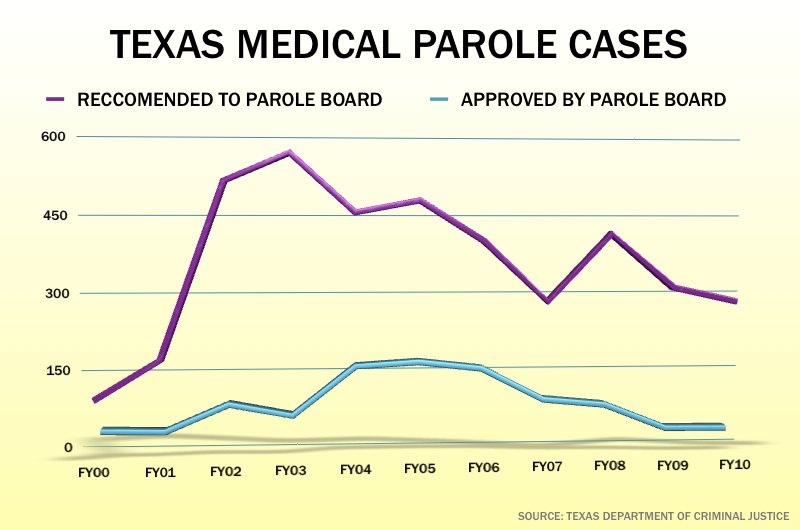
Prison doctors routinely offer up the oldest and sickest of these inmates for medical parole, a way to get those who are too incapacitated to be a public threat and have just months to live out of medical beds that Texas’ quickly aging prison population needs. They’ve recommended parole for 4,000 such inmates within the last decade. But the state parole board, which makes the final decision on “medically recommended intensive supervision,” has only agreed in a quarter of these cases, leaving the others to die in prison — and on the state’s dime.


Texas’ “geriatric” inmates, classified as those 55 and older, make up just 7.3 percent of Texas’ 160,000-offender prison population. But they account for nearly a third of the system’s hospital costs and make three times as many visits to prison medical departments as younger inmates. Elderly inmates have average annual hospitalization costs of $4,700, compared to $765 for inmates under 55. In total, providing inmate medical care costs the state correctional health care system — already facing hundreds of employee layoffs amid a budget shortfall — nearly half a billion dollars a year.


Parole board members say they’re faced with the difficult task of determining whether an inmate is still dangerous and must err on the side of public safety. “You can be sick, have an illness or a disease, and still be a threat,” said board chair Rissie Owens. “Our decisions aren’t based on numbers, on quotas. And we feel like we’re making good decisions.”


But criminal justice and prison funding experts say leaving elderly, terminally ill inmates to waste away behind bars is often unnecessary and exorbitantly expensive. Those costs would be shared with the federal government if the offenders weren’t in state custody.


“These are totally incapacitated inmates, terminally ill inmates, inmates on respirators, who are not paroled at a huge expense to the state and hardship to the inmate’s family because of the nature of a crime they may have committed 20 or 30 years ago,” said Sen. John Whitmire, D-Houston, who chairs the state Senate’s Criminal Justice Committee. “I think it’s largely for political reasons.”


The cost of care


While the total prison population in Texas isn’t growing, it’s quickly aging. The ranks of geriatric inmates are rising by about 6 percent every year, frightening the budget writers who have to figure out how to pay for them. Health care costs are rising too: The average daily medical bill for Texas inmates grows about 4 percent every year — which is low, compared to some states.


The sickest inmates can each cost the state up to $1 million a year in health care costs. If these same inmates were living in nursing homes or hospice facilities, the federal government — through Medicaid — would pay two-thirds of the cost and save Texas taxpayers up to $50 million a year, according to state projections. If the offenders are eligible for Medicare, the feds would pick up the full tab. “We could be transitioning them to some other facility where state taxpayers wouldn’t have to bear the full health care cost,” said Marc Levin, the director of the Texas Public Policy Foundation’s Center For Effective Justice Director, who suggested special nursing homes or hospice centers monitored by parole officers. “It’s a real opportunity to identify some savings without doing anything to endanger public safety.”


But despite the fact that the national one-year recidivism rate for older offenders is miniscule compared to that of younger offenders — 3.2 percent for inmates over 55, compared to 45 percent for inmates between 18 and 29 — an April report by the VERA Institute of Justice, a nonprofit criminal justice policy group, found that the 15 states that allow medical release rarely use it. What stands in the way? Political repercussions, complicated review processes and limited eligibility, the researchers found.


Getting Texas inmates released on medical parole is no easy task. To be eligible for it, an offender can’t be on death row or be serving life without parole, and must be either terminally ill (six months or less to live) or require intensive long-term care, said Dee Wilson, director of the Texas Correctional Office on Offenders with Medical or Mental Impairments. Sex offenders must effectively be in a vegetative state for consideration.


If inmates qualify, the office, in conjunction with the Correctional Managed Health Care Committee, recommends them for medical parole, then submits them to the seven-member Board of Pardons and Paroles for a decision. “It’s all about how long you have to live, and what your prognosis is,” Wilson said. “You can have a terminal illness but still be fully functioning.”


Dying behind bars


The parole board, in turn, relies on a pre-existing condition threshold of sorts. If an inmate with a particular illness commits a crime, Owens said, it’s unlikely he or she will get medical release for that same diagnosis. Some inmates with multiple amputated limbs may look incapacitated, Owens said, but managed to commit their crimes that way. Of the roughly 4,000 inmates prison health officials recommended for medical release in the last decade, the parole board turned down nearly 3,000.


In the last fiscal year alone, more than 440 Texas inmates died in prison. Thirty-one inmates who’d been recommended by medical staff for release died while awaiting the parole board to take up their case; another 26 died after the parole board rejected them for release. Twelve inmates were approved for medical parole but died before they could be sent home.


“There are documented cases where individuals had days or weeks left to live” and were rejected for medical parole, Whitmire said. “I saw no reason why they shouldn’t be paroled so the family could make plans for their funeral.”


Texas is not the only state struggling with skyrocketing prison health care costs and concerns around medical release. Between 1999 and 2007, the number of inmates 55 or older in state and federal prisons grew by more than 75 percent, to 76,000. To date, more than a dozen states have units set aside for elderly inmates; eight have dedicated hospice facilities. Estelle has an impressive medical facility, with a bustling emergency room, high-tech telemedicine equipment and a team of nephrologists that perform 1,800 dialysis treatments a month — sometimes on aggressive or unstable inmates.


“From a medical perspective, I’m comforted that [offenders are] getting a level of care they may not be getting on the street. On the other hand, we’re about to un-employ 363 people,” said Dr. Owen Murray, the chief physician for the University of Texas Medical Branch’s correctional managed care program, which oversees health care for the majority of Texas’ prisoners — and is facing layoffs this summer. “Are there other strategies to reduce our costs? And how do we prevent having to build more expensive units in the future?”


Charles Dill, a 71-year-old offender who started a 20-year sentence in 2000, has been hospitalized multiple times himself for costly heart problems, including getting stents for his carotid arteries. He’s befriended several elderly inmates in Estelle’s geriatric unit, only to watch them die on the ward.

“I’ve seen several of these guys drop over dead,” Dill said, gesturing across a prison dorm room of prosthetic limbs and wheelchairs, adult incontinence products and white-haired men in Coke-bottle glasses. “I guess they completed their sentence.”