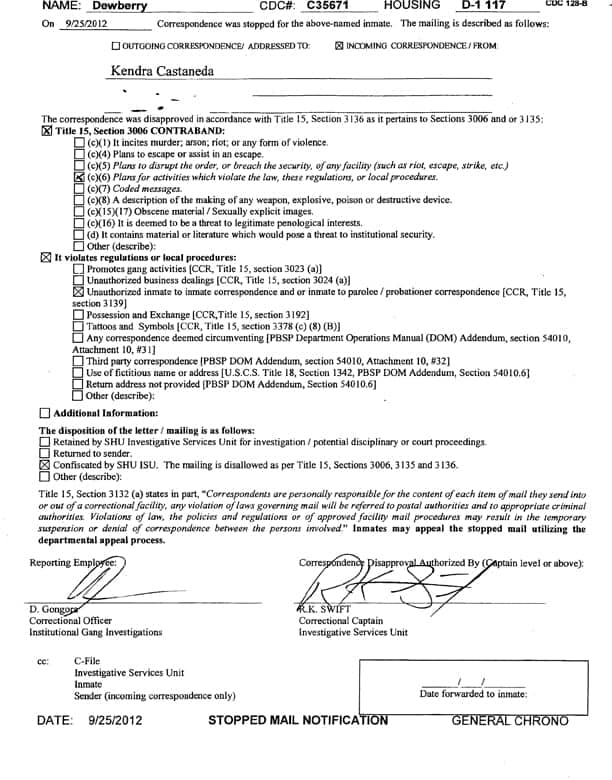
The California Prison Watch reports "In prisons throughout the country, perceived gang membership is one of the leading reasons for placement in solitary confinement. In California alone, hundreds of prisoners are in Security Housing Units (SHUs) because they have been "validated" as gang members. The validation procedure used by the California Department of Corrections and Rehabilitation (CDCR) employs such criteria as tattoos, reading materials, and associations with other prisoners -- . to identify gang members."
Spending a sufficient amount of point in time working and assigned as an officer and administrator inside these tough Special Management Units (SMU) in Arizona and New Mexico, I can attest to the fact that there are some issues that need to be cleared up regarding the validation process. This policy, as it applies under any policy written, can be altered in design or significance under the wrong intention or immoral directions by someone [the Director, the STG administrator or chairperson] who is vindictive and retaliatory in nature, these validation processes can be tainted to some degree and deny a due process to someone undergoing such a test. The matter rest purely on the selection and integrity of those members that attend the Security Threat Group Hearing Committees and how their spirit and interpretation of the policy can alter their psyche and presence to control the legitimate outcome of such hearings. It is likely they will receive verbal input by the powers to be before they adjourn the hearings. They must also be prepared to withstand policy allowances for a legitimate due process and a legitimate appeal process if found to be validated.
Thus, although it can be said that the process is sound and legitimate, the system is clearly open to abuses as it is written by the policy makers of the Arizona Department of Corrections (ADOC) The ADOC policy 806 states in part "The purpose of this Department Order is to minimize the threat that inmate gang or gang like activity poses to the safe, secure and efficient operation of institutions. No inmate shall create, promote or participate in any club, association, organization or gang, except as permitted by Departmental written instructions. Minimizing gang or gang like activity shall be accomplished by the identification, certification and validation of prison gangs and gang members, the debriefing and segregation of inmates who disavow gang membership and a step-down process for gang members who participate in programming, shun gang activity and affiliation, and remain disciplinary free.
The very first thing I want to express is related to the validation criteria and process. In my opinion, it is a legitimate management tool that can be used to remove gang influence from the prison open yards and result a justifiable placement into one of these SMU's. The policy as it is written is a sound policy. It exercises sound correctional practices and allows the displacement of legitimate gang influence within the vast prison system and localizes it within the designated housing within the SMU facility for closer and more intense supervision. Obviously, the overall result of such a placement is the classification to the most restrictive and most isolated custody level that exists within the Arizona custody level system, a level 5 placement. Expensive and growing, this group has now expanded beyond its original housing areas and crowding the general populations of the level 5 facility.
The potential for abuse in this practice exists in the manner or practice the validation process is conducted. The gathering of the STG files prepared for validation comes under the close scrutiny of the STG coordinator in central office and is communicated clearly with the STG investigators and Special Security Unit (SSU) for validation considerations. The manner on how this is articulated via the chain of command is to "trump" up as many validation points you can come up with so that during the validation process, if the prisoner challenges any part of the information provided, the points will still never drop below the required 10 to validate the individual. Hence the policy specifically states "The SSU Coordinator shall review all Validation Packets with the SSU staff prior to submission to the STG Validation Committee. Those packets requiring additional work shall be returned to the SSU staff with deficiencies identified.
It is true that I have seen STG suspects "beat" a validation process through an appeal process and that was mainly due to a sloppy investigation that was conducted by ill trained STG investigators or designees. However, the practice doesn't stop there as the file is returned and another "investigation" is conducted to coagulate the original findings boosting the evidence and points to mandate and create another return to the validation committee for a re-hearing on gang validation. The administration can repeat this process over and over and in the meantime, the prisoner is subjected to a higher classification that he scores while awaiting his fate with another round of deliberations in front of the STG validation committee. Eventually, there comes a time in the prisoner's mind that regardless of the outcome, he will be housed in a most restrictive manner until he finishes his sentence.
The classification appeal system and the annual classification reviews are cookie cutter templates for STG validated gang members. Regardless whether their validation was flawed, fabricated, "planted with evidence" or subjective in manner, once a prisoner is validated, he has no opportunity to go back down in the custody levels unless he makes the choice to debrief and meet with STG investigators and give them "significant information" regarding gang information they can use for further intelligence gathering or to validate another suspected gang member into the STG validation ranks. This debrief system is a most desperate method to take as those serving life or long consecutive sentences are forced to take the protective custody option if they successfully pass the polygraph during their debrief session with the STG staff. Debriefing is a viable tool for those who are serving shorter sentences. They can debrief, approved to go protective segregation (PS) and remain in a housing area away from the STG validated group and be released from the PS facility.
The second option for a validated gang member is to apply for the STG step down program if eligible. This program was designed for those STG members who have shown or demonstrated legitimate broken ties with the gang they once associated with and clear conduct for 4 years. Then if selected by the administration, they can participate in the 18 month program to make it down to close custody for the remainder of their sentence. Once they successfully completed the step down they are moved to another unit and are allowed those privileges for close custody that are much less restrictive to level 5 placements. The key to this option is the permission of the administration, the STG coordinator, and the Director to participate and enroll. This makes the process both politically inclined and difficult to overcome if you are a high profile STG inmate.
The step down program has its own political implications as these prisoners are subjected to a rigid and most scrutinized way of living while participating in this curriculum. Political influences from central office often change their schedules and observe their ability to adapt or overcome the negative changes testing them for resilience and fortitude on completing the program. Pressure is applied on these participants to engage in combined and mixed gang socialization to show they can function and cope within a general population setting. Their routines are often changed and time tables for incentives are delayed to show how they can manage their anger and their ability to go with the changes without complaining or protesting these interruptions in what is an unyielding and appropriate format to participate in.
The third option is the worst of the three as it applies to those serving life or long consecutive sentences. Once you are validated as a STG gang member, you will remain inside the SMU for the rest of your life until your natural death since you can not be lowered to another custody level without meeting the other elements of the policy. This cause and effect is regardless whether you are a model prisoner free of gang activity or disciplinary. The reason for this consequence is the cookie cutter classification process that will extend the prisoner's stay in level 5 for an indefinite amount of time including death if the sentence exceeds you natural life span. The cookie cutter is simply a short phrase that reads "STG Validated Gang member" and overrides all other options in the classification manual. This administrative override is the most powerful management tool that exists in the classification system as it does not require any new evidence, new updates, new data or new behaviors to sustain such a placement. It is an automatic extension of the first validation packet that lasts eternally.
To the best of my knowledge, no administrators have ever been successful in overriding this phrase and move an STG prisoner to a lower custody level. It would be political suicide to even attempt such a feat as this is the standard of the policy, the director and the agency. Once an STG, always an STG and no other tools are available to be removed from such a status unless you debrief or fortunate enough to be accepted into the STG step down program. It has already been made clear by numerous cases brought before the courts that "solitary confinement" is another form of punishment that subjects a prisoner to much harsher living conditions than those in an open yard or lesser custody level. If the intent of the prison system is to rehabilitate, and to rebuild character to allow a reasonable release back into society after the prisoner served his term, reasonable measures must be implemented to allow the prisoner to return back to reasonable and sane confinement conditions that will enhance his opportunities to stay out of prison.
Placing an inmate in solitary confinement as it is related to a level 5 placement creates many other influences that impact the body and mind in a very negative way thus creating additional concerns for those incarcerated within. Prisons designed for maximum security are instant isolation units merely by their design. The fact that maximum custody is designated to hold the "Worst of the Worst" is most misleading if anyone who worked in such an environment will testify to under oath. Following the road to this endless road to nowhere, you must first understand the dynamics involved to create this horde of thousands of human beings that are confined inside these cracker boxes designed for no human being to escape from.
Excluding those on death row, and crimes that are hideous and forever unforgivable, there are many locked up for the sake of being locked up. For the matter of providing the ultimate safety to its citizens, such places as the special management units are designed, staffed and operated in such a manner, every tiny little element of the environment is controlled. Much more restricted than any other place inside a prison, one would tremble with pure fear is ever left alone inside one of these boxes of concrete and steel designed to drive someone crazy through the use of the SID methods readily available to anyone who chooses to use them. None of the pods are soundproof thus every whimper, every cry and every shout can be heard by all those that live inside. Every sound triggers a response from someone down the tier and whether friend or foe, the result is a mixture of shouts and chants that compete to be heard by its intended receiver.
The officers, charged with the duty to maintain order, ignore these chants as they conduct their walks and exit the pods as quickly as they entered thus unable to distinguish a cry for help from a cry of disgust. None, even the best of the best, choose to remain inside one of these boxes any longer than they have to because of the steady pandemonium that exists within cell to cell and inmate to inmate. The heat in the summer is unbearable as the swamp coolers are insufficient for such a design that collects heat like a sauna does in design. The lack of direct sunlight creates a shadow on every wall and with no hope to see the sun unless fortunate enough to be allowed to exit the cell for the designated recreation time outside the cell but to another concrete box. Many have electricity but often, if the inmate is problematic in sorts, the breaker is turned off for a designated amount of time undocumented anywhere. The water is controlled and can be turned off anytime staff chose to do so as well as adjusting the timers on the showers to shorten their use of water. The grey walls are scratched with graffiti and the front of the cell where the food port is situated is filthy with residue of spoiled food or in some cases, fecal material smeared by someone to get the attention needed to have someone talk to them.
The staff, all wearing protective gloves and in some cases, shields to protect them from foreign objects hurled at them from both the top and the bottom of the tiers work hard just to keep up with the most elementary chores to keep it going. Day in and day out, working short handed and against time to complete their required duties, the attitude that prevails is "us versus them" as many inmates choose to duel or engage in combat with the officers just to prove to others he is not a "bitch" to someone. The presence of SID is abundant and it impacts the quality of life for the inmates to the extent of creating a deep abyss of hopelessness and an alien form of prison reality. Filthy, brutal, ignored and often perceived to be a form of "torture" for many, these inmates are kept away from the eyes of the public and anyone requesting to visit these dungeons.
Whenever a legislator, the attorney general, a lawyer or foreign consulate comes to visit the place sufficient warning is given to "clean the place up" and design the approved route for the tour or visit. Never seen in its real condition, not even by the agency director, it is repugnant that such a place exists in the first place. Toilets that are back up are left that way for weeks forcing some to crap on the floor. Lights stay on day and night and are eventually covered with paper to give them darkness to sleep in. Difficulties in sleeping at night as the screaming never ends, many choose to sleep during the day. The problem with covering up the lights during the night is it makes it impossible for the officer to see inside the cell without a flashlight and when maximum custody inmates are double bunked, there are dangers that an assault might have taken place but the officer's view is obstructed by the darkness and the willingness to have the inmate remove the cover is reluctantly and rarely done as it interrupts their hasty exit out of the box.
Mentally ill inmates are especially susceptible to the SID treatment. In fact, it is fair to say that because of their individual disorders, many suffer needlessly from sanctions imposed by those who may be unaware of their disabilities or dysfunctional capacities. This is the main reason mentally ill inmates should not be housed with behavioral problematic inmates. This influences administrative decisions when it should rather be a mental health decision to make with those parameters that are clinically sound and treatment effective. These inmates, often responding without malice, are given disciplinary for such conduct as covering their lights as they copy what others do or say while not understanding what they did wrong to get the punishment.
Many support staff, contract, medical and maintenance personnel refuse to enter cell areas because of the potential dangers in dealing with the mentally ill. This is largely due to misunderstandings of managing a mentally ill inmate and lack of training of such behaviors. As a result, the response time to a work order or a medical need is sufficiently delayed. Sometimes it is due to fear but other times it is impose a behavioral modification that if you are going to bother them, they will come and see you on their time and not theirs. The same applies to delayed letter deliveries, torn books, food thrown on the floor as a message that the inmate "needs to clean up his act" and other SID methods of satisfying the boundaries of control and who is actually in control of the box. There are cases where those inmates who have thrown their food tray back at the officer were provided sack meals for years to avoid the clean up of such waste on the cement floors. Never getting a hot meal or balanced diet, they live like that forever until someone questions why this inmate is not getting a regular meal.
Often called administrative segregation or lockup by many, the road to such a place is well designed and intentionally vague. Any inmate, whether serving life or serving two years of time can be directed to follow the course to solitary confinement through careful design of a set of management tools that can effectively erase someone's existence off the face of this earth for years. This toolbox of lockup tools consists of instruments that have for decades facilitated the route to lockup in a most legitimate manner but with the wrong spirit or design for use of such places. Let us examine these tools up close and decide whether or not they are legitimately or appropriately used to serve the purpose of administrative segregation for those who need such management controls.
Designated SID inmates are the focus of management efforts to remove them from the open yards or general population and cast them out of sight and out of mind. Tools designed to accommodate such a purpose are: 1. misconduct reports 2. Alleged threats to security or security staff 3. Alleged threat of harming themselves 4. Suicide ideations or expression of such 5. Attempted suicide 5. Assaultive behaviors 6. Gang activity or validation 7. Possession of weapons 8. Predatory conduct or behaviors.
Paying attention to these tools in the hands of a sound and ethical practicing corrections administrator creates no harm in the process. However, this would be the exception to the rule as each and every one of these tools provided, allows an administrator to remove an inmate to the most restrictive custody level without absolute proof of such conduct or behavior as it may only be inferred, speculated, documented as a possibility or with thin evidence that these tools can and do provide the catalyst to clear the administrator of any legal burdens for moving a inmate to a higher custody level without just cause. Sometimes, when a high ranking administrator wants to issue retribution or retaliation to a SID designated inmate for doing something negative on their "domain" they will enter a comment into the computerized management system that will override any custody score or any other trigger than would have allowed that person to be reduced when eligible to do so upon review. Thus an abuse of such a administrative '˜flag" could result in an extended stay in the higher custody level until such time the inmate is considered "taught a lesson" and reviewed for consideration to be lowered.
Herein lays the biggest problem as mentally ill inmates are included in these behavioral difficult inmates as no distinction is being made at the time of placement. Nobody speaks up and nobody challenges the move and when the inmate grieves the process, the system has already been updated to show just cause for the placement. The tricks of the trade allows that to be done since anyone can enter into the computerized management file and insert whatever critical comment needs to be made to justify the need. This is regardless whether disciplinary was upheld or not. It has no bearing. Once the inmate is housed inside a maximum custody unit he or she is subject to a review and medical / mental health assessment. These screens are pencil whipped by many [not all] and reveal only two things for sure. Cooperative or uncooperative attitudes towards those who interviewed them which rarely results in any productive dialogue.
There is no value in these screening processes as the inmate rarely talks about anything in fear of being targeted for more retribution or retaliation by staff through the administration. The routine inside is both mundane and often out of compliance with mandated living conditions. The frequency and the amount of time allotted for each inmate to have recreation and showers are often curtailed or in many cases skipped due to lack of staffing to facilitate such a task. This builds animosity between staff and inmates and often results in frequent force being used during those periods where the inmate is escorted out of his or her cell to go to the recreation pen.
Visitation is only as good as the inmate's ability to recognize what day of the week it is and the ability to schedule such an activity with the case manager or visitation officer. Mentally ill inmates do not participate as they are either drugged through chemical restraints or unaware of their visitation privileges or they show no interest in seeing family as solitary confinement breeds hopelessness and depression. Calls are good for those functional but not a means to talk to family by the mentally ill. Competing with behavioral inmates for the telephone means somebody has to lose his or her turn and therefore gives up the opportunity to call home. Personal property is limited especially if designed a suicide problem or behavioral troublemaker. Kick starters are those who ramp up others into creating chaos inside the concrete boxes and as a result, the entire day is spent on lockdown status with no showers and recreation.
Mentally ill inmates are often intimidated, manipulated or otherwise convinced to hand over their personal property e.g. television, walkman, or anything else that can serve someone else in an entertainment mode or item for barter with others as officers rarely search the cells for contraband and items switched, traded or stolen. One can only imagine that mentally ill inmates are often stripped of anything worth value by those who do it because they can. A review of suicides, self mutilations and other bizarre conduct within these isolated grey walls are horrendously revealing of a bigger problem. Being forced to live in isolation for years at a time creates intense feelings that can break a person's will to live or maintain a level of remaining rational under so much distress. It is not unusual for behavioral inmates to cut themselves just to get the attention from staff so they can socialize for just a few minutes with the nurse or staff member.
Unfortunately, for the mentally ill, this could result in death as they have no idea where the boundaries are when they self harm themselves and may incur a more severe or serious wound that could be fatal due to emotional and mental deterioration inside this box.SID can be used by staff, employees or even other inmates. This method of controlling behaviors inside a maximum custody unit have been effective for years and is often not questioned and rather, approved through tacit approval of those who choose to look the other way or not make changes in the routine of the unit affected. SID is destructive and responsible for homicides, suicides, serious assaults on both staff and inmates and is rarely identified as the cause or catalyst for such disruptive conduct.
The inmate has to tow the line and accept responsibility for all he or she does without any reprieve or relief through grievances that are totally ignored or processed unless the right person gets a hold of such a document. Staff is rarely punished for excessive force or unprofessional conduct unless such conduct was viewed on a surveillance camera, a taped recording of the incident or word of mouth by other participants who are willing to speak out loud and tell the truth. Such conduct is considered to be a blatant violation of the code of silence and offers repercussions that could result in future disciplinary by designation (ironically the same method used to elevate the inmate's existence into max custody through paperwork), banished or removed from the work setting, passed over for promotions. It can be accurately said that for both staff and inmate, only the strong survive.
The early warning signs for SID inmates are normally well structured and very transparent if someone is looking for them. The reason they are so transparent is because nobody has ever bothered to conduct an audit of these placements in maximum custody thus giving the administration free will and room to maneuver. If assigned to a human rights fact finding team it would be most expeditious for any member to pull out their records on all maximum custody inmates and glean their housing record, their mental health, medical scores, their disciplinary for frequency, severity and locations and most of all their use of force records, activity pod sheets showing participation in those mandated living conditions considered constitutional issues and comments by staff.
The disciplinary report, frequent and stacked by offenses indicates the severity of consideration provided. The signature of a lieutenant and above indicates ownership in the problem and the review by the deputy warden or designees shows the will to get rid of this SID inmate. Then when the inmate gets to the destination you must see if the person picks up more reports and gleans whether they were written by one person all the time or multiple persons including medical staff and administrative staff. This is important as it may indicate a targeted effort to keep this inmate at this most restrictive level. Statements supporting bizarre or unusual behavior can often support the placement into a temporary security watch or suicide watch depending on the space availability inside the max custody unit.
Follow up indicators should reveal the existence of a long term threat as the short term threat has now been assessed as needing more time in max custody. Max custody overrides are common tools to keep a SID inmate in max custody. Scoring lower levels but being overridden to remain in isolation and in a high secure setting is a powerful tool to break the spirit. One should read their classification forms and see what rationale was given to keep them in max custody.
The filing of grievances is a poor indicator of staff abuse or harassment as it is taught in "max custody 101" to file a grievance whenever you arrive. The key to such instruments are the topics of concerns e.g. medical care, food, property and staff harassment and then follow the trail to names, frequency and history of prior institutional placements to see if the problem was pre-existing.The most obvious means for family to be concerned with is the sudden interruption of regular phone calls or letter since both are controlled by the staff or administrations. Any inquiries by family members may prompt further SID treatment and create additional stress between the administration and the inmate. This elevation to a "high profile" inmate is not a popular event inside the box as it draws more heat on the living area with more cops being present to interrupt the inmate's games and schemes. This SID inmate will soon have to be moved due to threats made on his safety by other inmates.
Attempted suicides when there is no history of previous suicides is a cry for a "come look at me please' for I have problems. It could also be an indicator they have reached the end of their ability to manage their behaviors where they are assigned and asking for a "room change" not otherwise considered.
Excessive uses of forces are indicators of agitation and confrontation by staff who like to abuse their authority on others. SID inmates are often exposed to such an individual and are regularly abused by being played one against the other being blamed for things that happen inside the box when in fact, the officer created the problem. Thankfully, there are only a few staff members that engage in such abusive practices of "kick starting" a SID inmate but as others may look the other way, the abuse continues. This blind eye is driving those who are mentally ill beyond the parameters of coping with their lives. It is with deep regret that I feel so compelled to write such a document when in fact, there are many great and dedicated staff that work inside these units who perform with diligence and energy unmatched by many who chose to be a correctional officer or administrator.
The truth revealed only shows our weaknesses in management prisons designed for solitary confinement, isolation from the world and other human beings and deprivation of those basic rights to live under the most reasonable correctional practices allowed by law and polices. Human rights are valuable possessions no matter where they are located and should be respected as the rules are clear and compliance is an expectation. Unless the culture inside these prisons change, there will always be abused inmates and abusive staff. The rules are vague and it's easier "to do as I say rather than what is written." The oversight is nonexistent and the care or interest in such a place is apathetic and lackadaisical.
Perhaps when all is said and done, after serving 10 years or so inside a SMU facility, the agency could reconsider allowing the classification manual to be modified and allow a conditional or probational status tool for those inmates who have served their sentences without any misconduct or problems for the administration inmate back into population through an approved step down program such as the one that is place.
Looking at the "purpose statement" in DO 806, they agency appears to be focusing on who participate in "programming, shun gang activity and affiliation, and remain disciplinary free. The irony is that this "programming" is not available to all those STG housed at the SMU even when they meet the step down criteria and are rejected for political purposes. It appear the purpose of this statement is to "break" the inmate from his "gang" membership that may or may not have been an abstract, validated or even fabricated by the very same administrators who have re-written the STG policy at least three times since it has been updated since I first read it in 2005.
Source:
http://californiaprisonwatch.blogspot.com/2010/08/gang-validation-and-permanent-isolation.htmlhttp://www.azcorrections.gov/Zoya_dept_orders_1.aspx#600





















 Posts
Posts