THIS BLOG is NOW RETIRED

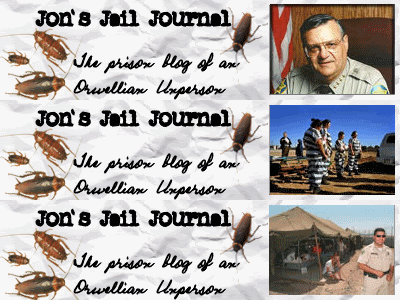
I began this blog in May 2009 following the death of Marcia Powell at Perryville State Prison in Goodyear, Arizona. It is not intended to prescribe the path that leads to freedom from the prison industrial complex.

Rather, these are just my observations in arguably the most racist, fascist, militaristic state in the nation at a critical time in history for a number of intersecting liberation movements. From Indigenous resistance to genocidal practices, to the fight over laws like SB1070 and the ban on Ethnic Studies, Arizona is at the center of many battles for human rights, and thus the struggle for prison abolition as well - for none are free until all are. I retired the blog in APRIL 2013.

Visit me now at Arizona Prison Watch or Survivors of Prison Violence-AZ
BLOG POSTS
Showing posts with label prisoner suicide. Show all posts

Saturday, September 10, 2011

Suicide Watch: Too many prisoners dead.

Today is:


Suicides at the Arizona Department of Corrections, January 2009-July 2011 (Chuck Ryan's tenure):

LinkJan - June 2009 (5 suicides in 6mos):
Angela Soto (MexAmer, 28) Harvey Rymer (W, 33)
Angel Torres (MexAmer, 32) Dung Ung (AsnAmer, 32)
Caesar Bojorquez (MexNatl, 37)

July - June 2010 (9 suicides in 12 months):
Erick Cervantes (MexAmer, 30) Douglas Nunn (W, 33)
Hernan Cuevas (MexAmer, 18) Monte McCarty (W, 46)
Patricia Velez (MexAmer, 24), Jerry Kulp (AfAmer, 17)
Jessie Cota, (MexAm, 28) James Adams (W, 46)
Eric Bybee (W, 32)

July - June 2011 (14 suicides in 12 months):

Tony Lester (NA, 26) Robert Medina (MexAm, 29)
Geshell Fernandez (NA, 28) Patrick Lee Ross, (AfAmer, 28)
Lasasha Cherry (AfAmer, 23) Rosario Bojorquez-Rodriguez (MexNat, 29)
Duron Cunningham (AfAmer, 40) James Galloway (W, 54)
Ronald Richie (W, 42) Susan Lopez (MexAmer, 35)
Michael Tovar, (MexAmer, 20) Carey Wheatley (AfAmer, 49)
Michael Pellicer (AfAmer, 35) Luis Moscoso-Hernandez (MexNat, 28)

In the first 2 1/2 years of his tenure, Chuck Ryan presided over 28 suicides. That's almost one per month. During that time the prison population remained relatively stable - even dropping a bit last year. In the 2 1/2 years that preceded Ryan, under Dora Schriro, there were only 12 suicides - less than 1 every two months.

Additionally, both Shannon Palmer and James Jennings were murdered by their cellies because Shannon and James were psychotic and isolated with intolerant cellies (in Shannon's case, his cellie was also psychotic).

Most suicides occurred in higher security settings and isolation cells - as best as I can tell, all but one of the women who killed themselves in their cells were in some kind of solitary confinement.

Several things that I know of changed when Chuck Ryan took over the ADC that may have affected these outcomes. According to retired deputy warden Carl Toersbijns, almost immediately the policies for how to house certain prisoners together changed (two other prisoners - not mentally ill, were subsequently murdered by cellies), and a suicide prevention program that used prisoners as aides to help identify and support other suicidal prisoners was cancelled, despite the relatively low cost of the program.

I haven't cross-referenced the prisoner population by race and don't have some other stats for before Ryan took over. But the suicides that occurred on his watch are by and large young minorities. The white prisoners (and one African American) who took their own lives tended to be older men facing long sentences for violent crimes; a couple of pedophiles were among them. The youthful ages and minority status of the rest - and the relatively short sentences they had by the time they died - are quite disturbing.

From the data above, I would argue that the mental health of young minority prisoners seems to be taken less seriously than that of white prisoners, across the board.
This is often the case in the "free world", as well - though on the outside, white males tend to have the highest, not the lowest, suicide rates. Minorities, by the establishment, are perceived as dangerous to others more so than to themselves, whether or not an individual's case or evidence exists to support that.

It is not uncommon, though, to find that many prison suicides are by individuals with a history of violence - at least two of the women who killed themselves had a history of assault in prison - which may be why they were in maximum security at the time they died. Unfortunately, maximum security means more isolation and restrictions, not necessarily closer supervision. Punishing prisoners by cancelling visitation and phone privileges seems like a set-up for more anti-social behavior, and undermines the rehabilitative process - two good reasons why the new $25 fee for visitors should have never been imposed, as it will cost prisoners a certain amount of community support and pro-social relationships (which are often so important to maintain to prevent further violence against others or oneself).

A significant number of the prisoners who suicided struggled with a previously-diagnosed psychiatric disorder. The prison psychiatric care is substandard, though, and access to the prison psychiatric facility where serious therapy is done is extremely hard to gain. Susan Lopez, for example, hung herself after two days of begging for help - including psychiatric hospitalization, and being ignored. That goes for most of the states jails, too. Just a week before she did herself in, Susan had been in the Greenlee County Jail where she was brutally strapped into a restraint chair by guards for being agitated on the phone and having a panic attack. She was sent to the hospital for unknown reasons soon after that traumatic incident.

I've heard numerous stories in the past year of how prisoners aren't getting their psychiatric meds, presumably because of the budget cuts. Tony Lester was off all his meds and getting psychotic when he cut his throat. Shannon Palmer and his cellmate, Jasper Rushing, were both seeking protective custody due to their paranoia when they were housed together, and neither - according to their families - were on anti-psychotic medicine at the time Shannon was murdered and castrated. The cell they were placed in should have only held two men for no more than 24 hours, because it was originally built to keep just one man in solitary. Instead, they were kept in that tiny cell together - without light or psychiatric care - for three weeks. When Shannon handed the guards a kite begging them to let him out of the cell with Jasper - just a day or two before he was killed - they simply laughed at him. That kite has not yet been found. I suspect this is typical of how the mentally ill in Arizona State Prisons are treated today.

Carl Toersbijns, the retired DW I referenced earlier, has done extensive blogging on the treatment of the seriously mentally ill in Arizona's Department of Corrections - check out his site here. He's also written quite a bit about alternative programming and policies that may hep reduce both the suicide and homicide rates among prisoners with psychiatric disabilities, while also improving the level of care for other at-risk prisoners. Before retiring, Carl worked in the Supermax, ASPC-Eyman, where many mentally ill prisoners are driven to psychosis and despair in isolation instead of being in a treatment setting; he knows of what he speaks. Unfortunately, the ADC seems to regard him as a traitor for his criticisms, and hasn't picked up on any of his suggestions.

In the face of the criticsm many of us have had about their suicide rates and psychiatric programs, the ADC released the following letter to the Mental Illness and Criminal Justice Commission defending themselves by minimizing our concerns and profiling a token program or two that few prisoners can even qualify for. See that memo here.

Read it for yourself, but there is no good explanation that I can see for why the suicide rates have skyrocketed under this administration - and since they fail to even acknowledge how much they are failing, I'm not optimistic that they will properly analyze those deaths and come up with more effective suicide prevention practices. Rather the memo justifies the policies and practices they currently employ, avoids confronting the possible reasons for high suicide rates, and attempts to marginalize the rest of us from the conversation as being ill-informed or even malicious.
Let me remind folks that Carl Toersbijns has decades of corrections' experience, including extensive work with mentally ill prisoners, and is particularly familiar with Arizona's Special Management Units.


Finally, while the memo argues that Director Ryan implemented programmatic and staffing changes in 2010 to respond to the high suicide and homicide rates (which they wouldn't even really admit to), the data since then shows an even higher body count than before. And in no place in the ADC's response is there a satisfactory discussion of the mental health and treatment needs of women prisoners, who are the most neglected...nor does it explore the stats that concern community advocates by race, crime, custody level, or age. As long as they deny the problems they have delivering adequate mental health care to prisoners, they won't be able to effect meaningful change.

Therefore, as I've done so often lately, I'm urging readers - especially the survivors of these prisoners - to contact Representative Cecil Ash at the Arizona State Legislature. Representative Ash is chair of the House Health and Human Services Committee, which seems to be the most appropriate place from which to organize a legislative investigation into the deaths and the poor mental health care in the state prisons. Ask him to convene legislative hearings into the state prisons (including testimony from prisoners and their families). The legislature has the authority to open an investigation, compel testimony, and bring many more resources to the table than those of us in the community can. Time is running out before the next prisoner takes his or her life, so please put the pressure on now. Rep. Ash can be reached at:

AZ State Legislature 1700 W. Washington St Phoenix 85007

Cecil's email address is cash@azleg.gov - but handwritten letters in the US mail make more of an impact - emails are too easily lost.

If you are the survivor of prison violence, then I'd also suggest that you try to make an appointment with him to advocate for an agency-wide investigation into the practices and patterns that are causing this level of violence and despair in our prisons to grow.
He's a sincere man - very interested in the plight of our prisoners and their families - and will give you the time of day if he has it. The legislature's phone number is 602-926-5999.

Feel free to contact me with any questions - or even criticisms - regarding this post. Blessings and condolences to all of you who have lost a loved one to prison violence, abuse, or neglect. If you want to organize with other such families, please let me know.

Take care,

Peggy Plews
480-580-6807
prisonabolitionist@gmail.com


"Fight Real Power"
Sandra Day O'Conner Federal Courthouse
November 13, 2010
(Phoenix)

Friday, April 1, 2011

Wrongful Deaths in Custody: Susan Lopez (ADC)

(UPDATED from March 29, 2011 post.)

As noted in the last post, a prisoner at ASPC-Perryville killed herself last week. Below is the notice of
35 year-old Susan Lopez' death from the AZ Department of Corrections. What follows is what some of the other prisoners had to say about her suicide. If you are a loved one of Susan's, please brace yourself. I'm sorry if this post is painful, but the public needs to know what's happening behind bars in this state, or more vulnerable people will die needlessly.

Susan was a mother of four children,
and was apparently a Certified Nurses' Aide. By the number of people landing on my site Googling her this week, I'd say she was probably well-loved by people in her community, even though she was ignored by her caretakers in prison, where she was sent for non-violent crimes. Her history suggests that her criminal activity may have been related to the disease of addiction. Most addicts in America never acquire a record for it; many get medical treatment for their illness or join a 12-step program and give a tremendous amount back to their communities. The ones who get criminalized before they get well are less fortunate, not less worthy of recovery, and their lives are often shredded by the excess branding, shaming, exiling, and impoverishment that results from initiating criminal prosecution. It can be completely devastating.

A few extraordinary souls pick themselves up after prison and make good anyway - we like to use them as proof that incarceration itself can "help" people get back on their feet. They are the exception to the rule, however, and it's what they already have within them - not some magic instilled by going to prison itself - that gets them through hell and back in one piece, if they make it. Once caught up in the machinery of "justice", though, too many just never break free. The criminal justice system is designed to extort us and exploit our troubles, not assist us, if we're in the shoes of the accused - guilty or not. Once law enforcement is on the scene we have no control over how it plays out from there; cops have been known to kill people who are suicidal, and courts here routinely hold mentally incompetent defendants criminally culpable for the symptoms of their mental illness.

There are no easy answers for addiction, of course; the ones out there are really as diverse as the population of addicts. I've seen courts be far too quick to take a one-size-fits-all approach and send people off to prison because AA didn't fit them and they screwed up their probation or couldn't pay off their restitution in time. A lot of folks think that the state is actually benevolent and calling the police on a loved one who's addicted might help speed along their recovery process by raising the bottom they have to hit before committing themselves to breaking the cycle, but that's especially misguided because of what I just described. I would only resort to such drastic action today if it was the only way to protect someone's life or limb in a crisis.

Most addicts who land in prison are admittedly there for crimes supporting their habits, too, like theft or fraud. That doesn't make them dangerous, though, or justify the violence of imposing imprisonment on them at outrageous public expense - especially while simultaneously refusing to cover treatment services for them to get well. Once you're a criminal, however, every relapse - which is "part of recovery" for the rest of us - is a potential parole violation or a new charge as a "repeat offender", and as your record gets longer judges get less sympathetic...

All of which appears to have happened to Susan.

Susan's guilty plea is on the internet; the sentencing minutes should be updated and posted soon. Her Graham County sentence is what's in question; that's the one that hasn't been posted as of yet. You can check current court records by searching her name with her month and year of birth (June 1975). She had a whole lot of petty stuff pile up on her in several different counties at once - apparently accumulating over several years then catching up to her once she was in custody.

I think if all her charges were in one county, she would have had more dismissed in a plea agreement; the poor woman was just pounded by court appearances this winter. By the looks of it, the respective county attorneys filed every single charge they possibly could to intimidate her into the deals she entered: she could have been facing the rest of her life in prison for forgery-related crimes if she lost at trial. They really do hurt people who resist them: I know one fellow doing 52 years for fraudulent schemes (largely because he accused the prosecution and judiciary of racism then lost in court).

I find it astounding that the judges who sent this mother off to prison were prepared to expend anywhere from $60,000 to over $120,000 in public funds just to punish her - that's what really seems criminal. Our legislature is equally as complicit. It's unbelievable that given such an investment no one could even bother to sit down to help Susan figure out how long she would be locked up and away from her family. There are sources of possible confusion evident in Susan's posted ADC records - her death notice lists her as being 40 though she was born in 1975, and her obituary indicates a different middle name than her court and ADC records. All the court documents indicate it's the same Susan, though. How hard could it have been to help her sort this out and cope with it? A little bit of attention could have saved her life.

Unfortunately, the nightmare that unfolded for Susan immediately prior to her suicide seems to be the standard MO at the Arizona Department of Corrections, though I've had some good experiences with at least one CO at ASPC-Tucson, and I know there are other exceptions - like former ASPC-Eyman DW Carl Toersbijns. It's not the individual CO's so much anyway - it's the staffing schedules, inadequate training, and an abusive institutional culture that results in deaths like Marcia Powell's, Brenda Todd's, and Susan's. There isn't the expectation that officers respond with compassion to prisoners, of course - they're all just criminals trying to manipulate them because that's what they do best.

If ADC policies and culture reflected a fundamental value for human rights, there would be less abusive and negligent conduct by employees. The leadership makes their disdain for their prisoners clear to all, however, and throws criminals on the legislature's alter for live sacrifices to offer their constituents without thought for the consequences of new fees and restrictions for prisoners and their families - who are also taxpaying constituents, I might add. The description of the main officer who ignored Susan's pleas for help is consistent with what I would expect from the current ADC, sadly.

At most the officer(s) involved might get written up - unless this becomes a politically charged case, and the ADC decides to sacrifice the officer to minimize the appearance of institutional negligence, as was alleged by CO's over the death of Marcia Powell. The pattern and practice of ignoring women begging for help in AZ state prisons is unlikely to change any time soon, then - not without serious litigation, anyway. The state is far more concerned with avoiding liability than it is with taking responsibility, despite the moralistic garbage it shoves down prisoners' throats about why they must be brutalized the rest of their lives for the smallest of crimes.


To Susan's family, on that note: take your time grieving, but file a notice of claim against the state within six months for each survivor, or you'll be precluded from suing in state court in the future. The ADC needs to be held responsible for their neglect; so many women out there are still suffering, and have no other hope for relief. I'll do what I can to put survivors in touch with attorneys who can help file claims for wrongful deaths - there are far too many happening like this. I'll also do what I can to help you compile evidence; that's what I've been doing in these blogs for nearly two years now.

My number is 480-580-6807; my email is prisonabolitionist@gmail.com; my name is Peggy. My office is at 1009 N. 1st St. #8, Phoenix, next to the Firehouse Gallery. Contact me anytime.


Anyone can contact the US Department of Justice to complain about all the prison suicides under Brewer, by the way. Ask for a CRIPA Investigation into the AZ Department of Corrections.


The address is:

Jonathan Smith, Chief

US DOJ Civil Rights Division,
Special Litigation Section


950 Pennsylvania Ave. NW, PHB

Washington, DC 20530


SOS DOJ: CRIPA Arizona.

Dodge Theater, Phoenix, AZ.

Halloween Night, 2010.


-------from the AZ Department of Corrections' website (posted 3/30/2011)-----


ARIZONA DEPARTMENT OF CORRECTIONS
1601 W. JEFFERSON
PHOENIX, ARIZONA 85007
(602) 542-3133
www.azcorrections.gov


JANICE K. BREWER, GOVERNOR CHARLES L. RYAN, DIRECTOR


NEWS RELEASE
For Immediate Release


For more information contact:
Barrett Marson
bmarson@azcorrections.gov
Bill Lamoreaux
blamorea@azcorrections.gov

March 28, 2011 Inmate Death Notification

Phoenix, Az. – Inmate Susan Lopez, 40, ADC #184221, died Friday night from an apparent suicide.

Lopez, sentenced out of Cochise and Graham County, was serving 6 years for forgery. She came to ADC Dec. 2, 2010 and was held at the Santa Cruz Unit, ASPC-Perryville.

The death is under investigation by the department.


-----via personal email, March 26, 2011 re: suicide on Santa Cruz-----


"Perryville - 16 yard: Inmate 184221 LOPEZ Susan died last night by hanging. Was told she was a low risk inmate who was put in 16 yard after returning from going to court.

She had just been brought back to from court where she was sentenced to 3 years concurrent on a charge but the counselor told her the computer said she got 6 years-consecutive. She begged for help and was ignored. Her counselor did nothing to try to get that corrected and would not allow her to talk to anyone about it.

She had been seeking help for several days and begged for help. The counselor did nothing. She asked for help from other officers.

Her husband called to say their daughter was having surgery in the hospital - a family emergency. She tried to get the counselor to let her call home on this emergency. He would not help her."


----received from ASPC-Perryville/Santa Cruz via US Mail on March 30, 2011 (dated 3/28/2011)-----


We must do everything we can to keep this from happening again...


To send Susan's family condolences, visit www.terrazasfuneralchapel.com

Tuesday, March 29, 2011

Perryville prisoner suicide: March 2011.

SOS DOJ: CRIPA AZ.
Sandra Day O'Connor Federal Court House.
November 14, 2010.


***UPDATED March 31, 2011 at: http://arizonaprisonwatch.blogspot.com/2011/03/deaths-in-custody-susan-lopez-adc.html


Another prisoner hung herself out at Perryville last Friday. The department has yet to put up the notice that she even died, for some reason, so I'll wait for them to release her name. I'm guessing they're either still notifying next-of-kin or trying to do some kind of damage control. A lot of people have been Googling her name and poking around my site for news of her, though, so I hope the state puts out the information soon. Once they do, I'll post the notice and fill in the blanks with what little I've been told; it was another case of people just not listening to the distress of prisoners.

I hope the ADC has learned that they need to do critical incident debriefing with affected prisoners or there'll be another suicide out there within a short time; their policies just suggest that they offer counseling to prisoners who ask for it; staff get the debriefing. There have been at least two suicides in the past seven months that were precipitated by another prisoner killing themselves on the same yard: Lasasha Cherry was preceded by Geshell Fernandez at Perryville/Lumley, and Duron Cunningham killed himself at Florence/Central just a week after Rosario Rodriguez-Bojorquez. Both might have been prevented by an intervention after the first suicide.

Just so folks know, if you have a loved one who has killed themselves or been murdered in Arizona's prisons, the best thing you can do to reduce the risk of it happening to the next person's loved one is to hold the state responsible in civil court. Sue them. Survivors must file a notice of claim within six months to take action in state court; don't wait until the last minute.

Contact me at 480-580-6807 if you need help finding an attorney.

Saturday, January 8, 2011

The Highly Preventable Suicide of Tony Lester.

-------------------------------------

Family sues Arizona over inmate’s suicide

by JJ Hensley on Jan. 08, 2011, under Arizona Republic News

Anthony Lester’s life came to an end in July, as Arizona Department of Corrections officers stood around his limp body, unable to stanch the bleeding.

Lester committed suicide in his Tucson prison cell, a medical examiner’s report concluded. His family filed a claim this week against the state, alleging that the Corrections Department’s culture of negligence and indifference to prisoners with mental illness directly contributed to the 26-year-old’s death.

Lester had attempted suicide in late June but was taken off a subsequent suicide watch two days before his death. The state’s investigation shows that officers were confused about where he should have been moved.

The same records indicate that Lester should not have received razors in a hygiene kit the prison provides. A corrections officer mistakenly gave Lester a kit containing a pair of razors that Lester used to cut his throat.

As officers responded to the incident, their statements indicate, they were overcome by the severity of the situation and froze. Their pause was due in part to the fact that officers could not see one of Lester’s hands and feared he might be holding a weapon. The delay was also due to lack of training, said one responding officer.

Orlando Pope, a 13-year veteran of the department, said Lester was “bleeding too heavily” and “he (Pope) was never trained on how to apply pressure to a wound,” according to a department report into Lester’s death.

“Pope stated that he has gone to first-aid training, but he would not call it training, and he does not remember anything about using pressure to stop bleeding,” the report states.

Pope and four other officers were punished with 80-hour unpaid suspensions following Lester’s death, but Lester’s family wants the Department of Corrections to do more.

A department spokesman said the agency had not seen the claim and could not comment.

“I want to help the mentally ill in the prison system. I wanted to be an eye-opener for other people,” said Patti Jones, Lester’s aunt.

The corrections officer who mistakenly gave Lester the kit with razors – and the actions of officers who tried to tend to his wounds – were key factors in his death, the family claims, but it was the prison system’s disregard for Lester’s mental condition that put him in a cell where he could take his own life.

Lester was diagnosed with schizophrenia, and his struggles with mental illness stretched back more than a decade, to when he was still a student at Brophy College Preparatory.

Lester developed a habit of self-mutilation as a teenager and claimed he was blackout drunk during the crime that gave him a 12-year prison sentence for aggravated assault: stabbing two girlfriends at a 2007 party.

Lester went through a program in Maricopa County jails that gave him enough medication to be competent for trial. The trial judge warned that Lester should be in a facility where he could receive mental-health treatment, the claim said.

His medical records indicate he refused to take his medication in prison due to side effects.

Lester’s family claims a lack of adequate training and a culture of negligence concerning mentally ill inmates in the Corrections Department made his prison stint a death sentence.

“We admit that he did something horrifically wrong, but he was mentally ill,” Jones said. “But people I talked to at the prison said he was trying to game the system by claiming mental illness.”

The claim requests $3 million in damages to compensate Lester’s mother and his toddler daughter.

The Arizona Attorney General’s Office was served with the claim but declined to comment.

Friday, December 31, 2010

Death in Custody: Paul Anthony Casteldeoro.

According to the Pima County Sheriff's department, 31 year old Paul Anthony Casteldeoro was found hanging in his holding cell this week in the county jail. They said he had been held there on numerous charges since November 5, but nothing on him has been updated on the court website in years.


Condolences to Paul's friends and family. Please contact me if you want to share any of his story, so I can publish more than just his criminal record.


- Peg

Tuesday, September 21, 2010

Grieving Jessie Cota.

Jesus Cota was a prisoner of the state of Arizona when he passed away January 10, 2010. His death was ruled a suicide by the Arizona Department of Corrections. I've been doing some research into the prison suicides of late, and came up with a few things on Jessie, as he was known. I think it helps the community to know that prisoners have families and complicated lives, too.

First is his AZ Republic Guestbook, where his friends and family have been leaving messages for him since he died. Jessie loved and was loved by a good many folks. There are a few recent entries because it would have been his birthday September 1. These are the secondary victims of incarceration who never get counted - prisoners' families and communities. Here's a sample:

 --------------------------

 August 31, 2010
 
 
September 1st is here..and although theres no candles or cake here today..or presents for you to open I hope you know,and can see that you haven't been forgotten.. And if your looking down and wondering why, it's because you live in the memories of everyone wishing you a Happy Birthday today..Friends, family, everyone..A part of you is always here Jessie and today a little more than any other day your being thought of.. Happy Birthday.. Love Your Friend,"Lola" 
 
 -------------------
January 19, 2010

"Jessie you always reminded me of dad. your laugh just like his and now your with him and pappi.i wish i could have seen you one last time.to hug you and to tell you how much i loved you.and i want to let you know you will never be forgotten you will always be remembered love always your lil sister crystal a.k.a.tutu"

---------------------- 
January 14, 2010
 
DAD I MISS YOU SO MUCH..WHEN I HEARD YOU HAD PASSED.. I WAS VERY SAD BECAUSE YOUR MY ONLY DAD.. ILOVE YOU.. ME AND DAMIEN MISS YOU SO MUCH.. I WONT FORGET YOU AS LONG AS I LIVE NO ONE COULD REPLACE A COOL DAD LIKE YOU.. I REMEMBER WHEN YOU USED TO CALL AND SAY I LOVE YOU ANDDAMIEN.. THANKS FOR STILL BEING THERE FOR ME EVEN WHEN YOU WHERE IN PRISON.. THANKS FOR LOVING MY MOM SINCE YOU GUYS WHERE KIDS.. LOVE YOUR SONS : ALEX COTA, DAMIEN COTA.... 
 
-------------------------------------------
April 08, 2010
 
SON THESE DAYS HAVE BEEN SOON PAINFUL, I LOST MY MOTHER FIRST, THEN MY FATHER, THEN YOU, SO MUCH PAIN IN SUCH A SHORT PERIOD OF TIME. I REALLY DONT KNOW HOW BUT WERE STILL TRYING TO GET THOUGH IT, BUT .WERE STILL TRYING I DONT THINK THAT PAIN WILL NEVER GO AWAY. LOSING THREE PERSON WHO WE ALL LOVED AND MENT THE WORLD TO US THIS PAIN WILL NEVER FADE AWAY. WISH SOMEONE OUT THERE WOULD TELL US WHAT REALLY HAPPEND. ITS HARD FOR ME TO SLEEP, JUST WONDERING WHAT REALLY HAPPEND THAT DAY. I CLOSE MY EYES AND I PICTURE YOU IN THE POSITION THEY SAID YOU WERE IN AND I START TO CRY. WHY SON Y! I ALWAYS LOVE YOU. TAKE CARE OF NANA AND TATA GIVE THEM A HUG FORM ALL OF US. LOVE YOU. LOVE YOU SON FROM YOUR MOM
------------------

June 20, 2010

It's June 20th 2010, and yes today your being thought of Jessie.. "Happy Father's Day".. I know your kids are thinking about you and missing you today as well as everyone else..I've never been one to pray but I pray for you every night and I hope that your at peace... God bless you & sleep with the angels.. Love Always, Your friend "Lola"..
----------And a blessing for his journey--------
January 14, 2010 
 
Jessie,

I remember you as a little boy always eager to read and learn. You were at my house doing your homework when I lived on 27th lane. I had gone to the drug store across your mom house and you wanted to come to my house. You were in the 6th grade and was going to Sutton school. That little boys who had dreams of being a teacher. You liked school so much then. After Tata's passing I found your report card in papers nana saved. You had made HONOR ROLL the whole year!!! I told Gloria I'm going to keep it and then I told her, no I am going to mail it to him. 
 
But a few weeks later here we are now. As I never told you, I want you to know as I watch you grow older and farther apart how I wish you had the glow in your eyes to follow your dreams. How time has change and you change your destiny, but I am sure inside your heart those dreams were still there. We take different path in our lives and sometimes it is not our choosing but for comfort. I pray to God to fill your heart with your dreams in heaven, that were really meant for you here on earth. The plans that heavens has for you will soon be answered. Just reach for the sky and you will find your wings. Forgiviness for what took place here on earth has been answered. God Bless You Jessie, and he will bless you and recieve you with open arms.

Love Tia Nena
 
-----------------------------


The most pressing thing I found, however, is troubling, but shouldn't be discounted or ignored. It's a comment that was buried at the bottom of the Phoenix New Times article that covered Jesse's death. It seemed important to the discussion we've been having about prisoner safety to bring to the surface, where it can be more easily assessed. The allegations appear to be made by someone who knew Jesse pretty well and has the details on how this relationship unfolded in prison. 

Here's an excerpt about the circumstances surrounding Jesus Cota's death (from "karma belief"). I do hope this is being investigated thoroughly:

"...I am hoping to bring attention to this matter, but more than likely this will go ignored or set aside. Below you will find an email I sent to several departments within the AZ DOC. The only response received from DOC is that Warden Larson retired as of 01/08/2010. They couldn't even reply that this was under investigation and they could not comment.

No one has bothered to question the fact that he was assaulted by Officer Apodaca (there were witnesses). Or how odd it is that as soon as SMU learned of the relationship he began with a former guard, he is suddenly found dead and they call it a suicide. Sure it may have been, but with all of the other information, why are there no further questions being asked? What if this had been your son, brother, father, or anyone else important to you? When a person called down there to check on him after he had been trying to reach them that day, why didn't the guard check on him? If he had been having issues earlier, and the person called, why were they told to call back on Monday and ask someone else? Had that guard got up and looked into this, this never would have happened...

(email follows)

How unfortunate yet another inmate has been able to succeed with possibly having committed suicide. What exactly are my tax dollars covering in these facilities? Obviously not education and training...

Let me get to the point. The death notification and news articles state that an investigation is under way. Are you going to do a proper investigation and start from the beginning? Are you going to take this back to the Lewis complex where Jessie was assaulted BY A CORRECTIONAL OFFICER for getting involved with one of the other officers? Where the assault took place AFTER she QUIT her job to be with him? And while DURING the assault, the guard made it clear as to why he was beating Jessie?

 Are you going to go back to Lewis where SSU got involved after she quit and started doing everything they could to cut him off from recreation, where things as simple as a TV were taken from him, where he was cut off from mail, phones, and other family before they shipped him off to SMU? Are you going to look into why he was not being given his mail because the officers at Lewis took it upon themselves to share the letters and pictures he was sent? Again all of this happening AFTER she QUIT working there. They cut him off from the world during the same time his brother and grandfather passed away. During the same time his own children were experiencing hardships in life and he couldn't even contact them.

You may be thinking what this has to do with suicide and SMU... Are you going to look into officers being advised on 01/10/2010 that Jessie was not doing well and needed either attention or supervision? Are you going to look into him being pulled out of his cell for a brief time and then sent right back, all the while no one taking into consideration just how serious his mental state may have been. Why wasn't he placed on watch?

Are you going to look into why there are two versions of how he was found? One states he was found in his cell and the other claims he ran through the door and jumped when it was opened. Do all of your guards open a door and then stand to the side to allow an inmate such freedom of movement? And once again Jessie had been cut off from his family because someone let them know at SMU he had become involved with woman that had QUIT her job at Lewis to be with him. Did she mean that much to all of you?

Are you all satisfied that you not only broke him but cost him his life? And was whatever you were told worth a life? But let me guess, this will go nowhere because anyone that overheard or saw something will be too afraid to come forward. They will be afraid of either being assaulted themselves or losing time with their families. And once again, DOC employees will say either he was just an inmate or had been in trouble so it was to be expected. "
-------------------------------


Anyone who wants to help me fill in some of the blanks about Jessie's life and death, please contact me at prisonabolitionist@gmail.com or 480-580-6807.  - Peggy Plews

Sunday, September 19, 2010

For Lasasha Cherry and her Heroes...

Sasha was the 23 year old woman from Coolidge who ended the pain of this leg of her journey in the custody of the Arizona Department of Corrections on September 6, 2010. According to records from the ADC she had been sentenced there in July 2009, and would have been released within another month or two, had she lived.

She was housed on
Lumley at Perryville, where the maximum security yard is, which is where Marcia Powell (killed when locked in an outdoor cage in 2009) and Geshell Fernandez (the only other woman in ADC custody who appears to have committed suicide this year) resided at the time of their deaths.

Based on minutes retrieved from the Maricopa County Superior Court, Sasha was originally given 10 years probation under an agreement with the Comprehensive Mental Health Probation Court. Her records pertaining to her competency remain sealed, but it appears that she struggle with both a substance abuse disorder and psychiatric disability, and was to be placed in a 24-hour dual diagnosis treatment program through Magellan once she was put on probation.

I don't know what happened with those plans, but Sasha apparently violated probation when charged with a new crime within six weeks, and was consequently sent to prison. Sasha's final sentence took all of six minutes to impose. That was after a process lasting more than a year from the time she was charged with her original crime, during which period it appears she was in MCSO custody (presumably in chemical restraints) where she had to undergo mental health treatment and several rounds of competency exams before being allowed to enter a guilty plea.

In light of that, I suspect that Sasha must have been pretty impaired when first charged. My guess is that the court's primary concern was for her ability to care for her young child, though, if she wasn't institutionalized or successfully engaged in a recovery program. We've got to come up with something more responsible than prison terms for dually disabled moms.

I tried to find out more about who Sasha was this week, other than what the courts had to say, but haven't heard from anyone who knew her, and couldn't afford to subscribe to the paper that lists her obituary. I did, however, find her Myspace page. There's only a page on her interests and some photos there - it hadn't been updated since 2007. But you can see the little boy she adored, Malachi, who was born that spring. Her mother's astonishingly beautiful artwork is there, too, as are a handful of photos of herself, her and Malachi, and her child's father. She shared a lot of herself in that very small space, perhaps the most telling things being that she liked movies that made you think, was a proud parent, and that her heroes "are people that stand by your side no matter what and grab (you) when they see (you) slipen."

Sasha seems to have wanted to do right by her kid, but struggled to because of her disabilities. The last statement of hers, though,suggests that she had some pretty important heroes in her life, who had been there for her many times before. To Sasha's heroes (you know who you are), I'd like to say that I'm sorry for what you're no doubt going through right now. No matter how strong or faithful or courageous one is, sometimes it's just not possible to save those we love from addiction, depression and despair - especially when they are physically out of reach.


I don't know if Sasha received any treatment in prison or what compelled her to take her own life so close to release, though I can certainly empathize with the desperate feeling that one is slipping hopelessly into inescapable pain. I know what it is to long for freedom, and that the most important kind has nothing to do with other people's chains. Most of all, though, I know how it feels to survive a loved one's suicide, so my heart especially goes out those she left behind. I can't imagine the grief that her mother must feel, however, or the confusion and loss her child will struggle through.


I borrowed the photo above from Sasha's Myspace album, since the only other material we had on her life and death were from the ADC. With her mother's permission, I'd like to post the artwork of hers that Sasha so admired. I try to help people understand who ends up in prison in America and how, but I think it's important for visitors here to see more than just prisoner's mugshots and criminal histories, especially when they pass away. They are more than just numbers to be counted three times a day.


Anyone who wants to share more about this young woman's life is welcome to contact me at
prisonabolitionist@gmail.com.

Friday, September 10, 2010

Despair Behind Bars: Suicide in Arizona Prisons


Today being International Suicide Prevention Day, I thought it would be a good time to remember both the victims and survivors of the kind of despair that drives one to take one's life. For some reason, Arizonans are much more prone to suicide than most of the rest of the country. As reported by the Arizona Republic last year:

"Arizona perennially finishes in the top 10 nationally for suicides per capita, according to the National Center for Health Statistics, part of the Centers for Disease Control and Prevention. In 2007, 986 Arizonans died by suicide, twice the number of those who were murdered, according to Magellan. The rate of suicide was 15.9 per 100,000 people; in New York, the rate was 6.9 per 100,000.

Among people with serious mental illnesses, the risk of suicide is roughly six times higher than for people who have not been diagnosed, according to academic research..."
Considering that suicides in this state far outnumber homicides, one has to wonder why we allow life-saving mental health services to be cut each year while we busy ourselves with feeding increasing numbers of people - and public funds - to the criminal justice system.

Because of the nature of my blogs, my focus here has been on prisoners. My Arizona Prison Watch archives are not exhaustive of all prisoner suicides in the state over the past 15 months, but I believe I have accessed all those who were reported by the AZ Department of Corrections. They are as follows:


23 y.o. Lasasha Cherry (9/08/10) ASPC-Perryville/Lumley

28 y.o.
Patrick Lee Ross (8/31/10) Great Plains Correctional Facility, OK (Cornell under contract with AZ)

28 y.o. Geshell Fernandez (7/23/10) ASPC-Perryville/Lumley

26 y.o.
Anthony Lester (7/12/10) ASPC-Tucson/Manzanita

29 y.o. Robert Medina (7/11/10) ASPC-Eyman/Browning

17 y.o. Jerry Kulp (5/11/10) ASPC-Tucson/Minors' Unit

46 y.o. James Adams (3/14/10) ASPC-Eyman/Browning (Death Row)

28 y.o. Jesus Cota (1/10/10) ASPC-Eyman/Special Management Unit

47 y.o. Monte McCarty (12/26/09) ASPC-Eyman/Special Management Unit

18 y.o. Hernan Cuevas (10/10/09) ASPC-Phoenix, Baker Unit

32 y.o. William Englebert (8/22/09) ASPC-Tucson

30 y.o. Erick Cervantes (8/14/09) ASPC-Eyman/Special Management Unit

33 y.o. Dung Ung (6/25/09) ASPC-Lewis

37 y.o. Caesar Bojorquez (6/28/09) ASPC-Eyman/Browning


Another tragic loss this year was the life of 17-year old Presley Austin, who killed himself at the Arizona Department of Juvenile Corrections' Adobe Mountain School in Phoenix in May. By accounts of other kids there, Presley was bullied to death within a week of being placed in a unit with more violent youth after he was in a fight on the mental health unit. His was the first suicide at the AzDJC in seven years.

My condolences to all those loved ones left behind in the wake of these tragedies.

Prior to Marcia Powell's death in May, 2009, notices of inmate deaths were seldom posted at the ADC news site. Now they seem to be pretty consistently updated, regardless of cause of death, which I give Director Charles Ryan some credit for - as far as I know, they don't have to do that.

The high number of prisoner suicides is disturbing, however, and should be investigated more closely, if the ADC hasn't already done so - especially those in the Special Management Unit, where I believe there is a higher concentration of prisoners with mental illness held in solitary confinement. At Perryville, both of the women who suicided were on the maximum security unit, where prisoners with serious mental illness are also frequently held. Theoretically, while it may be a higher-risk population, the environments should be better controlled and the staff should have some specialized training.

The national average for suicides in prisons is 14/100,000. The Arizona Department of Corrections warehouses about 40,000 prisoners at any given time, with about 20,000 new ones replacing those departing each year.

There are several good resources on suicide in jails/prisons in the side column of Arizona Prison Watch. I'd also recommend the following posts/articles, for those interested:
Mentally Ill Offenders Strain Juvenile System

Man's Death in Private Immigration Jail Bares Difficulty of Detention Overhaul

Suicide Among Incarcerated Veterans

The other way we tend to die in custody

Top Ten Places to Suicide: Arizona.


(this post includes a link to a moving slide show of quilt panels made to memorialize suicide victims in Arizona)

Real Lives Loved and Lost: "Criminals" and Suicide.

SOS: Suicide in Massachusetts state prisons.

Teen Kills Himself After Being Put in Solitary for…Trying to Kill Himself

Illinois Youth Prisons See More Suicide Attempts


I should also note that corrections officers themselves are also at increased risk for suicide - far higher than that of prisoners. Two that I know of occurred over the course of the past 15 months. The first was an officer at Perryville prison for women, who shot himself on the prison grounds - along the perimeter - not long after Marcia Powell was killed. The second was a youth corrections officer at Adobe Mountain School in May, the same week Presley died. I'm sure there were more, however, and that all left heartbreak in their wake.

I know far less about the above officer's suicides than I do about the prisoners I've covered, but my condolences go out to their families, friends and colleagues as well. I have also survived the suicide of a loved one - my ex-partner, who was also my friend and colleague through the many years I worked with people who were homeless in Michigan. He sat down in front of a train. Losing him - particularly that way - was devastating to our entire community. I imagine the officers' deaths hit their respective communities hard as well.

This post is for those still here and struggling to survive. Don't give up hope, no matter where you are or where you're heading. Even in prison there is always a role you can play to make this a better world - and we need all the help we can get these days.