THIS BLOG is NOW RETIRED

I began this blog in May 2009 following the death of Marcia Powell at Perryville State Prison in Goodyear, Arizona. It is not intended to prescribe the path that leads to freedom from the prison industrial complex.

Rather, these are just my observations in arguably the most racist, fascist, militaristic state in the nation at a critical time in history for a number of intersecting liberation movements. From Indigenous resistance to genocidal practices, to the fight over laws like SB1070 and the ban on Ethnic Studies, Arizona is at the center of many battles for human rights, and thus the struggle for prison abolition as well - for none are free until all are. I retired the blog in APRIL 2013.

Visit me now at Arizona Prison Watch or Survivors of Prison Violence-AZ
BLOG POSTS
Showing posts with label marilyn buck. Show all posts

Sunday, July 3, 2011

To Be Free: Nina, Marilyn, and Perryville Women's Resistance.


One of the best professors I've ever had, documentary producer HLT Quan, turned me on to Nina Simone during my course with her on Social Movements at Arizona State University a few years ago. Dr. Quan probably doesn't realize it, but she has a lot to do with me embracing prison abolition. I ended up dropping out of school to take all this on, in fact...

Anyway, this tune is to honor the women of Arizona's Perryville prison in Goodyear who have been resisting coercion and abuse of late, and fighting back by speaking out. That not only goes for those prisoners assigned to the Martori Farms work crew, but those who are contesting the poor medical care, writing letters to legislators about conditions, helping other women file grievances, and resisting in a host of other ways - some much more subtle, like teaching another woman to read.

Now, the prisoners can't watch this video, but imagine that just for a few minutes you can commandeer a guard station and the prison communications system. Lock yourselves in, pop open all the cells, crank out a soulful tune, and dance...that would almost be worth the price one would undoubtedly have to pay, once they broke in and took you down for it.

That's just a fantasy to enjoy, women, not advice.

I often play Nina in remembrance of poet and former political prisoner Marilyn Buck - known as "the only white member of the Black Revolutionary Army".
She was sentenced to 80 years for armed car robberies she carried out to fund liberation movements, as well as for the 1979 escape of Assata Shakur from a New Jersey prison. Marilyn and her comrades (see the Resistance Conspiracy) were also prosecuted for the 1983 bombing of the U.S. Senate building.

During her incarceration, Marilyn was known for her continued outspoken criticism of the US government and the prison industrial complex and her advocacy on behalf of other prisoners in addition to her art and poetry. Branded as one of the most infamous women "ter
rorists" of the 20th century, even after 15 years in federal custody Marilyn was considered such a threat that she was thrown into the hole and forbidden to even contact her attorney for two weeks after the attacks of 911, while they investigated any possible connection she had to them.

Because of that - and the officer and guards killed in the Brinks robberies - I never would have expected the feds to release her on parole. Never. What a blessing that they did. Marilyn developed an extremely aggressive cancer and was paroled on compassionate grounds last summer, two weeks before she died. She was always more free, however - even in prison - than most Americans who go through their lives as sheep.

Take some time to check out Marilyn's work
...start with the Wild Poppies CD at Freedom Archives. Here's the title piece...


Wild Poppies

Marilyn Buck

[This poem is read on the CD by Marilyn Buck. MP3 of this poem]


I remember red poppies, wild behind the school house
I didn’t want to be there, but I loved to watch the poppies

I used to sit in the window of my room, sketching charcoal trees
what happened to those magnolia trees, to that girl?

I went off to college, escaped my father’s thunderstorms
Berkeley. Rebellion. Exhilaration!

the Vietnam war, Black Power, Che took me to Chicago
midnight lights under Wacker Dr. Uptown. South Side. Slapped
by self-determination for taking Freedom Wall photos
without asking

on to California, driving at 3:00 in the morning in the mountains,
I got it: what self-determination means
A daunting task for a young white woman, I was humbled

practice is concrete … harder than crystal-dream concepts

San Francisco, on the front steps at Fulton St.
smoking reefer, drinking “bitterdog” with Black Panthers and white
hippie radicals, talking about when the revolution comes

the revolution did not come. Fred Bennett was missing
we learned he’d been found: ashes, bones, a wedding ring
but later there was Assata’s freedom smile

then I was captured, locked into a cell of sewer water
spirit deflated. I survived, carried on, glad to be
like a weed, a wild red poppy,
rooted in life


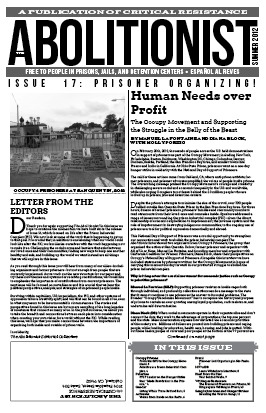
And this was one of Marilyn's last published essays, printed by Critical Resistance's paper, "The Abolitionist" (W2010):


Alternatives While Waiting: Self-Reliance
by Marilyn Buck


A community’s people, with their creative energy and labour, are the greatest resource it has, but an increasing number, mostly young, are MIA, in graves or prisons, into which so many rush obliviously when they act out Hollywood-constructed desires, images, and stereotypes to “make it” in the midst of still-white supremacist and hierarchical America. Far too many have embraced the 30 years of culturally-contrived amnesia that has mis-educated them to believe in the very system that exiles them to the cages. Valuable human beings – community residents, who could have and should have been the teachers, nurses, doctors, mechanics, public servants, and builders of their communities are disappeared.

Among the disappeared and exiled, many haven’t been formally educated or taught to read well, having dropped out or been driven out of the faltering California school systems, weakened both by funding and a general disregard for and animosity towards the children of the working and underemployed classes, particularly when Black, Latino, or Asian. There are a few, if any, educational or rehabilitation-geared programs within prisons. On a recent KPFA radio program, a freed elder pointed out that many of California’s prisons are on lock-down at any given time, meaning that the few programs that do exist, however reluctantly and apathetically, do not function much of the time.

In the prison charnel houses, forgetfulness or oblivion settles like quicklime on the spirit, intelligence and bodies of exiled and illegalized young people. A sense of responsibility to the community is replaced with rage, and beneath any posturing, despair, self-mutilation, and suicide.

Alternatives? To re-imagine communities with the resources to educate children, to provide work with sufficient income, to get drugs and the weapons of collective suicide out, to make the streets safe again for children, elders and the young women and men. This is similar to the 10-point program the old Black Panther Party called for, a program that in slightly different manifestations is still understood world-wide as necessary for community and nations’ health and well-being for peace and justice.

It’s never too later to learn, to get educated or develop the social or political conscience necessary to challenge the systematic social genocide of our communities. No one has to stay lost; no one is not subject to change. The question is: will you change yourself, have a hand in your destiny and development, or will you accept the changes forced at you by the prison systems’ dog-eat-dog programming that wants you to become a gladiator and a puppet?

There are many who are looking for ways to break such a decimating cycle. Meanwhile, what? The prisoner’s alternative is not to wait for alternatives and social change from the outside, but to begin a process of reconstruction on the inside.

To be a builder, or to be a demolisher, those are the choices. It’s easy to demolish, to destroy. You can be a one-man or a 100-man wrecking crew, but to build you have to become a bricklayer, willing to dig foundations, willing to take care of your neighbourhood and work with others. It means being humble and giving back because when you left you took a whole lot of human and community potential with you. It means learning what you need to know. Find a teacher, no matter whether they wear your colours, are your colour, or are low on the ladder of that peculiar prison concept of “respect.” (Prison culture doesn’t really give any prisoner true respect, or better-said, dignity; the man is still pulling the strings.) If you can’t earn a skill you want where you are (like being a doctor or an environmental engineer), learn all you can about the world. Learn about other societies; learn about communities’ fight for self-reliance and self-determination. Learn Spanish, or English, or Chinese. Or history. The more you study about the world, the better able you will be to see where you are and can go in the world. Choose to be on the side of the people who are not the greedy rulers and bosses.

Of course it’s easier to succumb to the haters who want to decimate your community, and to hang with those who participate in the suicide of their own communities through ignorance and individualism. Reignite your creativity and imagination that you may have put aside when you were 14 or that was discouraged in school. There is enough war from without, end the wars from within. Nothing can be build during a civil war, and certainly nothing can be defended from the war from without, without skills, knowledge and dignity of connection to and love for your community. Become a warrior for reconstruction.

Set a premium on education. No one can ever take it from you. Ultimately, knowledge and skills are more valuable than gold and SUVs, or anything you may have possessed for a few brief moments in life, before prison became your home with its prolonged lesson in absence.

Sunday, September 12, 2010

All my friends have FBI files: Policing prisoner support networks.

This heads up to prisoner support networks came today by way of the Freedom Archives' Political Prisoner Newsletter. I lost track of all the watch lists my friends and I should be on by now, but this might be an added motive behind anyone feeling particularly surveilled, harassed, or abusively prosecuted. Apparently if the feds really have it in for the prisoner we correspond with (like Marilyn Buck, whom one likely cop left me a disturbing comment about recently) - they'll just send the local and state police after us, wherever we may be in the world.

It all smacks of COINTELPRO and is probably legitimized under the Patriot Act.
Ironic that anyone would be so worried about our kind of "extremists" in this state - it's the ones holding office who really threaten public safety, not the Anarchists.

I shouldn't really have to say this, but no matter how "innocent" you think are, don't let anyone in uninvited without a proper warrant.


---------------------------------


From: sacprisonersupport@riseup.net
Date: Sun, September 12, 2010 4:16 am

Recently we began receiving documents in response to a FOIA request we filed with the FBI about Eric McDavid. The documents have uncovered a few alarming pieces of information, but one in particular we felt it necessary to share with the public as soon as possible. For years people have been speculating that writing political prisoners would result in a person being “put on a list.” Unfortunately, it seems that those speculations were not unfounded.

We have received perhaps hundreds of pages documenting Eric's correspondence with other people. These letters are not just kept on file ­ the Sacramento County Main Jail forwarded all of these letters to the Sacramento FBI field office, which then forwarded them to local field offices around the country (and to law enforcement internationally) to warn the FBI in other cities of a “possible environmental/ animal rights extremist” or “a possible anarchist extremist” in their community.

Originally, the FBI's communications included a statement that “Sacramento is forwarding this communication for information purposes only.” But later, they began including a much longer statement which read, in part: “this information has been determined to be of such a nature that some follow-up as to the possibility of criminal activity is warranted...” These statements were included no matter what was the content of the letter ­ often the documents include the statement that the letter was “benign in nature.”

It is unclear whether or not the FBI is still forwarding Eric's correspondence to local field offices. We have not received any documents dated after his move to a federal facility. It is also unknown whether or not all correspondence with political prisoners is treated in the same
manner. What we do know is that if a person sent Eric a letter to the Sacramento County Main Jail with their full name and address on it, the local FBI field office more than likely now has that information.

We are not sharing this information to raise alarm or spread fear. We have every intention of continuing to write political prisoners, and we urge others to do the same. That said, we hope to expose the FBI's politically motivated investigations and, unlike the FBI, we believe people have a right to know when they have been spied on. This kind of government intrusion could cause the “chilling effect” so often thrown about in conversations about 1st amendment activities. But when we give in to those fears, political prisoners are the ones who suffer. And this is exactly what the government wants.

The state is constantly trying to expand its reach by gathering information about social movements and those who participate in them. Instead of letting this new information scare us
into silence, we should use it to make informed decisions about how we support and prioritize political prisoners. This kind of repression has implications for more than just people involved in “activism.” Millions of people are incarcerated in this country. It is possible that the government uses similar tactics to investigate other communities that they actively repress. Writing our friends, family members and comrades should not be a justified excuse for investigation ­ no matter who our friends are.

If you would like to view some of these documents, you may do so at:
http://www.indybay.org/newsitems/2010/09/12/18658489.php

If you would like to find out if the FBI has been collecting information
on you, here is a website that explains how to request information under
the freedom of information act.

http://www.firstamendmentcenter.org/press/information/topic.aspx?topic=how_to_FOIA


Freedom Archives
522 Valencia Street
San Francisco, CA 94110

415 863-9977

www.Freedomarchives.org


Questions and comments may be sent to claude@freedomarchives.org

Thursday, August 26, 2010

Inside Shadows: Memorial for Marilyn Buck, NOV 11.

This comes from the SF Chronicle via Marilyn's friends in the Phoenix Anarchist Coalition. Maybe we should host a memorial here, too.

--------Women Prisoner News: Marilyn Buck obituary in SF Chronicle-------

A memorial gathering will be held on November 7th from 4-7 at the First Unitarian Church, 685 14th St., Oakland. Additional ones will be held in Texas, New York City, and Puerto Rico; details will be posted on www.marilynbuck.com.

On Tuesday, August 3, 2010, long-time U.S.political prisoner and acclaimed poet Marilyn Buck, 62, passed peacefully at her home in Brooklyn. On July 15th, several weeks before the date originally set for her release, Marilyn had been released from the federal Bureau of Prisons medical facility in Carswell, Texas and paroled to New York. Marilyn served 25 years of an 80-year prison sentence for politically motivated actions undertaken in support of self-determination and national liberation and in opposition to racial injustice and U.S. imperialism. Throughout her years in prison, Marilyn remained a steadfast supporter of fellow political prisoners and an advocate for the women with whom she was imprisoned.

Marilyn became involved in the civil rights and anti-war movements and joined the Students for a Democratic Society during her college years and became an active supporter of the Puerto Rican, Native American and Black liberation struggles in this country. She was a consistent and outspoken advocate for the liberation of women and gay liberation.Marilyn was incarcerated in Dublin, California for 15 years, during which time she earned a Bachelor of Arts in psychology and Master of Arts in poetics. Her poetry and essays have been printed in a wide variety of journals and books. A new collection of her poetry will be published next year under the title "Inside Shadows."

In 2009, Marilyn was diagnosed with an aggressive form of cancer; treatment came too late to save her life. Marilyn is survived by three brothers, three sisters-in-law; cousins, nieces and nephews; her friend and attorney Soffiyah Elijah, and other loving friends worldwide. A memorial gathering will be held on November 7th from 4-7 at the First Unitarian Church, 685 14th St., Oakland. Additional ones will be held in Texas, New York City, and Puerto Rico; details will be posted on www.marilynbuck.com.

http://sfgate.com/cgi-bin/article.cgi?f=%2Fc%2Fa%2F2010%2F08%2F22%2FMNBUCKMARI6.DTL

This article appeared on page Z - 99 of the San Francisco Chronicle © 2010 Hearst Communications Inc.

Saturday, August 14, 2010

Decimas para Marilyn Buck: Carlos Quiles.

Thanks to Freedom Archives for putting this out where we can find it.

-----------------------

En Memoria Marilyn Buck
Emacs!

Sentada al frente Marilyn Buck, detras las hermanas Lucy y Alicia Rodríguez

Ida Luz Rodríguez
Especial para CLARIDAD

Se nos ha ido nuestra hermana y compañera Marilyn Buck. Pasó a otra vida el 3 de agosto rodeada por el profundo amor de amigas y amigos quienes dieron testimonio que Marilyn enfrentó la muerte de la misma manera que vivió la vida, con amor y valor.


En 1985, Marilyn, fue sentenciada a 80 años de cárcel por su incansable defensa del derecho a la dignidad y libertad de los seres humanos. Luchó contra la injusticia, el racismo y el colonialismo que tanto daño le ha hecho a la humanidad y la naturaleza. Durante sus 25 años en cárceles del gobierno de los Estados Unidos logró engendrar solidaridad, amor y respeto internacional.


Al final de 2009, Marilyn fue diagnosticada con un sarcoma uterino, un cáncer poco común y muy agresivo. El 15 de julio de 2010, fue excarcelada del centro médico carcelario en Carswell, Texas y vivía en Brooklyn, Nueva York en la casa de su entrañable amiga y abogada Soffiyah Elijah. El ser que fue Marilyn caló profundamente en mi corazón y en el de mi hermana Alicia. Nosotras como prisioneras políticas compartimos momentos muy importantes con la compañera. Su humanidad y brillantez nos sirvió como una luz.


Alicia y yo pensando en Marilyn nos acordamos de un domingo, 5 de septiembre de 1999 en la cárcel en Dublin, California cuando todavía estábamos dialogando y reflexionando sobre si aceptar o no la oferta del Presidente Clinton. Esa mañana nosotras nos encontrábamos frente al televisor mirando el programa Meet the Press con un moderador y tres invitados. Uno de los panelistas fue el congresista puertorriqueño Luis Gutiérrez quien bravamente enfrentó la cólera y el racismo de los otros panelistas enfurecidos con la oferta del Presidente Clinton. Ya habían pasado casi tres semanas de una gigante ola de represión y racismo desatada por gran parte de los medios noticiosos y represivos que buscaban las formas de impedir nuestra salida de la cárcel.


Como puertorriqueño Luis Gutiérrez sintió el impacto racista y peligroso de las palabras de los panelistas, miró fijamente la cámara, y dijo “que salgan ya”. Nosotras entendimos que se dirigía a nosotros los prisioneros políticos. Marilyn, Alicia y yo entendimos que había fuerzas poderosas que buscaban mantenernos encarcelados costara lo que costara y que la salida nuestra de la cárcel sería una victoria para la nación boricua. Nos acordamos que Marilyn nos miró y nos dijo ustedes no pueden negar la oferta. Tienen que salir ahora. Esas palabras nos tocaron el corazón porque sabíamos que ella se iba a quedar encarcelada.


De nuevo pensando en Marilyn nos acordamos del 10 de septiembre, día de nuestra salida de la cárcel. Alrededor del medio día nos despedíamos de las compañeras de prisión cuando oí un profundo llanto. Pregunté quién lloraba y las mujeres me dijeron es tu hermana Alicia. Había muchas mujeres dándonos la despedida así que no podía verla. Luego Alicia me dijo que el llanto fue producto de una profunda indignación que sintió porque no salían todos los presos políticos particularmente Carlos Alberto Torres, Oscar López Rivera y Haydée Beltrán. Mi hermana sintió un estado de paralización del cual se percató Marilyn y fue ella la que agarró a Alicia y la movió hacia la puerta y afuera la llevó hasta el lugar donde nos procesaron antes de salir de la cárcel. Para Alicia, Marilyn fue su puente hacia la puerta de salida de la prisión. Ésa fue Marilyn Buck. Tuvo un corazón noble y muy bravo.


El testimonio del compañero Carlos Quiles surge de su encuentro con Marilyn a través de la poesía, llamadas telefónicas y cartas.

Décimas para Marilyn Buck

Compañera, para ti
una décima criolla,
la más genuina, que apoya
lo más genuino de aquí.
Del terruño el frenesí
en humilde convivencia,
del campo la luz, la esencia,
los olores mañaneros
y los nocturnos luceros
testigos de tu conciencia.

Es que te siento tan nuestra,
tan nacional, tan cercana,
tan genuina, tan hermana,
del isleño amor la muestra.
El sentir patrio demuestra
lo que tú me has demostrado,
tú eres surco que el arado
ha abierto de libertad,
tú estás en mi vecindad,
tú eres boricua a mi lado.

Yo no quisiera llorar
pero tengo atragantado
tu sentimiento que ha dado
tanto, tanto por amar.
Yo no quisiera mirar
con mis ojos lagrimosos
esos tuyos tan hermosos
más no puedo contener
la rabia ni el llanto al ver
lo que te causó el acoso.

Con los brazos de esta tierra,
Marilyn, quiero abrazarte,
compañera, y quiero darte
todo el amor que ella encierra.
Tú eres patria, nuestra, guerra
por nuestra liberación
ajena a nuestra nación
ante los ojos del mundo,
presente en cada segundo
de nuestra revolución.

Tú eres la décima mía,
la de Llorens y Virgilio,
eres extranjero idilio,
tú eres cercana alegría.
La octosilábica via
para cantar nuestra historia,
tú eres lucha, eres memoria,
eres canto libertario,
eres fusil necesario
para llenarnos de gloria.

Marilyn Buck, compañera,
reconozco tu presencia,
tu lucha y tu consistencia
y tu entrega siempre fiera.
Esa voluntad sincera
que se acercó a mi nación
fue un acto de devoción
y de solidaridad
y apoyo a la libertad
desde lejana prisión.

Maravillosa mujer,
que mi patria te conozca
y que en tu ser reconozca
lo valioso del poder.
El poder de poder ser
en valor y sacrificio
chispa y fulgor, el indicio
que siempre estará presente
en las manos de la gente
para ser del fuego inicio.

Una décima sencilla,
una décima de amor,
una décima cual flor
que representa a mi Antilla.
Para tí, la maravilla
de mujer universal,
para tí ese cideral
espacio de gloria eterna
en la décima más tierna
de nuestro espacio vital.

5 de agosto de 2010


Freedom Archives
522 Valencia Street
San Francisco, CA 94110

415 863-9977

www.Freedomarchives.org


Questions and comments may be sent to claude@freedomarchives.org

Tuesday, August 3, 2010

Be Strong: Marilyn Buck dies free.

I just learned that my favorite poet and revolutionary, Marilyn Buck, has passed away from cancer. She was exceptionally gracious and kind to me at a very difficult period in my life when we corresponded, speaking nothing of her own illness. That selflessness was characteristic.

Here is a roundabout link to her friend Mariann Garner-Wizard's beautiful photo album, where I first came across the news. Once there is more information out there about her, I'll post it. Check the Rag Blog first for updates - I'm posting Mariann's note about her today from there below.

If you have or know of a spot on this planet where Walmart will never build, please plant a tree in her memory - and help a prisoner. Then join us, if you can, in Arizona's streets, or boycott this place completely. There must be no more business as usual. If this fascism isn't stopped here, it spreads across the country like a virus. It has already.

Blessings, Marilyn. Thank you for sharing your freedom with us all these years. May you always dance.
---------------------------------

Mariann G. Wizard : Poet/Political Prisoner Marilyn Buck Dies in New York Hospital

Marilyn Buck was released from prison July 15, 2010.

Recently released from Texas prison:
Cancer takes poet Marilyn Buck


By Mariann G. Wizard / The Rag Blog / August 3, 2010

AUSTIN -- Friends of long-time political prisoner, former Austinite, and acclaimed poet Marilyn Buck, 62, were saddened by news of her death in a New York hospital early Tuesday, August 3.

Buck was released from the federal prison medical center in Carswell, Texas, July 15, 2010, and was paroled to New York City.

Buck served 25 years of an 80-year prison sentence for politically motivated crimes undertaken in opposition to racial injustice and U.S. imperialism. As a prisoner, Marilyn, while moderating her ideas about methods, continued to stand tall for her beliefs.

A selfless advocate for others, especially in the arena of prison medical care, Marilyn was diagnosed late last year with a uterine sarcoma, a rare and aggressive cancer, too late for treatment to save her life.


Marilyn Buck was the recipient of funds raised at a June 25 benefit in Austin hosted by eight local groups, including NOKOA the observer and The Rag Blog, and supported by many businesses, artists, poets, and compassionate individuals.

While attending the University of Texas at Austin, Buck became involved in the civil rights and anti-war movements, and worked with SDS and the underground newspaper, The Rag. In the following years she became increasingly committed to and active in support of the black liberation struggle in this country.

Buck is survived by three brothers; several cousins; her long-time counselor, Jill Soffiyah Elijah; and loving friends worldwide. Her parents, Dr. and Mrs. Louis Buck, who both pre-deceased her, were leading civil rights activists in Austin in the early 1960s.

According to sources close to Marilyn's family, there will not be a funeral, but memorial gatherings will be scheduled in the future in New York City, in California's Bay Area, and in Texas. Funds raised for her hoped-for transition to the free world that had not been dispersed at the time of her death will be used according to her wishes to assist other aging prisoners.

The size of the U.S. prison population guarantees that increasing numbers of those released after lengthy sentences will lack savings, health insurance, or the network of friends from all walks of life that sustained Marilyn -- and benefited from her generous, principled spirit -- throughout her years behind bars.

Youth Emergency Service, Inc., fiscal sponsor for last month's Austin benefit, will continue to accept tax deductible contributions through PayPal at its website, or by check or money order, made out to YES, Inc., at PO Box 13549, Austin, TX 78711.

Also see:

Tuesday, July 20, 2010

Africa Today with Marilyn Buck

What an amazing woman. Click on the KPFA icon for the interview (mp3 file). There's also an interview with her attorney, Jill Soffiyah Elijah (a pretty incredible woman herself) at the website for the Friends of Marilyn Buck.

After all that, you should head over to kerspledebeb to sample the CD of her poetry from prison, Wild Poppies. She reads a handful herself, but most are read by other people from around the world who were themselves political prisoners. My favorites are probably "Thirteen Springs" and one that isn't with the samples, "To Vieques, in Solidarity" (which is read in both English and Spanish - the Spanish version is the most beautiful).

Finally, I'm so sure that you'll want to buy a copy for yourself - and a couple to have on hand as Christmas gifts - that I'm giving you that link too. Enjoy.

Thursday, July 15, 2010

Back from Exile: Marilyn Buck is FREE!!!

This is the best news I've had in a long while, and came to us just moments ago from Vikki Law, who wrote the book on women's resistance in prison...today is truly a day to celebrate freedom.

Welcome Home, Marilyn. It's about time.


---------------------------------------------------


Activist, Poet, Writer, Translator, Teacher


Former Political Prisoner Marilyn Buck Freed!!!

On July 15, 2010, Marilyn Buck was released from the federal prison medical center in Carswell, Texas. She is paroled to New York.

More news will be posted on http://marilynbuck.com/ as it becomes available.

Wednesday, June 30, 2010

Friends of Marilyn Buck update: June 2010.

Here's an update on Marilyn Buck's battle with cancer, from The Friends of Marilyn Buck via the Rag Blog. Her report on her health care experience is heartening, and her friends seem to have a good grip on how best to help. Here's the bottom line (literally) from the Rag Blog about how to donate even if you missed the benefit.

"To make a contribution to Marilyn Buck’s support, please send your check or money order to YES, Inc; PO Box 13549, Austin, TX 78711, with a note that it is for this purpose. Contributions are tax-deductible to the extent allowed by applicable tax law."

Blessings to Marilyn, and thanks to the folks at the Rag Blog.

- Peg


-------from the Rag Blog-----------

(visit link for full story on the benefit held for Marilyn in June)


See Warrior-Poet Marilyn Buck: No Wall Too Tall by Mariann G. Wizard / The Rag Blog / May 19, 2010 (great article!)


And listen to Thorne Dreyer's interview with Robert King and Mariann Wizard on Rag Radio / June 22, 2010

The Rag Blog's Mariann Wizard (left) with Marilyn Buck at Dublin FCI in 1996.
Marilyn Buck's bout with cancer

[The following update on Marilyn Buck's condition comes to us from Friends of Marilyn Buck.]

Marilyn has received her last chemo treatment at the hospital and is now back at the prison, receiving palliative care. She has undergone as much chemo as her body can tolerate. She feels that her medical care has been similar to what she would be getting in the free world, and that her doctors have been both competent and respectful of her. She is also receiving support from her sister-prisoners who are able to visit with her.

She's been having very good visits with her family, and continues to feel the love and support of so many people who are meditating with her, sending her cards and generally keeping her in their thoughts.

Every effort is being made by her attorney to secure an early release. Marilyn asks that people not initiate their own letter-writing or phone campaigns for her release, as these are likely to be counterproductive. Should the situation change and such a campaign be deemed helpful, we'll let everyone know right away.

In spite of the serious situation she faces, Marilyn's spirits remain incredibly strong and her energy is focused on coming home to be with the people who love her.

Sunday, June 20, 2010

Marilyn Buck: State of Exile.

From the Friends of Marilyn Buck, who is fighting cancer in federal prison. She's an extraordinary poet and translator (see State of Exile by Cristina Peri Rossi), and a sharp essayist. The article this links to at the Rag Blog is awesome. Note Marilyn's address change below, and drop her a card of encouragement and blessings. She is supposed to be paroled in August: show them how big and caring her community is.

Hit this page on her friends' site and listen to an interview with her attorney, Professor Jill Soffiyah Elijah, detailing Marilyn's history, prosecution, and experiences as a political prisoner. Professor Elijah has represented many of our freedom fighters and political prisoners over the years...

----------------------

Political Prisoner, Poet, Writer, Translator, Teacher –

Free Marilyn Buck!

Photo  of Marilyn 2000

political prisoner

Marilyn Buck began her antiracist activism as a teenager in Texas. As a college student, she organized against the war in Vietnam and in solidarity with the Black liberation movement. “After less than a decade as a political activist,” she writes,“I went to prison, convicted of procuring firearms for the Black Liberation Army. I faced 10 years in prison—a very long time for a young woman."

After serving four years, Marilyn was granted a furlough from prison and did not return. She spent the next eight years in clandestinity. Marilyn was recaptured in 1985. In addition to charges related to Assata Shakur’s escape, she was convicted of conspiracy to protest government policies (the invasion of Grenada and military intervention in Central America) through the use of violence against government property. Her total sentence was 80 years.

poet, writer

“The trials, those years of intense repression and US government denunciations of my humanity had beat me up rather badly. Whatever my voice had been, it was left frayed. I could scarcely speak.” Instead, Marilyn wrote. “For prisoners, writing is a life raft to save one from drowning in a prison swamp. I could not write a diary or a journal; I was a political prisoner. Everything I had was subject to investigation, invasion and confiscation. I was a censored person. In defiance, I turned to poetry, an art of speaking sparely, but flagrantly.”

Marilyn’s poems can be found in many collections, in her chapbook, Rescue the Word, and on her CD Wild Poppies. She has been awarded three prizes by the PEN Prison Writing Program, including first prize for poetry in 2001. Some of her poems are online here.

translator, teacher

Marilyn has long translated for Spanish-speaking women held in prison, and she is now translating Spanish literature to English. In 2009 City Lights published her translation of Uruguayan poet-in-exile Cristina Peri Rossi’s extraordinary collection, State of Exile. Read more about her publications.

She has also taught writing, GED preparation, history, and yoga inside.

imagination

One of more than 100 political prisoners in the United States, Marilyn is proof that imagination and solidarity can’t be stifled, no matter how many prisons or patriot acts we face.

her address is:

MARILYN BUCK 00482-285
FMC CARSWELL
P.O. BOX 27137
FORT WORTH TX 76127

more

Read a recent profile of Marilyn by a long-time activist friend at Austin's Rag Blog.

Monday, March 8, 2010

Women's Day: Prisons and Social Control, M Buck.

Remember our Sisters in Jails, Prisons, and Detention Centers today. Celebrate Women's Resistance! International Women's Day, March 8, 2010.
------------------------

This is another post I actually dropped in the draft bin yesterday AM after preparing, too exhausted to finish edits. Still am, so it's pretty raw. It's really going on Tuesday morning now, so the rest of these I'm backdating to get them in under the 8th of May entries.

This, like the article below, was on Women and Prison: A Site For Resistance.

Marilyn is an extraordinary poet, an astute political theorist, a patient correspondent, and probably a very busy mentor to other women at FCI-Dublin trying to figure out how they're going to face three or five or ten or twenty more years inside. I don't think Marilyn has ever claimed to have all the best answers to that, but she's been held as a political prisoner for some 25 years now, and still has a brilliant mind and an intact soul.

And a way with words.

You can read a little more about her politics - and catch some of her poetry and a few more good essays - on the Prison Activist website - I won't go into all that, since I tend to get myself into trouble talking revolutionary politics - and sure don't want to cause her any trouble. Besides, most of it's probably over my head. I learned from a brief period of corresponding with Marilyn to try to be more patient and reasoned in my dealings with the state; more deliberate and thoughtful in how I use words. I do get carried away when I've got my fighting voice on, though. I do a get a bit agitated and excited about things when I'm writing - I think that has something to do with why I blog.

I also saw quite clearly in the few months we were connected that although Americans show a careless disregard for human life towards prisoners - failing to assure that even their basic health and safety needs are met - it's not because we cast them to our social garbage heap. They've been behind enemy lines in the hands of far less restrained interrogators than probably most people asking questions at Guantanamo. And we can't even imagine what kind of technology and drugs they employ that haven't been talked about quite like water-boarding has.

They do still mind-fuck political prisoners, though, and our elders have hardly become irrelevant over time. So many are in for life or some absurd number of years that they can do all sorts of long-term studies on how revolutionaries can be worked on over time, what kind of stressors they can tolerate, what illnesses or pathologies they develop as a result of manipulating sleep, diet, movement, stimulation, human contact, and so on. Why do some respond only to violence, others to the threat of it, and some to neither threat nor the use of pain and force? How and where are they most vulnerable? How are men and women different?

We're at war, of course. It's a "war on terror", which is the war on the world's poor and revolutionaries cranked up a few notches, so far as I can can tell.. Our own political prisoners, by and large, have been prosecuted for domestic terrorism; that makes them particularly interesting to counter-terrorism experts - especially those who still won't abandon their politics after all these years. I'd be surprised if there wasn't a team all this time between the BOP, DOJ, DHS, assorted forensic psychiatrists, and Military Intelligence, working on how to to break people like them. Marilyn and her comrades never turned on each other or abandoned the movement (one guy who wasn't too tight turned on them, that's it).

Anyway, there's a benefit coming up in Oakland for Marilyn's release fund - yeah, her RELEASE FUND! She's really is coming up for parole this year. Hit the Sparks Fly Benefit flyer above if you'll be able to head that way Saturday, March 13. If I had a vehicle I thought would make it, I'd take a road trip to Oakland for this. Several former political prisoners will be there, like Angela Davis and Laura Whitehorn - really brilliant thinkers and activists in the anti-racist, anti-imperialist, prison abolition communities.

With that, here's a glimpse into what's it's like to be a political prisoner of the American State...

-------------------------

Prisons, Social Control and Political Prisoners

Marilyn Buck

January 1999

Increasingly, the globalization of markets and profit-seeking has pressed U.S. prisons to become profit-generating enterprises - the prison-industrial complex. Nevertheless, prisons continue to serve their main purpose as well: to warehouse and disappear the "unacceptable." Prisons exist to deprive their captives of their liberties, their human agency, and to punish. These institutions stigmatize prisoners through moralistic denunciations and indictments based on bad genes - skin color as a crime. The law — a political institution in itself — provides the framework for the war of social control against oppressed nations, working classes and non-compliant women.

The vast majority of prisoners are not imprisoned because they are "criminals," but because they've been accused of breaking one of an ever-increasing number of laws designed to exert tighter social control and State repression. They have been scapegoated and criminalized. This can be seen in the increased number of Black, Latino, Native American and Asian youth detained under youth-crime acts and "anti-gang" laws; the number of foreign nationals (excluding most Europeans) imprisoned under hate-mongering immigration laws; and of course, the "drug" war in which hundreds of thousands have been kidnapped from their communities, even from other countries. These sweeping laws embody and embolden U.S. capitalist policies to criminalize and decimate targeted populations and to sustain a hostage Third World and white working-class wage-labor force behind prison walls. Most prisoners, by virtue of their ethnicity and class, are victims of ethnic-cleansing policies — death deferred to incarceration.

There are other "undesirables" as well: those who have consciously, politically resisted, opposed - even attacked - the injustices and inequalities of this State system of social control. These prisoners are political prisoners, historically among the most feared and despised by those who wield State power. In the 1950's, COINTELPRO (the Federal COunter INTELligence PROgram) was created. (1) It employed dirty tricks, disinformation, militarized police agencies and assassination in its political war against the national liberation, anti-imperialist and pro-socialist forces. Imprisonment was also, and continues to be, one of its weapons against political activists.

The State shows little mercy to its political enemies. The case of Mumia Abu-Jamal is a current well-known example. He was denied even a modicum of a fair trial, under more "liberal" standards than exist in this period. Geronimo ji-Jaga (Pratt) and Leonard Peltier were both framed for murders by Federal and local COINTELPRO forces. Geronimo was freed after much struggle and 27 years. Leonard is still in prison. Assata Shakur was convicted of a police killing she could not have done and is only free in exile. More than a few political prisoners remain imprisoned for nearly two decades and some for nearly three decades - the Angola Three, the New York Three, Black Panthers and New Afrikan militants, Puerto Rican independentistas, North American anti-imperialist solidarity fighters, and other comrades. To be a political prisoner is neither a comfortable nor a privileged situation. To remain committed to one's beliefs and principles exacts a heavy price. Political prisoners in New York state prisons are rarely held in the same prison. Many have spent years, even a decade, in isolation control units for no other reason than their political association and "political crimes." Many have been denied health care for security reasons. Enemies of the state are deliberately targeted, subject to continual surveillance. The State is determined to destroy us. On purpose. Not merely because the prison system is a vehicle of equal-opportunity punishment and casual cruelty that is by its very nature crushing the life and breath from its victims and hostages.

To be a political prisoner is not a matter of standing higher in a "hierarchy" of prisoners. Where one stands is a matter of consciousness, not of social status or privilege. It is a placement based in political practice and international law. A U.S. court has even noted that "crimes" must be looked at differently when carried out in furtherance of a political struggle against a State. There are both pure political offenses (like sedition) and relative political offenses. These include "otherwise common crimes committed in connection with a political act, or common crimes committed for political motives or in a political context." (2) The court goes on to say in relation to political status and international law:

It is the fact that the insurgents are seeking to change their governments that makes the political offense exception applicable, not the reasons for wishing to do so or the nature of the acts by which they hope to accomplish that goal. (3)

As well there are some social prisoners sucked into the prison machine who have become conscious through the daily, punishing repression, brutality, racism, and injustice. These comrades, men like George Jackson, Ruchell Magee, Hugo Pinell and many others, stepped beyond their social offenses and kidnapping-victimization, beyond the individualism demanded by the prison system to challenge the system consciously, as self-determining protagonists. They became enemies of the State, subject to that specific jacket and treatment for political prisoners. Comrades such as these are murdered by the prison or languish in control unit prisons for decades as well.

Political prisoners come from their communities, become conscious. Part of that consciousness is understanding that we are from the community of oppressed and exploited. Many political prisoners were active in opposing the prison system long before we ever imagined that we would end up prisoners. Many continue to work against concentration kamp USA once released. The injustice and inhumanity of the prison system are only logical extensions or conclusions of the overall inequalities of the entire system. We oppose cruelty, brutality, and inhumanity in the system and in our communities.

There will be more political prisoners as it becomes more imperative to resist the rapacious, human-eating system, as our social and political movements grow stronger and challenge more directly globalization, capitalism, and the increasingly militarized police state. After all, the State is more invested in social control than ever. (It was caught off guard in Seattle at the anti-WTO demonstrations but reacted in a predictable manner.) What will be the destination of the 60 people still being charged there in Seattle? What about the young activist given a seven-year sentence in Oregon for throwing a rock in an anti-WTO demonstration last summer? Or Khalil Jacobs-Fantauzzi, the Puerto Rican comrade who was the only person to face trial after demonstrations against corporate seizure of KPFA radio in Berkeley last summer? Khalil is an anti-prison activist and played a leading organizing role in California in the campaign to free the Puerto Rican Prisoners of War and political prisoners. (He was acquitted after taking his case to trial).

Many social and political activists have escalated their work in support of prisoners and to challenge the brutal slave-labor prison establishment. This growth was reflected in the timely, qualitative conference of Critical Resistance in Fall 1998. The work of activists contributed to creating the conditions in which Amnesty International at last issued a report on human rights in the U.S., in the face of U.S. power and imperial pronouncements that it is the godfather of democracy and human rights. Prisoners in even the deepest of holes are feeling some hope despite the downward spiral of inhuman treatment and increasing demonization.

Yet in the midst of this rise of activism, there seems to be a reticence to support political prisoners and Prisoners of War, or a tendency to say that there are no differences in consciousness, or roles of prisoners - for example, "all prisoners are political prisoners" since imprisonment is a political policy. (4) Some pamphlets about prison support work include "support for political prisoners and POWs" but little about who we are or why we should be supported as part of prison activism. Surely supporting political prisoners is not an impediment to the real work of opposing the prison establishment or fighting for more humane conditions. We, too, experience the full range of repression. We are here because we have challenged that social repression!

At times it seems the hesitance to support is precisely because of our politics, our political consciousness and actions. Perhaps the conscious, relative political "crimes" we have been charged with committing conflict with some people's own political strategies. But should we as a movement not encourage consciousness, and self-determining, creative and collective protagonists in the struggle for human dignity and rights?

There is always room to debate politics, points of view, strategies and tactics. To confront differences and questions is a good thing. Any struggle for liberation demands free and open debate of ideas and practice. At the same time, active struggles need to support those who act consciously, politically. To do so is a part of asserting the right to struggle as well as to defend activism and promote stronger resistance to the military, financial, and political apparatus that denies our society and the whole world true equality and justice.


Footnotes

1 See Ward Churchill, Agents of Repression: The FBI's Secret Wars Against the Black Panther Party and the American Indian Movement, (South End Press, 1988) and Ward Churchill, Jim Vander Wall, COINTELPRO Papers: Documents from the FBI's Secret Wars Against Domestic Dissent, (South End Press, 1990).

2 Quinn v. Robinson, 783 F. 2d at 793-4.

3 Quinn v. Robinson, supra at 805.

4 I will not discuss here whether socially conscious, politicized prisoners are the political prisoners of the prison world. That is another issue and a different article, but the question is a good one. To assert that position would be to ask whether all socially/politically conscious prisoners in the prisoner community would be denominated as political prisoners or whether only those who are repressed because of that consciousness would be included. For instance, there are several politically conscious women here (anti-state) who have populist though not explicitly racist politics. I would not call them political prisoners from the Left, but they are likely so from the Right. Ultimately, there are no hard lines. However, criteria exist based on who is doing the supporting work in the field of common law and international agreements, which is my main point.


This article was written following the Critical Resistance conference, Berkeley, 1998 and submitted to Social Justice. It was published in slightly different versions in Crossroad, Vol. 9, No. 3 (Fall 2000) pp. 18-20, and in Critical Resistance to the Prison-Industrial Complex, a special issue of Social Justice: A Journal of Crime, Conflict & World Order, Vol. 27, No. 3 (2000) pp. 25-28 (as edited by their respective editors). Reprinted here with the author's permission. Copyleft — permission to reprint is freely granted to non-profit organizations provided it is reprinted in full.


Back to Marilyn's home page, with more poetry, writings on prison control units, on "Legal Issues for Women in Federal Prison," and "On the Burning of African-American Churches,"

Back to the Prison Activist Resource Center political prisoner page