One of the best professors I've ever had, documentary producer HLT Quan, turned me on to Nina Simone during my course with her on Social Movements at Arizona State University a few years ago. Dr. Quan probably doesn't realize it, but she has a lot to do with me embracing prison abolition. I ended up dropping out of school to take all this on, in fact...
Anyway, this tune is to honor the women of Arizona's Perryville prison in Goodyear who have been resisting coercion and abuse of late, and fighting back by speaking out. That not only goes for those prisoners assigned to the Martori Farms work crew, but those who are contesting the poor medical care, writing letters to legislators about conditions, helping other women file grievances, and resisting in a host of other ways - some much more subtle, like teaching another woman to read.
Now, the prisoners can't watch this video, but imagine that just for a few minutes you can commandeer a guard station and the prison communications system. Lock yourselves in, pop open all the cells, crank out a soulful tune, and dance...that would almost be worth the price one would undoubtedly have to pay, once they broke in and took you down for it.
That's just a fantasy to enjoy, women, not advice.
I often play Nina in remembrance of poet and former political prisoner Marilyn Buck - known as "the only white member of the Black Revolutionary Army". She was sentenced to 80 years for armed car robberies she carried out to fund liberation movements, as well as for the 1979 escape of Assata Shakur from a New Jersey prison. Marilyn and her comrades (see the Resistance Conspiracy) were also prosecuted for the 1983 bombing of the U.S. Senate building.
During her incarceration, Marilyn was known for her continued outspoken criticism of the US government and the prison industrial complex and her advocacy on behalf of other prisoners in addition to her art and poetry. Branded as one of the most infamous women "terrorists" of the 20th century, even after 15 years in federal custody Marilyn was considered such a threat that she was thrown into the hole and forbidden to even contact her attorney for two weeks after the attacks of 911, while they investigated any possible connection she had to them.
Because of that - and the officer and guards killed in the Brinks robberies - I never would have expected the feds to release her on parole. Never. What a blessing that they did. Marilyn developed an extremely aggressive cancer and was paroled on compassionate grounds last summer, two weeks before she died. She was always more free, however - even in prison - than most Americans who go through their lives as sheep.
Take some time to check out Marilyn's work...start with the Wild Poppies CD at Freedom Archives. Here's the title piece...

Wild Poppies
Marilyn Buck
[This poem is read on the CD by Marilyn Buck.  ]
]
I remember red poppies, wild behind the school house
I didn’t want to be there, but I loved to watch the poppies
I used to sit in the window of my room, sketching charcoal trees
what happened to those magnolia trees, to that girl?
I went off to college, escaped my father’s thunderstorms
Berkeley. Rebellion. Exhilaration!
the Vietnam war, Black Power, Che took me to Chicago
midnight lights under Wacker Dr. Uptown. South Side. Slapped
by self-determination for taking Freedom Wall photos
without asking
on to California, driving at 3:00 in the morning in the mountains,
I got it: what self-determination means
A daunting task for a young white woman, I was humbled
practice is concrete … harder than crystal-dream concepts
San Francisco, on the front steps at Fulton St.
smoking reefer, drinking “bitterdog” with Black Panthers and white
hippie radicals, talking about when the revolution comes
the revolution did not come. Fred Bennett was missing
we learned he’d been found: ashes, bones, a wedding ring
but later there was Assata’s freedom smile
then I was captured, locked into a cell of sewer water
spirit deflated. I survived, carried on, glad to be
like a weed, a wild red poppy,
rooted in life
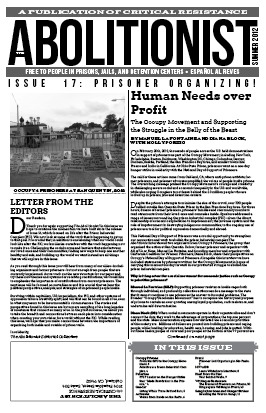
And this was one of Marilyn's last published essays, printed by Critical Resistance's paper, "The Abolitionist" (W2010):
Alternatives While Waiting: Self-Reliance
by Marilyn Buck
A community’s people, with their creative energy and labour, are the greatest resource it has, but an increasing number, mostly young, are MIA, in graves or prisons, into which so many rush obliviously when they act out Hollywood-constructed desires, images, and stereotypes to “make it” in the midst of still-white supremacist and hierarchical America. Far too many have embraced the 30 years of culturally-contrived amnesia that has mis-educated them to believe in the very system that exiles them to the cages. Valuable human beings – community residents, who could have and should have been the teachers, nurses, doctors, mechanics, public servants, and builders of their communities are disappeared.
Among the disappeared and exiled, many haven’t been formally educated or taught to read well, having dropped out or been driven out of the faltering California school systems, weakened both by funding and a general disregard for and animosity towards the children of the working and underemployed classes, particularly when Black, Latino, or Asian. There are a few, if any, educational or rehabilitation-geared programs within prisons. On a recent KPFA radio program, a freed elder pointed out that many of California’s prisons are on lock-down at any given time, meaning that the few programs that do exist, however reluctantly and apathetically, do not function much of the time.
In the prison charnel houses, forgetfulness or oblivion settles like quicklime on the spirit, intelligence and bodies of exiled and illegalized young people. A sense of responsibility to the community is replaced with rage, and beneath any posturing, despair, self-mutilation, and suicide.
Alternatives? To re-imagine communities with the resources to educate children, to provide work with sufficient income, to get drugs and the weapons of collective suicide out, to make the streets safe again for children, elders and the young women and men. This is similar to the 10-point program the old Black Panther Party called for, a program that in slightly different manifestations is still understood world-wide as necessary for community and nations’ health and well-being for peace and justice.
It’s never too later to learn, to get educated or develop the social or political conscience necessary to challenge the systematic social genocide of our communities. No one has to stay lost; no one is not subject to change. The question is: will you change yourself, have a hand in your destiny and development, or will you accept the changes forced at you by the prison systems’ dog-eat-dog programming that wants you to become a gladiator and a puppet?
There are many who are looking for ways to break such a decimating cycle. Meanwhile, what? The prisoner’s alternative is not to wait for alternatives and social change from the outside, but to begin a process of reconstruction on the inside.
To be a builder, or to be a demolisher, those are the choices. It’s easy to demolish, to destroy. You can be a one-man or a 100-man wrecking crew, but to build you have to become a bricklayer, willing to dig foundations, willing to take care of your neighbourhood and work with others. It means being humble and giving back because when you left you took a whole lot of human and community potential with you. It means learning what you need to know. Find a teacher, no matter whether they wear your colours, are your colour, or are low on the ladder of that peculiar prison concept of “respect.” (Prison culture doesn’t really give any prisoner true respect, or better-said, dignity; the man is still pulling the strings.) If you can’t earn a skill you want where you are (like being a doctor or an environmental engineer), learn all you can about the world. Learn about other societies; learn about communities’ fight for self-reliance and self-determination. Learn Spanish, or English, or Chinese. Or history. The more you study about the world, the better able you will be to see where you are and can go in the world. Choose to be on the side of the people who are not the greedy rulers and bosses.
Of course it’s easier to succumb to the haters who want to decimate your community, and to hang with those who participate in the suicide of their own communities through ignorance and individualism. Reignite your creativity and imagination that you may have put aside when you were 14 or that was discouraged in school. There is enough war from without, end the wars from within. Nothing can be build during a civil war, and certainly nothing can be defended from the war from without, without skills, knowledge and dignity of connection to and love for your community. Become a warrior for reconstruction.
Set a premium on education. No one can ever take it from you. Ultimately, knowledge and skills are more valuable than gold and SUVs, or anything you may have possessed for a few brief moments in life, before prison became your home with its prolonged lesson in absence.


















 Posts
Posts