THIS BLOG is NOW RETIRED

I began this blog in May 2009 following the death of Marcia Powell at Perryville State Prison in Goodyear, Arizona. It is not intended to prescribe the path that leads to freedom from the prison industrial complex.

Rather, these are just my observations in arguably the most racist, fascist, militaristic state in the nation at a critical time in history for a number of intersecting liberation movements. From Indigenous resistance to genocidal practices, to the fight over laws like SB1070 and the ban on Ethnic Studies, Arizona is at the center of many battles for human rights, and thus the struggle for prison abolition as well - for none are free until all are. I retired the blog in APRIL 2013.

Visit me now at Arizona Prison Watch or Survivors of Prison Violence-AZ
BLOG POSTS
Showing posts with label war on drugs. Show all posts

Saturday, December 10, 2011

Police State, USA.


---------from Huffington Post-------


SWAT Raids, Stun Guns, And Pepper Spray: Why The Government Is Ramping Up The Use Of Force

Posted: 12/ 5/11 11:23 AM ET Radley Balko Huffington Post

In February of last year, video surfaced of a marijuana raid in Columbia, Mo. During the raid on Jonathan Whitworth and his family, police took down the door with a battering ram, then within seconds shot and killed one of Whitworth's dogs and wounded the other. They didn't find enough pot in the house to charge Whitworth with even a misdemeanor. (He was, however, charged with misdemeanor possession of drug paraphernalia when police found a pipe.) The disturbing video went viral in May 2010, triggering outrage around the world. On Fox News, conservative columnist Charles Krauthammer and Bill O'Reilly cautioned not to judge the entire drug war by the video, which they characterized as an isolated incident.

In fact, very little about the raid that was isolated or unusual. For the most part, it was carried out the same way drug warrants are served some 150 times per day in the United States. The battering ram, the execution of Whitworth's dog, the fact that police weren't aware Whitworth's 7-year-old child was in the home before they riddled the place with bullets, the fact that they found only a small amount of pot, likely for personal use -- all are common in drug raids. The only thing unusual was that the raid was recorded by police, then released to the public after an open records request by the Columbia Daily Tribune. It was as if much of the country was seeing for the first time the violence with which the drug war is actually fought. And they didn't like what they saw.

That video came to mind with the outrage and public debate over the now-infamous pepper-spraying of Occupy protesters at the University of California-Davis protest earlier this month. The incident was just one of a number of high-profile uses of force amid crackdowns on Occupy protesters across the country, including one in Oakland in which the skull of Iraq War veteran Scott Olsen was fractured by a tear gas canister, and in New York, where NYPD Officer Anthony Bologna pepper-sprayed protesters who had been penned in by police fencing.

But America's police departments have been moving toward more aggressive, force-first, militaristic tactics and their accompanying mindset for 30 years. It's just that, with the exception of protests at the occasional free trade or World Bank summit, the tactics haven't generally been used on mostly white, mostly college-educated kids armed with cellphone cameras and a media platform.

Police militarization is now an ingrained part of American culture. SWAT teams are featured in countless cop reality shows, and wrong-door raids are the subject of "The Simpsons" bits and search engine commercials. Tough-on-crime sheriffs now sport tanks and hardware more equipped for battle in a war zone than policing city streets. Seemingly benign agencies such as state alcohol control boards and the federal Department of Education can now enforce laws and regulations not with fines and clipboards, but with volatile raids by paramilitary police teams.

Outraged by the Occupy crackdowns, some pundits and political commentators who paid little heed to these issues in the past are now calling for a national discussion on the use of force. That's a welcome development, but it's helpful to review how we got here in order to have an honest discussion.

Part of the trend can be attributed to the broader tough-on-crime and drug war policies pushed by politicians of both parties since at least the early 1980s, but part of the problem also lies with America's political culture. Public officials' decisions today to use force and the amount of force are as governed by political factors as by an honest assessment of the threat a suspect or group may pose. Over the years, both liberals and conservatives have periodically raised alarms over the government's increasing willingness to use disproportionately aggressive force. And over the years, both sides have tended to hush up when the force is applied by political allies, directed at political opponents, or is used to enforce the sorts of laws they favor.

How We Got Here

According to Eastern Kentucky University criminologist Peter Kraska, the number of SWAT raids carried out each year in America has jumped dramatically over the last generation or so, from just a few thousand in the 1980s to around 50,000 by the mid-2000s, when Kraska stopped his survey. He found that the vast majority of the increase is attributable to the drug war -- namely warrant service on low-to-mid-level drug offenders. A number of federal policies have driven the trend, including offering domestic police departments military training, allowing training with military organizations, using "troops-to-cops" programs and offering surplus military equipment and weaponry to domestic police police departments for free or at major discounts. There has also been a constant barrage of martial rhetoric from politicians and policymakers.

Dress cops up as soldiers, give them military equipment, train them in military tactics, tell them they're fighting a "war," and the consequences are predictable. These policies have taken a toll. Among the victims of increasingly aggressive and militaristic police tactics: Cheye Calvo, the mayor of Berwyn Heights, Md., whose dogs were killed when Prince George's County police mistakenly raided his home; 92-year-old Katherine Johnston, who was gunned down by narcotics cops in Atlanta in 2006; 11-year-old Alberto Sepulveda, who was killed by Modesto, Calif., police during a drug raid in September 2000; 80-year-old Isaac Singletary, who was shot by undercover narcotics police in 2007 who were attempting to sell drugs from his yard; Jonathan Ayers, a Georgia pastor shot as he tried to flee a gang of narcotics cops who jumped him at a gas station in 2009; Clayton Helriggle, a 23-year-old college student killed during a marijuana raid in Ohio in 2002; and Alberta Spruill, who died of a heart attack after police deployed a flash grenade during a mistaken raid on her Harlem apartment in 2003. Most recently, voting rights activist Barbara Arnwine was raided by a SWAT team in Prince George's County, Md., on Nov. 21. Police were looking for Arnwine's nephew, a suspect in an armed robbery.*

The drug war has been the primary policy driving the trend but, since 2001, the federal government has also used the threat of terror attacks to further militarize domestic law enforcement. This includes not only finding new sources of funding for armor, weapons and gear, but also claiming new powers for the "War on Terror" that are then inevitably used in more routine law enforcement.

But paramilitary creep has also spread well beyond the drug war. In recent years, SWAT teams have been used to break up neighborhood poker games, including one at an American Legion Hall in Dallas. In 2006, Virginia optometrist Sal Culosi was killed when the Fairfax County Police Department sent a SWAT team to arrest him for gambling on football games. SWAT teams are also now used to arrest people suspected of downloading child pornography. Last year, an Austin, Texas, SWAT team broke down a man's door because he was suspected of stealing koi fish from a botanical garden.

CORRECTION: An earlier version of this article indicated that the police may have raided the wrong house. Arwine initially made that claim when the police didn't immediately produce a search warrant. The Prince George's County Police Department has since unsealed the search warrant, which shows that they were looking for Arwine's nephew. The police say they found evidence that the nephew was living or staying in Arwine's home, as well as evidence of the robbery.

Thursday, September 8, 2011

On Medical Marijuana, the DEA is full of shit.

from the Drug Policy Alliance

------------------

Ethan Nadelmann, executive director of the Drug Policy Alliance, responds to the recent decree by the Drug Enforcement Agency (DEA) that marijuana has no accepted medical use. The decision by the DEA comes almost nine years after medical marijuana supporters asked the government to reclassify cannabis to take into account a growing body of research that shows its effectiveness in treating certain diseases. For more on this subject please go the July 14 LA Times piece titled "Medical marijuana: A science-free zone at the White House" by DPA's Bill Piper and Stephen Gutwillig.


Ethan Nadelmann Responds To DEA Claim That Marijuana Has No Accepted Medical Use from Drug Policy Alliance on Vimeo.

Sunday, August 15, 2010

War on Drugs, War on us: America's Prison Industrial Complex.

Good video on the prison industrial complex. Close look at Mississippi and private prisons about six minutes in. They also echo my concern that private prisons benefit too much from "crime", not from investments in things like public education.

------------------------------


Watch this video on VideoSurf or see more Profit Videos or Freedom Videos

Sunday, May 9, 2010

Mother's Day: Sentencing and the War on Drugs.

                 
Women in Prison: A Fact Sheet
The Issue: Sentencing and the War on Drugs

The Department of Justice found that women were over represented among low level drug offenders who were non-violent, had minimal or no prior criminal history, and were not principal figures in criminal organizations or activities, but nevertheless received sentences similar to “high level” drug offenders under the mandatory sentencing policies. From 1986 to 1996 the number of women sentenced to state prison for drug crimes increased ten-fold. Nationally one in three women in prison and one in four women in jail are incarcerated for violating a drug law. (Department of Justice, Bureau of Justice Statistics Prisoners in 1997)

·  According to The Boston Globe, "nearly 26% of the nearly 2000 men and women crowding Massachusetts prisons for  drug crimes are first-time offenders…. Worse, nearly three out of four drug traffickers who do get charged in major cases, but agree to forfeit substantial drug money to prosecutors, bargain their way out of the long sentences…. The result: those with no money or information to trade face the hard mandatory sentences."

·     From 1986 to 1996, the number of women sentenced to state prison for drug crimes increased from 2,370 to 23,700.  (Bureau of Justice Statistics, Washington DC Prisoners in 1997)

·  In 1986, 12.0% of women in prison were drug offenders. In 1991, 32.8% of women in prison were incarcerated for  drug offenses.  (Women in Prison, Survey of State Prison Inmates, 1991. US Department of Justice, March 1994, NCJ 145321)

The Issue: Sexual Assault and Misconduct Against Women in Prison

The imbalance of power between inmates and guards involves the use of direct physical force and indirect force based on the prisoners’ total dependency on officers for basic necessities and the guards’ ability to withhold privileges. Some women are coerced into sex for favors such as extra
food or personal hygiene products, or to avoid punishment.   

·  Powerlessness and Humiliation
There are 148,200 women in state and federal prisons. In federal women’s correctional facilities, 70% of guards are male.  Records show correctional officials have subjected female inmates to rape, other sexual assault, sexual extortion, and groping during body searches. Male correctional officials watch women undressing, in the shower or the toilet. Male correctional officials retaliate, often brutally, against female inmates who complain about sexual assault and harassment

·  Retaliation and Fear
In many states guards have access to and are encouraged to review the inmates’ personal history files (this includes any  record of complaints against themselves or other prison authorities). Guards threaten the prisoner’s children and visitation rights as a means of silencing the women. Guards issue rule infraction tickets, which extend the woman’s  stay in prison if she speaks out. Prisoners who complain are frequently placed in administration segregation.

·  Impunity 
Ineffective formal procedures, legislation and reporting capacity within US jails and prisons account for much of the  ongoing sexual abuse of women. In 1997, according to the US Justice Department only 10 prison employees in the  entire federal system were disciplined, and only 7 were prosecuted. If a prison official is found guilty, he is often simply transferred (“walked off the yard”) to another facility instead of being fired. The inmate may also be transferred. 

The Issue: Medical Neglect of Women in US Prisons
Women are denied essential medical resources and treatments, especially during times of pregnancy and/or chronic and degenerative diseases.

·  Failure to refer seriously ill inmates for treatment and delays in treatment
Women inmates suffering from treatable diseases such as asthma, diabetes, sickle cell anemia, cancer, late-term miscarriages, and seizures have little or no access to medical attention, sometimes resulting in permanent injury or death. Instances of failure to deliver life-saving drugs for inmates with HIV/AIDS have also been noted.  

·  Lack of qualified personnel and resources and use of non-medical staff
There is too few staff to meet physical and mental health needs. This often results in long delays in obtaining medical attention; disrupted and poor quality treatment causing physical deterioration of prisoners with chronic and degenerative diseases, like cancer; overmedication of prisoners with psychotropic drugs; and lack of mental health treatment. The use of  non-medical staff to screen requests for treatment is also common. 

·  Charges for medical attention
In violation of international standards, many prisons/jails charge inmates for medical attention, arguing that the charge deters prisoners from seeking medical attention for minor matters or because they want to avoid work. In some supermaximum prisons, where prisoners cannot work at all, the US Justice Dept. expressed concern that charging prisoners impedes their access to health care.

·  Inadequate Reproductive Health Care
In 1994, the National Institute of Corrections stated that provision of gynecological services for women in prison is inadequate.  Only half of the state prison systems surveyed offer female-specific services such as mammograms and Pap smears, and often entail a long wait to be seen.

·  Shackling During Pregnancy
Shackling of all prisoners, including pregnant prisoners, is standard policy in federal prisons and in the US Marshall Service and exists in almost all state prisons. Shackling during labor may cause complications during delivery such as hemorrhage or decreased fetal heart rate. If a caesarian section is needed, a delay of even 5 minutes may result in permanent brain damage to the baby.
  
·  Lack of treatment for substance abuse
The gap between services available and treatment needs continues to grow. The number of prisoners with histories of drug abuse is growing, but the proportion of prisoners receiving treatment declined from 40% in 1991 to 18% in 1997.  

·  Lack of Adequate or Appropriate Mental Health Services
 48-88% of women inmates suffer from post-traumatic stress disorder due to sexual or physical abuse experienced prior to coming to prison.  Very few prison systems provide counseling. Women attempting to access mental health services are routinely given medication without opportunity to undergo psychotherapeutic treatment.  


The Issue: Discrimination Based On Gender, Race and Sexual Orientation
The growth in incarceration has had its greatest impact on minorities, particularly African Americans. Women are most vulnerable to different forms of discrimination, including sexual harrasment or abuse. Women that do not fit the “norm”, such as lesbians, are more succeptable to torture and abuse.

Discrimination Based on Race:
·  Over a five-year period, the incarceration rate of African American women increased by 828%. (NAACP LDF Equal Justice Spring 1998.) An African American woman is eight times more likely than a European American woman is to be imprisoned.  African American women make up nearly half of the nation’s female prison population, with most serving sentences for nonviolent drug or property related offenses. 

·  Latina women experience nearly four times the rates of incarceration as European American women.

·  State and federal laws mandate minimum sentences for all drug offenders.  This eliminates the option for judges to refer first time non-violent offenders to drug treatment, counseling and education programs.  The racial disparity revealed by the crack v. powder cocaine sentences insures that more African American women will land in prison.

Although 2/3 of crack users are white or Hispanic, defendants convicted of crack cocaine possession in 1994 were 84.5% African American.  Crack is the only drug that carries a mandatory prison sentence for first time possession in the federal system. 

Discrimination Based On Sexual Orientation:
·   Human Rights Watch has documented categories of women who are likely targets for sexual abuse. Perceived or actual sexual orientation is one of four categories that make a female prisoner a more likely target for sexual abuse, as well as a target for retaliation when she reports that abuse.

·  If a woman is a lesbian, her criminal defense becomes more challenging.  Jurors in the US were polled as to what factors would make them most biased against a defendant, and perceived sexual orientation was chosen as the most likely personal characteristic to bias a juror against a defendant, three times greater than race. (National Law Journal November 2, 1998.)

·  The case of Robin Lucas depicts how sexual identity may subject a woman to further abuse or torture by a guard. She was placed in a men’s prison where male guards allowed male inmates to rape her.  The male guards taunted her about her same sex relationship, saying to her “maybe we can change your mind”.  

For more information on issues affecting women in prison and other women’s human rights issues, please visit the Women’s Human Rights Program website at www.amnestyusa.org/women or contact us at AIUSA 5 Penn Plaza-16th floor, New York, NY 10001 or at (212) 633-4292.

Wednesday, April 21, 2010

Prosecuting people of conscience.

Lets show some solidarity with our brother this Friday, folks. Hook up with me for a ride.
Peg
-----------------
 
Let's gather in community with Josh the night before the court appearance for his November arrest at Ft. Huachuca, for music, refreshments and a roundtable discussion on why we need to continue to protest torture - April 22 at 7 p.m. at Southside Presbyterian Church (address below).  And if you're able, please come to court as well -

Ft. Huachuca protester Joshua Harris, from Santa Barbara, California, will appear on Friday, April 23 at 9:30 a.m. in U.S. District Court, Tucson, Arizona.  He intends to enter a change of plea and expects to be sentenced that day.

Josh was one of five protesters who entered Fort Huachuca (home of the U.S. Army Intelligence Center where interrogators are trained) on November 15, 2009 with a message for military personnel and civilian employees.  They carried a statement (see below) opposing the cruel treatment and abuse of detainees from the wars in Afghanistan and Iraq, and calling for the civilian oversight of all military interrogation practices.  The statement also condemned the used of armed drones in warfare.

All five protesters were given a formal letter barring them from entering the base for a year.  Because Josh initially refused to identify himself, instead saying he was there representing a victim of torture, he was also charged with trespass and refusing to provide a truthful name.

Please join us:

Thursday evening, April 22 at 7 p.m.
Southside Presbyterian Church, Fellowship Hall
317 W. 23rd Street, Tucson, Arizona
Let's gather in community with Josh the night before his court appearance

Friday morning, April 23 at 8:30 a.m.
DeConcini U.S. Federal Courthouse, plaza in front of courthouse
405 W. Congress, Tucson, Arizona
Join Josh for an 8:30 a.m. circle of support before his 9:30 a.m. court appearance

Please note that you need a photo I.D. to get into the courthouse.  Cameras, pocketknives, etc. are not allowed in the courthouse.

For more information about past and future protests at Ft. Huachuca, please visit http://tortureontrial.org and http://southwestwitness.org/

The annual Ft. Huachuca demonstration will take place on Sunday, November 14, 2010.


STATEMENT CARRIED INTO FORT HUACHUCA, November 15, 2009

We return to Fort Huachuca to call for an end to torture.

We are here because we desire dialogue with soldiers and commanders engaged in interrogation training. We are here because we still question whether soldiers are provided with adequate training about international human rights law so they would know to refuse illegal orders and other pressure to torture captives (including a guarantee that speaking out would not lead to retaliation or punishment). We are here in the hope that healing can take place--healing for the victims of torture, as well as the men and women who have been involved in carrying out torture.

Because the Obama administration has failed to close Guantanamo and the U.S. continues to imprison and interrogate thousands of captives at military prisons in Afghanistan, Iraq and places unknown, we renew our call for civilian, human-rights centered oversight of all interrogation training and practice.

Ft. Huachuca is also implicated in the rapidly expanding, legally questionable and morally reprehensible use of remotely-piloted aircraft, or drones, as a weapon of war. We're told that currently the Army only trains for the operation and maintenance of reconnaissance and surveillance drones at Ft. Huachuca. But we also know that the Army plans to weaponize some of these same drones.

Drone attacks have killed many more innocent civilians in Iraq, Afghanistan, Pakistan and elsewhere, than alleged terrorists. The U.N. Special Rapporteur on Extrajudicial Executions has asked whether the use of drones in targeting terrorists to be killed constitutes "arbitrary extrajudicial executions," or rogue assassinations in violation of international law. We are here today to call for an end to the use of armed drones in warfare. We believe this terrorizing and killing generates deep resentment in the region that incites hatred for the U.S., boosts recruitment for Taliban, Al Qaeda and other terrorist groups, and may spawn decades of retaliation.

We act in solidarity with the campaign to close the School of the Americas/Western Hemispheric Institute for Security Cooperation at Ft. Benning, Georgia, where the testimony of torture survivors has informed our outrage and moved us to action. We also act in solidarity with people in New York protesting the presence of Reaper drones at a NY Air National Guard base outside of Syracuse today.

Rogue assassinations and torture have damaged the soul of our nation and tarnished our image around the world. We know that a world without torture, without violence and without war is possible. We invite you to help us create that world.

Tuesday, March 30, 2010

Prisoner of the War on Drugs: Letter to the President

This was in the Huffington Post, originally published last month (just now discovered by me). Still topical and well-articulated. We need to hear and support these voices more often.

This grandmother, by the way, appears to still be in prison.

We need to get these people home.

This would be a good model letter to send friends and family in prison,
by the way, for them to appeal their sentencing. Just cut and paste it, so it doesn't look printed up from a website (some prisons have rules about website material, to keep prisoners out of trouble) - just put it in a word doc like an essay - I think that's totally legitimate.

Anyone who does write a letter like this to a judge, the governor, a legislator (particularly Cecil Ash's House Study Committee on Sentencing), or Obama, we'd love a copy to publish - your letter in turn emboldens other prisoners and family members to write in. That's how we begin to build critical mass.

--------------

A Letter from Behind Bars on President's Day


Hamedah Hasan
Posted: February 15, 2010 08:41 AM

As we celebrate President's Day, one prisoner asks President Obama to exercise his clemency power to commute the remaining 10 years of her 27-year sentence, which she received for a first time, non-violent drug offense. Hamedah Hasan, who is represented by the American Civil Liberties Union, filed a formal commutation petition today and included a letter addressed directly to President Obama. Below is a condensed version of her letter, adapted especially for Huffington Post. To read Hamedah's full letter and learn more about her story and the President's unique power to send her home, click here.

Dear Mr. President,

Today is President's Day. As the President of the United States, you have the unique and absolute power to commute the sentence of any federal prisoner. That means you could send me home today, and that is what I am asking you to do.

From everything I have observed, you are a compassionate and just man. I pray that if you learn of the story behind my sentence, you will be moved to exercise your clemency power to give me a second chance.

I am a mother and grandmother serving my 17th year of a 27-year federal prison sentence for a first time, nonviolent crack cocaine offense. I never used or sold drugs, but I was convicted under conspiracy laws for participating in a drug organization by running errands and wiring money. Had I been convicted of a powder cocaine offense, I would be home with my three daughters and two grandchildren by now. I have had a lot of time to think about where I went wrong, and I genuinely take full responsibility for my actions. But I hope you will see that over 16 years in prison is enough time for me to pay my debt to society.

When I was 21 years old, I found myself in a horridly abusive relationship with a man in Portland, Oregon, who intimidated, cursed, slapped, punched and kicked me. I had my first child, Kasaundra, when I was 16 years old, and this man was the father to my second child, Ayesha. Even though my self-esteem at this point in my life was virtually nonexistent, in my heart I knew that this life wasn't what I wanted for myself or -- most importantly -- for my children.

The only option I could see was to go live with my cousin, Ahad, in Omaha, Nebraska. Ahad set me up with a safe place to live, and most importantly, it was hundreds of miles away from my violent ex-boyfriend. Ahad recently wrote a letter in support of my commutation petition. In it, he accurately summed up the situation:

Her boyfriend was a gang member and his main goal in life was to be the best gang member he could be. He beat Hamedah all the time and threatened to kill her. She could not hide from him in Portland - he knew where everybody lived. He drank a lot and used drugs. It was not a good environment for Hamedah to raise her kids in, and it wasn't safe for Hamedah either. So she came to me in Omaha.

The thing is, Ahad was dealing crack cocaine. Although I never used drugs myself, it wasn't long before he asked me to run various errands and to transfer some money. He never held a gun to my head; I knew what I was doing, and I regret my poor decisions during this period of my life more than anything else. At the time, I felt out of options, and I believed that I needed to perform these tasks to show my gratitude for Ahad's help in escaping my abusive relationship.

After less than two years, I decided to move back to my hometown in order to get away from the drug operation. I wanted my girls to grow up with their mother earning an honest living and leading by example. I enrolled in a welfare-to-work program and was getting back on my feet.

But soon after I returned home, I was arrested, indicted and convicted of conspiracy to distribute crack cocaine from my time in Omaha with Ahad. I was sentenced to life in prison (later reduced to 27 years), based on the total quantity of drugs involved in the operation. I gave birth to Kamyra, my youngest child, in prison. That was one of the hardest experiences of my life.

During my more than 16 years of incarceration, I have taken long, hard looks at myself. I've done everything in my power to redeem myself and to demonstrate through deeds that upon release, I will be a community asset, not a community liability.

If you commute my sentence, I could have 10 years back on my life. Ten more years to make up for being so far apart from my daughters. Ten more years to realize my dream of starting a nonprofit dedicated to providing community services for the children of incarcerated parents. Ten more years to make a real, positive difference in the world.

I hope you will give me that chance. You have said you believe the crack-powder cocaine sentencing disparity should be eliminated. I know Congress is considering legislation to equalize the federal sentences. You should understand, however, that none of the legislation being considered would apply retroactively to me.

As much as I am cheering -- even from behind prison bars -- for a reform in the federal laws, I don't want to fall through the cracks. I still have a lot of living, mothering and giving to do.

I would not be writing to you today unless I had no other option. I have appealed my case to the highest courts in the land, and you, and you alone, Mr. President, can send me home by exercising your executive clemency power to commute my sentence.

Sincerely,

Hamedah Hasan

Sunday, March 28, 2010

The New Jim Crow...

From the SF Bay View:
-------------

The new Jim Crow: How the war on drugs gave birth to a permanent American undercaste

Posted By mary On March 25, 2010 @ 4:26 pm In Prison Stories

Introduction by Andy Kroll
[2]
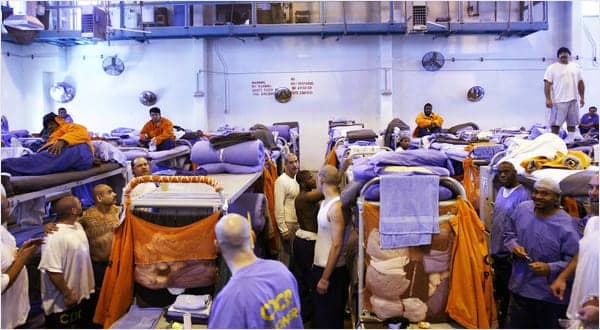
The California State Prison at Lancaster outside Los Angeles is at double capacity, with 150 triple-bunked here in the gym. Michelle Alexander says, “There are more African Americans under correctional control today – in prison or jail, on probation or parole – than were enslaved in 1850, a decade before the Civil War began” and that more Black men were disenfranchised in 2004 than “in 1870, when the 15th Amendment was ratified, prohibiting laws that explicitly deny the right to vote on the basis of race.” – Photo: by Ann Johansson, New York Times


California is, as the time-worn adage has it, our nation’s bellwether, and nowhere is that truer than in the Golden State’s prison crisis. California’s inmate population is among the highest in the nation. Its complex of prisons spills over with tens of thousands of inmates housed in every available inch of space and sleep-stacked three-high [3]. So overcrowded are California’s prisons that the state penal system has been successfully sued for violating the constitutional rights of inmates – essentially by subjecting them to a public health crisis. That its inmates consistently resort [4] to violence in prison should come as no surprise.

The dire state of California’s prisons can, in part, be traced to its draconian “three-strikes law [5],” which throws three-time felons behind bars for a mandatory 25 years. Overflowing prison populations have, in turn, contributed to that state’s bleak economic future, helping consign California to a perpetual budget deficit, annual financial crises, and repeated deep cuts in education and social funding. The state currently spends [6] a staggering 10 percent of its annual operating budget, or $10.8 billion, on its prison system and its nearly 170,000 prisoners – more than it spends on the University of California system, once the jewel in the crown of American public higher education.

And which Americans have borne the brunt of California’s prison boom? Mostly minorities, African Americans especially. In 2005, the state was incarcerating [7], on average, 5,125 for every 100,000 male adult Blacks in the population – nearly four and a half times more than for Latino men and six and a half times more than for white men. California’s prisons are also notorious for separating their prisoners by skin color, a form of segregation that was, one lawyer remarked [8], “not tolerated in any other aspect of American life and hasn’t been for 50 years. It’s the shame of California.”

As Michelle Alexander, legal expert and author of a startling just-published book, “The New Jim Crow: Mass Incarceration in the Age of Colorblindness [9],” points out in her first TomDispatch post, California’s racially infused prison quagmire is only a snapshot of a growing racial divide, one which includes the formation of a new undercaste in America that loses its normal rights at the prison gates and often never recovers them. To check out the latest TomCast, Timothy MacBain’s striking audio interview with Alexander in which she explains how she came to realize that this country was bringing Jim Crow into the Age of Obama, click here [10].

by Michelle Alexander

Ever since Barack Obama lifted his right hand and took his oath of office, pledging to serve the United States as its 44th president, ordinary people and their leaders around the globe have been celebrating our nation’s “triumph over race.” Obama’s election has been touted as the final nail in the coffin of Jim Crow, the bookend placed on the history of racial caste in America.

Obama’s mere presence in the Oval Office is offered as proof that “the land of the free” has finally made good on its promise of equality. There’s an implicit yet undeniable message embedded in his appearance on the world stage: This is what freedom looks like; this is what democracy can do for you. If you are poor, marginalized or relegated to an inferior caste, there is hope for you. Trust us. Trust our rules, laws, customs and wars. You, too, can get to the promised land.

Perhaps greater lies have been told in the past century, but they can be counted on one hand. Racial caste is alive and well in America.

[11]
Cover designed by Jamaal Bell

Most people don’t like it when I say this. It makes them angry. In the “era of colorblindness” there’s a nearly fanatical desire to cling to the myth that we as a nation have “moved beyond” race. Here are a few facts that run counter to that triumphant racial narrative:

*There are more African Americans under correctional control today – in prison or jail, on probation or parole – than were enslaved in 1850, a decade before the Civil War began.

*As of 2004, more African American men were disenfranchised (due to felon disenfranchisement laws) than in 1870, the year the Fifteenth Amendment was ratified, prohibiting laws that explicitly deny the right to vote on the basis of race.

* A Black child born today is less likely to be raised by both parents than a Black child born during slavery. The recent disintegration of the African American family is due in large part to the mass imprisonment of Black fathers.

*If you take into account prisoners, a large majority of African American men in some urban areas have been labeled felons for life. (In the Chicago area, the figure is nearly 80 percent.) These men are part of a growing undercaste – not class, caste – permanently relegated, by law, to a second-class status. They can be denied the right to vote, automatically excluded from juries, and legally discriminated against in employment, housing, access to education and public benefits, much as their grandparents and great-grandparents were during the Jim Crow era.

Excuses for the lockdown

There is, of course, a colorblind explanation for all this: crime rates. Our prison population has exploded from about 300,000 to more than 2 million in a few short decades, it is said, because of rampant crime. We’re told that the reason so many Black and Brown men find themselves behind bars and ushered into a permanent, second-class status is because they happen to be the bad guys.

The uncomfortable truth, however, is that crime rates do not explain the sudden and dramatic mass incarceration of African Americans during the past 30 years. Crime rates have fluctuated over the last few decades – they are currently at historical lows – but imprisonment rates have consistently soared. Quintupled, in fact. And the vast majority of that increase is due to the War on Drugs. Drug offenses alone account for about two-thirds of the increase in the federal inmate population and more than half of the increase in the state prison population.

The drug war has been brutal – complete with SWAT teams, tanks, bazookas, grenade launchers, and sweeps of entire neighborhoods – but those who live in white communities have little clue to the devastation wrought. This war has been waged almost exclusively in poor communities of color, even though studies consistently show that people of all colors use and sell illegal drugs at remarkably similar rates. In fact, some studies indicate that white youth are significantly more likely to engage in illegal drug dealing than Black youth. Any notion that drug use among African Americans is more severe or dangerous is belied by the data. White youth, for example, have about three times the number of drug-related visits to the emergency room as their African American counterparts.

That is not what you would guess, though, when entering our nation’s prisons and jails, overflowing as they are with Black and Brown drug offenders. In some states, African Americans comprise 80 percent to 90 percent of all drug offenders sent to prison.

This is the point at which I am typically interrupted and reminded that Black men have higher rates of violent crime. That’s why the drug war is waged in poor communities of color and not middle-class suburbs. Drug warriors are trying to get rid of those drug kingpins and violent offenders who make ghetto communities a living hell. It has nothing to do with race; it’s all about violent crime.

Again, not so. President Ronald Reagan officially declared the current drug war in 1982, when drug crime was declining, not rising. From the outset, the war had little to do with drug crime and nearly everything to do with racial politics. The drug war was part of a grand and highly successful Republican Party strategy of using racially coded political appeals on issues of crime and welfare to attract poor and working class white voters who were resentful of, and threatened by, desegregation, busing and affirmative action. In the words of H.R. Haldeman, President Richard Nixon’s White House chief of staff: “[T]he whole problem is really the Blacks. The key is to devise a system that recognizes this while not appearing to.”

A few years after the drug war was announced, crack cocaine hit the streets of inner-city communities. The Reagan administration seized on this development with glee, hiring staff who were to be responsible for publicizing inner-city crack babies, crack mothers, crack whores and drug-related violence. The goal was to make inner-city crack abuse and violence a media sensation, bolstering public support for the drug war which, it was hoped, would lead Congress to devote millions of dollars in additional funding to it.

The plan worked like a charm. For more than a decade, Black drug dealers and users would be regulars in newspaper stories and would saturate the evening TV news. Congress and state legislatures nationwide would devote billions of dollars to the drug war and pass harsh mandatory minimum sentences for drug crimes – sentences longer than murderers receive in many countries.

Democrats began competing with Republicans to prove that they could be even tougher on the dark-skinned pariahs. In President Bill Clinton’s boastful words, “I can be nicked a lot, but no one can say I’m soft on crime.” The facts bear him out. Clinton’s “tough on crime” policies resulted in the largest increase in federal and state prison inmates of any president in American history. But Clinton was not satisfied with exploding prison populations. He and the “New Democrats” championed legislation banning drug felons from public housing (no matter how minor the offense) and denying them basic public benefits, including food stamps, for life. Discrimination in virtually every aspect of political, economic and social life is now perfectly legal, if you’ve been labeled a felon.

Facing facts

But what about all those violent criminals and drug kingpins? Isn’t the drug war waged in ghetto communities because that’s where the violent offenders can be found? The answer is yes … in made-for-TV movies. In real life, the answer is no.

The drug war has never been focused on rooting out drug kingpins or violent offenders. Federal funding flows to those agencies that increase dramatically the volume of drug arrests, not the agencies most successful in bringing down the bosses. What gets rewarded in this war is sheer numbers of drug arrests. To make matters worse, federal drug forfeiture laws allow state and local law enforcement agencies to keep for their own use 80 percent of the cash, cars and homes seized from drug suspects, thus granting law enforcement a direct monetary interest in the profitability of the drug market.

The results have been predictable: People of color rounded up en masse for relatively minor, non-violent drug offenses. In 2005, four out of five drug arrests were for possession, only one out of five for sales. Most people in state prison have no history of violence or even of significant selling activity. In fact, during the 1990s – the period of the most dramatic expansion of the drug war – nearly 80 percent of the increase in drug arrests was for marijuana possession, a drug generally considered less harmful than alcohol or tobacco and at least as prevalent in middle-class white communities as in the inner city.

Federal drug forfeiture laws allow state and local law enforcement agencies to keep for their own use 80 percent of the cash, cars and homes seized from drug suspects, thus granting law enforcement a direct monetary interest in the profitability of the drug market.

In this way, a new racial undercaste has been created in an astonishingly short period of time – a new Jim Crow system. Millions of people of color are now saddled with criminal records and legally denied the very rights that their parents and grandparents fought for and, in some cases, died for.

Affirmative action, though, has put a happy face on this racial reality. Seeing Black people graduate from Harvard and Yale and become CEOs or corporate lawyers – not to mention president of the United States – causes us all to marvel at what a long way we’ve come.

Recent data shows, though, that much of Black progress is a myth. In many respects, African Americans are doing no better than they were when Martin Luther King Jr. was assassinated and uprisings swept inner cities across America. Nearly a quarter of African Americans live below the poverty line today, approximately the same percentage as in 1968. The Black child poverty rate is actually higher now than it was then. Unemployment rates in Black communities rival those in Third World countries. And that’s with affirmative action!
[12]
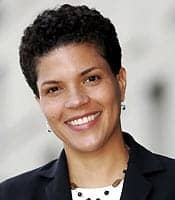
Michelle Alexander
When we pull back the curtain and take a look at what our “colorblind” society creates without affirmative action, we see a familiar social, political and economic structure – the structure of racial caste. The entrance into this new caste system can be found at the prison gate.

This is not Martin Luther King Jr.’s dream. This is not the promised land. The cyclical rebirth of caste in America is a recurring racial nightmare.

Michelle Alexander is the author of “The New Jim Crow: Mass Incarceration in the Age of Colorblindness [9]” (The New Press, 2010). The former director of the Racial Justice Project of the ACLU in Northern California, she also served as a law clerk to Justice Harry Blackmun on the U.S. Supreme Court. Currently, she holds a joint appointment with the Kirwan Institute for the Study of Race and Ethnicity and the Moritz College of Law at Ohio State University. To listen to a TomCast audio interview in which Alexander explains how she came to realize that this country was bringing Jim Crow into the Age of Obama, click here [10]. © Copyright 2010 Michelle Alexander. This story first appeared on TomDispatch [13] and, without the introduction, on the Huffington Post [14]. Andy Kroll, who wrote the introduction, is a writer based in San Francisco, an associate editor at TomDispatch and a staffer at Mother Jones magazine.

---------------------------

Article printed from San Francisco Bay View: http://www.sfbayview.com

URL to article: http://www.sfbayview.com/2010/the-new-jim-crow-how-the-war-on-drugs-gave-birth-to-a-permanent-american-undercaste/

URLs in this post:

[1] [Translate]: http://www.sfbayview.comjavascript:show_translate_popup(

[2] Image: http://www.sfbayview.com/wp-content/uploads/2010/03/Prison-overcrowding-Lancaster-4600-double-capacity-150-in-gym-0310-by-Ann-Johansson-NYT.jpg

[3] sleep-stacked three-high: http://articles.sfgate.com/2007-05-21/news/17245259_1_california-s-prison-budget-higher-education-incarcerating-inmates

[4] consistently resort: http://www.nytimes.com/2009/08/10/us/10prison.html

[5] three-strikes law: http://www.nytimes.com/2009/02/11/us/11prisons.html

[6] spends: http://cbs2.com/politics/California.prisons.spending.2.1140595.html

[7] incarcerating: http://www.ppic.org/content/pubs/jtf/JTF_PrisonsJTF.pdf

[8] remarked: http://www.pbs.org/newshour/bb/race_relations/jan-june06/prisons_3-15.html

[9] The New Jim Crow: Mass Incarceration in the Age of Colorblindness: http://www.amazon.com/New-Jim-Crow-Incarceration-Colorblindness/dp/1595581030

[10] here: http://tomdispatch.blogspot.com/2010/03/new-jim-crow.html

[11] Image: http://www.sfbayview.com/wp-content/uploads/2010/03/The-New-Jim-Crow-cover-designed-by-Jamaal-Bell.jpg

[12] Image: http://www.sfbayview.com/wp-content/uploads/2010/03/Michelle-Alexander.jpg

[13] TomDispatch: http://www.tomdispatch.com/blog/175215/tomgram:_michelle_alexander,_the_age_of_obama_as_a_racial_nightmare/

[14] Huffington Post: http://www.huffingtonpost.com/michelle-alexander/the-new-jim-crow-how-the_b_490386.html

[15] here: http://www.democracynow.org/2010/3/11/legal_scholar_michelle_alexander_on_the

[16] here: http://www.democracynow.org/blog/2010/3/11/part_ii_michelle_alexander_on_the_new_jim_crow_mass_incarceration_in_the_age_of_colorblindness

[17] Image: http://www.addtoany.com/share_save?linkurl=http%3A%2F%2Fwww.sfbayview.com%2F2010%2Fthe-new-jim-crow-how-the-war-on-drugs-gave-birth-to-a-permanent-american-undercaste%2F&linkname=The%20new%20Jim%20Crow%3A%20How%20the%20war%20on%20drugs%20gave%20birth%20to%20a%20permanent%20American%20undercaste

[18] America’s war in Central Africa: http://www.sfbayview.com/2009/america%e2%80%99s-war-in-central-africa/

[19] Black flight: http://www.sfbayview.com/2010/black-flight/

[20] The Census form: Send it back!: http://www.sfbayview.com/2010/the-census-form-send-it-back/

[21] Time for a U.S. revolution: 15 reasons: http://www.sfbayview.com/2010/time-for-a-u-s-revolution-15-reasons/

[22] Rwandan opposition parties condemn grenade attacks in Kigali: http://www.sfbayview.com/2010/rwandan-opposition-parties-condemn-grenade-attacks-in-kigali/

Wednesday, November 25, 2009

Weed and War: We Were Wrong.

Stepping out a little further on my limb of late, perhaps, but this seemed appropriate to post, since there's a petition to get medical marijuana on the AZ ballot for 2010. Here's the DOJ's Drug Threat Assessment on pot in Arizona, by the way - just for some balance. Hightower knows his stuff, though. I'm all for decriminalization of things like pot, and tougher regulations on the pharmaceutical industry for the toxic waste they push on children in this country.

 -------

The War on Weed: Marijuana Is Basically Harmless -- The Monumentally Stupid Drug War Is Not

By Jim Hightower, Hightower Lowdown
Posted on November 23, 2009, Printed on November 25, 2009
http://www.alternet.org/story/144115/

You might remember Robert McNamara's stunning mea culpa, delivered a quarter century after his Vietnam War policies sent some 50,000 Americans (and even more horrendous numbers of Vietnamese) to their deaths in that disastrous war. In his 1995 memoir, the man who had been a cold, calculating secretary of defense for both Kennedy and Johnson belatedly confessed that he and other top officials had long known that the war was an unwinnable, ideologically driven mistake. "We were wrong," he wrote, almost tearfully begging in print for public forgiveness. "We were terribly wrong."

Yes, they were, and so are today's leaders (from the White House to nearly all local governments), who are keeping us mired in the longest, most costly, and most futile war in U.S. history: the drug war. As one adamant opponent of this ongoing madness put it, "I cannot help but wonder how many more lives, and how much more money, will be wasted before another Robert McNamara admits what is plain for all to see: the War on Drugs is a failure. Americans are paying too high a price in lives and liberty for a failing War on Drugs, about which our leaders have lost all sense of proportion."

That was no ex-hippie stoner expressing himself through a haze of herbal smoke. It was America's "Uncle Walter," the journalistic icon Walter Cronkite, calling earlier this year for a new truthfulness and sanity in American drug policy.

The drug war is rife with major failures and absurdities, including the rise of a vast, murderous narco-state within Mexico, caused by U.S. consumer demand for drugs outlawed by our government; Plan Colombia, a secretive, multibillion-dollar U.S. military operation started by Bill Clinton in 2000 to eradicate coca production in that country, which now produces 15% more coca than it did before the plan was launched; the racist and grossly unjust sentencing disparity, established by lawmakers in the 1980s, between crack-cocaine users (mostly black) and powder snorters (mostly white); and the ridiculous refusal by pious federal authorities to allow our farmers to grow hemp--a useful, profitable, sustainable, and historic crop (see Lowdown, May 1999).

Here we focus on one particular piece of policy insanity that has afflicted our country for nearly 100 years and was foisted on us by political demagogues, power-hungry police agencies, fire-breathing preachers, fear-mongering media moguls, self-appointed moralists, and other forces of ignorance and arrogance. Thanks to them, America is mired in--get this--a war on a weed. Marijuana is the foe, and after a century of battle, the weed is winning!

A painful price
In 1914, newspaper magnate William Randolph Hearst mounted a yellow-journalism crusade to demonize the entire genus of cannabis plants. Why? To sell newspapers, of course, but also because he was heavily invested in wood-pulp newsprint, and he wanted to shut down competition from paper made from hemp--a species of cannabis that is a distant cousin to marijuana but produces no high. Hearst simply lumped hemp and marijuana together as the devil's own product, and he was not subtle about generating public fear of all things cannabis. As reported in the August issue of Mother Jones magazine, Hearst's papers ran articles about "reefer-crazed blacks raping white women and playing 'voodoo satanic' jazz music."

Actually, marijuana was largely unknown in America at the time and little used, but its exotic name and unfamiliarity made it an easy target for fearmongers. The next wave of demonization came in 1936 with the release of an exploitation film classic, Reefer Madness. It was originally produced by a church group to warn parents to keep their children in check, lest they smoke pot--a horror that, as the film showed, would drive kids to rape, manslaughter, insanity, and suicide.

Then Congress enthusiastically climbed aboard the anti-pot political bandwagon, passing a law that effectively banned the production, sale, and consumption of marijuana. Signed by FDR on August 2, 1937, this federal prohibition remains in effect today. Although it has been as ineffectual as Prohibition, the 1919-1933 experiment to stop people from consuming "intoxicating liquors," this ban continues, despite its staggering cost and dumfounding destructiveness. Consider a few facts about America's weed war:


  • It diverts hundreds of thousands of police agents from serious crimes to the pursuit of harmless tokers, including agents from the local and state police, FBI, Drug Enforcement Agency, and U.S. Marshals, Secret Service, Border Patrol, Customs, and Postal Service.
  • By even the most conservative estimate, the outlay from us taxpayers now tops $10 billion a year in direct spending just to catch, prosecute, and incarcerate marijuana users and sellers, not counting such indirect costs as militarizing our border with Mexico in a hopeless effort to stop marijuana imports.
  • Police agents at all levels trample our Bill of Rights in their eagerness to nab pot consumers by conducting illegal car searches, phone and email taps, garbage scrounging, and door-busting night raids.
  • Even people who are merely suspected of marijuana violations and have had no charges filed against them can (and regularly do) have their cars, money, computers, and other property confiscated by police. In a reversal of America's fundamental legal principles, it is up to these suspects to prove that their property is "innocent" of any crime.
  • People convicted of possessing even one ounce of marijuana can face mandatory minimum sentences of a year in jail, and having even one plant in your yard is a federal felony.
  • 41,000 Americans are in federal or state prisons right now on marijuana charges, not counting people in city and county jails.
  • 89% of all marijuana arrests are for simple possession of the weed, not for producing or selling it.

Tidbit: In September, the useful and always vigilant Sen. Russ Feingold revealed that the Justice Department was perverting a dangerous provision in the infamous Patriot Act of 2001 for use in non-terrorism cases.

"Sneak-and-peek" search warrants (based on a liberty-busting provision allowing police agents to break into a home or other private facility and search the premises without the owner's knowledge) were supposed to be reserved for extraordinary investigations into suspected terrorist activity. However, Feingold found that of the Justice Department's 763 requests last year for such searches, only three involved terrorism cases--while 65% of the sneakandpeeks were used in drug-war investigations, including pursuit of marijuana "criminals."

How's the war going?
Hitting yourself over the head one time with a ball-peen hammer could be considered an experiment. Doing it twice, though, would be stupid. And doing it repeatedly is insane.

The war on weeds is insane, for our officials keep sacrificing tax dollars, lives, civil liberties, and their own credibility in a "terribly wrong" and losing effort. They've been whacking us for decades with ever-bigger and more-repressive prohibition hammers, but marijuana availability and use keep going up, not down.

The 2008 survey on drug use conducted by the Department of Health and Human Services (HHS) shows pot to be popular with millions of Americans. Of those surveyed, 41% admit to having partaken at some point in their lives, 10% enjoyed it in the past year, and 6% use it regularly. These numbers greatly understate the actual level of marijuana consumption, because the survey is taken by federal health agents going door-to-door for in-person interviews. In effect, they're asking, "Have you been consuming an illicit drug--an activity that violates federal law and is punishable by a long prison term?" Many choose to fib.

Well, say Washington's die-hard weed warriors, it's really about protecting America's youth, deterring them from the evils of pot. Good luck with that. Ask practically any teenager, and you'll learn that marijuana is readily available to them -- in a 2005 survey, 85% of high-school seniors said it was "easy to get." Because kids don't need an ID to get an ounce of pot, it's even easier to get than alcohol, which is a regulated drug. Last year's HHS drug-use survey found that 15% of 14-to-15-year-olds have taken tokes, as have 31% of the 16-to-17-year-olds. By age 20, 45% of adolescents have tried marijuana.

Tidbit: After the Bush regime pushed through a $1.4 billion anti-pot ad blitz, a study found that the campaign had backfired, increasing first-time pot use among 14-to-16-year-olds. The White House buried the study--and kept funding more ads.

One educational contribution made by the weed war is that it exposes the depths of nincompoopery at the highest levels of authority. The page-one quote we cite from Nixon, who first coined the phrase "war on drugs," sets the nincompoop bar awfully high, but that has not kept various officials from trying to top it. One challenger was John "MadDog" Ashcroft, George W's attorney general. At 6 a.m. on February 24, 2003, an array of federal agents stormed the homes of three California small-business people who owned glass-blowing firms. The charge? Conspiracy to sell drug paraphernalia. Among the products made by these artisans were glass pipes, which--gasp!--could be used for smoking pot. Three dozen glassblowers were nabbed that day in a nationwide sweep that the feds dubbed Operation Pipe Dreams. Unbelievable, but true. In a tone straight out of Reefer Madness, Ashcroft himself declared that "the illegal drug paraphernalia industry has exploded" across America.

Marijuana prohibitionists have produced absurdity after absurdity, failure after failure, but none of those in charge are called to account. They've been allowed to perpetuate their policies through a combination of money, myths, and political intimidation.

MONEY.
Like military industrialists, the prohibitionist establishment has created a steady flow of tax dollars into every congressional district, building a local support base that is hooked on what amounts to free money. Few police chiefs, school superintendents, or city managers want to cut off their piece of the cash, even if they admit privately that years of funding have not put them anywhere close to victory. Ironically, the lack of progress is used to demand more funds.

MYTHS.
Over the years, the anti-reefers have cemented myths (a.k.a. lies) in the popular culture to demonize the product--including sensational claims that marijuana is more addictive than cigarettes, causes lung cancer, leads users to heroin, produces schizophrenia, and makes your teeth fall out. Such claims are ludicrous and have been soundly refuted by numerous independent scientific studies, but the media rarely covers these uncolorful truths.

While marijuana cannot be said to be completely harmless--what product is?--neither is it the dangerous bugaboo it is portrayed to be. As a typical scientific study concluded in 2002, "The high use of cannabis is not associated with major health problems for the individual or society." Indeed, it poses nowhere near the health dangers of alcohol--yet no one proposes to destroy breweries or imprison people for drinking martinis.

INTIMIDATION.
Truth aside, prohibitionists have been able to intimidate most reform-minded politicians with the simple threat to brand them as soft on drugs. Well, gosh, say potential reformers, it's a shame that tens of thousands of Americans who've done no harm are in prison and that our public treasury and liberties are being squandered by this stupid drug war, but I don't need the grief of trying to oppose it. Thus, our country continues to have a policy that does far more harm than marijuana itself can ever do.

A change is coming
In May, I received an email from a 20-year-old student at the University of Michigan. He made this concise and cogent argument against marijuana prohibition: "If the government trusts society to use alcohol responsibly, it is idiotic to assume citizens are somehow incapable of responsible use of cannabis. Marijuana is not used only by hippies; it is used by doctors, writers, lawyers, musicians, college students, even presidents."
Right. And it appears that public attitudes are finally evolving from strict, authoritarian, and morally pious Reefer Madness-style disapproval into a rational, nondestructive, controlled acceptance that is at the heart of this student's position.

Such conservative icons as Milton Friedman, William F. Buckley, Jr., and George Schultz have been unabashed advocates of rethinking pot prohibition. The mayor of New York City, the governor of California, and rising numbers of politicos between the two coasts no longer fear owning up to a pot past. Also, we've now elected three presidents in a row who were known tokers in their earlier days. (In admitting the deed, they progressed from Clinton's slippery "I didn't inhale" to Obama's candid "I inhaled. That was the point.")
Several TV shows, including the widely acclaimed "Mad Men," portray characters using marijuana as matter-of-factly as those sipping wine. One hit show, unblinkingly titled "Weeds," is about a suburban pot-dealing mom. Another indicator of marijuana's movement into the cultural mainstream is the emergence of "stiletto stoners." Featured on the "Today Show" and in popular magazines, these are successful professional women who unapologetically prefer to wind down after work with a joint instead of a Cosmopolitan.

Public-opinion polls are also reflecting this major shift in attitudes: 55% say possession of personal amounts of marijuana should not be criminal (Gallup, 2005); 78% support doctor-prescribed medical marijuana (Gallup, 2005); 51% say alcohol is more dangerous than marijuana and only 19% think the opposite (Rasmussen, August 2009); more than 75% say the drug war is a failure (Zogby, 2008); and 52% say marijuana should be legal, taxed, and regulated--while only 37% disagree (Zogby, May 2009). As attitudes are changing, so are repressive laws. Pushed by grassroots activists (and basic logic), state and local governments have begun walking step by step away from the weed war. Since 1996, 13 states--from Rhode Island to Alaska--have passed laws (most by majority vote in initiative elections) to allow the growing and distribution of doctor-prescribed marijuana for medical purposes.

More recently, a move has been sweeping the country to decriminalize the mere possession of marijuana --a small fine might be issued (like a traffic ticket), but there are no criminal penalties. Pot possession is no longer criminalized in 13 states: Alaska, California, Colorado, Maine, Massachusetts, Minnesota, Mississippi (!), Nebraska, Nevada, New York, North Carolina, Ohio, and Oregon.

Other changes include initiatives passed in Albany, Denver, Missoula, Seattle, and the state of Oregon mandating that police make pot possession and public consumption one of their lowest enforcement priorities. Drug reformers are also succeeding in Louisiana, Michigan, New York, and Washington state to scale back the harsh mandatory sentences for marijuana violations.

The most recent move is for outright legalization. The concept here is straightforward: treat marijuana the same as we do booze--i.e., turn its production, sale, and consumption into activities that are legal, regulated, and taxed.

This approach is particularly attractive to cash-strapped cities and states that are continuing to lay out billions of tax dollars annually to surveil, catch, prosecute, and incarcerate marijuana cartels, street dealers, growers, and users. Under pot-reform laws, officials could take the exorbitant profit and violence out of illicit black-market weed by legalizing it and then turn it into a revenue producer by collecting taxes on it. Marijuana is, after all, a big business. The Office of National Drug Control Policy says that Americans spend $9 billion each year on pot coming from Mexican cartels, as much as $10 billion on that smuggled in from Canada, and $39 billion on that provided by (surprise!) U.S. suppliers.

Tidbit: It's not widely publicized by the U.S. Agriculture Department, but marijuana is America's largest cash crop--topping the value of corn and wheat combined. A 2005 analysis by Harvard economist Jeffrey Miron found that legalization would generate $7.7 billion a year in enforcement savings for local, state, and federal taxpayers, while producing annual tax revenues of $6.2 billion. Numbers like these have caught the attention of such officials as California Gov. Arnold Schwarzenegger, who says legalization should be considered seriously.

With the public, the cities, and the states on the move, even Washington has had to wake up and smell the tell-tale herbal smoke of change wafting across the country. From President Obama to maverick Republican Ron Paul, there is at least talk of reform emanating from the Capital City, and that talk is likely to grow stronger as more and more officials learn that it's not just Cheech & Chong demanding change.
 -------------------------------

We'll leave the last word of this Lowdown issue to Rep. Barney Frank, who is sponsoring a bill to decriminalize marijuana possession: "I now think it's time for the politicians to catch up to the public. The notion that you lock people up for smoking marijuana is pretty silly."

Jim Hightower is a national radio commentator, writer, public speaker, and author of the new book, "Swim Against the Current: Even a Dead Fish Can Go With the Flow." (Wiley, March 2008) He publishes the monthly "Hightower Lowdown," co-edited by Phillip Frazer.
© 2009 Hightower Lowdown All rights reserved.
View this story online at: http://www.alternet.org/story/144115/

Tuesday, September 15, 2009

The State of the American Carceral State

Good, well-sourced and articulated article summarizing the current state of affairs from a monthly I hadn't read before:
------------

The land of the unfree

US war on crime has nothing to do with crime
One in 35 Americans are caught up in the corrections system and incarceration is on the rise. Why is this when the US crime rate has dropped so remarkably?

by Andrew Oxford
LeMonde Diplomatique (Eng Edition; September 2009)

The United States incarcerates more of its own citizens than any other nation. It has only 5% of the world’s population but 25% of the world’s prisoners. If you count everyone ensnared in the corrections system – on probation or parole – millions of Americans (one of every 31) are anything but free in the land of liberty (1).

“Incarceration is a rich country’s hobby,” says Scott Henson, a Texan journalist and political consultant who has monitored America’s addiction to imprisonment for years and thinks it a pastime of impractical and frivolous consequences. Crime and punishment are disconnected. As funding has increased, more prisons have been built, more of the usual suspects – drug users, dealers, and petty gangsters – have been wrangled into newly constructed penitentiaries, and more warders hired to man the guard towers.

Crime seems to have fluctuated of its own free will, unaffected by the billions of dollars thrown at it and the policies written to combat it. Although crime declined throughout the 1990s and into the new millennium, incarceration rates climbed dramatically, even among the young. Meanwhile, the state of New York saw a dramatic decrease in violent crime as its prison population dropped (2).

State budgets are being leached by rising bills for ever-expanding penal systems – nearing a cumulative $50bn this year – and politicians are exacting cuts on education, healthcare and other social services to make up the difference. Between 1988 and 2008, spending on the prison system grew from four to 30 times the budget for public housing (3).

There is a current of racial inequality and strife that runs through America’s history. From slavery to reconstruction, urban migration to ghettos, one of the starkest examples of the lingering racial divide is the over-representation of people of colour in the prison system.

While distinct in some ways and eerily parallel in others, the racial and criminal narratives of America became particularly intertwined at a time of cultural conflagration. In the 1960s America mutinied. Long-oppressed racial groups – blacks, Latinos and the indigenous people – demanded civil rights, students called for an end to the war in Vietnam, women challenged the assumptions of patriarchy, and environmentalists mobilised against ecological destruction. America was in open revolt against its own culture and Washington responded one of the few ways it knew: it declared a war.

‘Tough on crime’

With many citizens fearful of the uncertain future, politicians devised policies to win the war on crime and the war on drugs. Writing to Dwight Eisenhower in 1968, Richard Nixon expressed confidence in his “tough on crime” platform: “I have found great audience response to this law and order theme in all parts of the country, including areas like New Hampshire where there is virtually no race problem and relatively little crime.” (4)
 

The war on crime has nothing to do with crime. As Dr Bruce Western, professor of sociology at Harvard University, points out: “Crime rates themselves may not have driven the prison boom but long-standing fears about crime and other social anxieties may form the backdrop for the growth in imprisonment.” (5) While violent crime did drop remarkably in the 1990s, the role “tough on crime” policies played is debatable. Instead, changes in local policing tactics and economic growth should be credited.

Incarceration rates rose steadily throughout this period thanks to the war on drugs, which received more and more funds from federal authorities. In the 1960s drugs were beginning to emerge in the counter culture and working-class neighbourhoods, and their burgeoning popularity and expanding market were seen as a sign of lawlessness. Lawmakers decided to take the war to the streets and create heavy-handed penalties for even petty possession. These laws remain on the books and are enforced by a wide range of agencies, bureaus and police departments, all receiving increasing sums from the federal government. “Drugs draw many into the system who do not actively contribute to crime” explains Western. He says the effect incarceration had on crime rates was small. The government has wasted billions on treating as a crime wave what is really a pressing public health issue.

Yet despite the lacklustre results of the zero-tolerance “lock ’em up and throw away the key” approach to drugs and petty crimes, America continues to break records in terms of incarceration rates. Why? “That’s the $100,000 question,” says Tracy Velasquez, executive director of the Washington-based Justice Policy Institute. “Our political system tends to reinforce an increase in incarceration; [for politicians] there’s a need to be tough on crime.”

Ever since the racial and social strife of the 1960s, rehashed for a new generation by the campaign ads Ronald Reagan ran against Michael Dukakis featuring rapist and murderer Willie Horton, leaders everywhere have been working to appear tougher than their opponents. Henson claims “if you had to put your finger on it, Reagan set the tone of the debate”. But he is quick to emphasise – as observers and activists usually are – that it’s wrong to examine criminal justice policy as a left-right issue, since the left and right have both failed miserably. “Joe Biden and John Kerry and Tom Harkin are the biggest drug warriors in the Senate,” he claims. “Obama, in his stimulus package, even wanted to triple funding [for drug enforcement agencies] and ended up doubling it.”

Velasquez explained that “there hasn’t been a downside to being tough on crime” – a downside when courting votes. But for the millions of Americans locked up for minor crimes and pushed around by well-funded police, the downside has been apparent for some time.

There are social issues in the prison system that warrant not just concern but urgent action. Gangs have been using the penal system as a recruiting mechanism and their influence has grown. Inmate populations have segregated themselves along racial lines to further conform to gang culture. Sexual abuse is also prevalent: a recent study found that 60,000 inmates are abused each year with prison staff cited as frequent culprits (6).

Beyond the fences there are other problems: more than half of America’s incarcerated citizens are parents.
Occasionally, politicians point to the amenities afforded to some inmates and lament that murderers and rapists are living more comfortably than they should. A sheriff in Arizona garnered press attention for having his prisoners live in tents beneath the desert sun (a move that prompted an investigation by Amnesty International). Such attitudes have created a system that merits shame and disappointment.

Cradle to prison

In 40 years Americans have asked their leaders only to take those unseemly, typically non-white people on the sidewalks peddling crack, lock them up, and throw away the key. While conservatives like Reagan lamented “cradle-to-grave” welfare, his and other presidential policies have created a cradle-to-prison system where impoverished communities produce youth who choose to take their chances within the profitable drug or criminal world rather than do a minimum-wage job in the service sector. Police, flush with money from the federal government, round up some of the “usual suspects” who will face stiff penalties in a legal system they will have little help in navigating. Locked away, they may leave behind families who could use their help, in fact need it.

Each inmate is different and each story is complicated but politicians at every level of government seem to have found a solution that is absurdly simple. And yet none of it works. Crime is not falling as a result of tougher laws; the criminal justice system is anything but economical; mass incarceration is creating a wide range of social problems in the communities it has affected; and even after the one million plus people who work in the prisons are paid their wages and more laws are authored, America has little to show for its crusade against crime and drugs.

“It’s not the kingpin but the low-level dealer [who is put] in jail,” Velasquez points out. It’s a lack of alternative work that has drawn millions of Americans into drugs and then jail. While narcotics have also spread to wealthier neighbourhoods, Henson reminds us that “one side of the [railroad] tracks has taken the brunt. Drugs have spread but not prosecution”.

If the problem rests in bipartisan racism, in bipartisan neoliberalism and in bipartisan indifference, a solution seems to be emerging from bipartisan concern. While there are several lawmakers on the left who have worked on this issue for decades, the political climate has marginalised their power. Yet as Republicans scramble to secure their conservative credentials by exercising “fiscal conservatism”, many have considered ways of diminishing the costs of the corrections system and finding alternatives to incarceration. And as states struggle to balance their budgets, polls reflect more positive attitudes towards the legalisation of marijuana and wardens run out of cells, this could be the perfect moment for debate.

Andrew Oxford is a writer living in San Antonio, Texas

(1) Pew Center on the States, One in 31: The Long Reach of American Corrections (Washington, DC: The Pew Charitable Trusts, March 2009).
(2) Ibid.
(3) Funding for state expenditures on prisons are detailed in One in 31 and other federal and state budget issues are cataloged by The National Priorities Project.
(4) Christian Parenti, Lockdown America: Police and Prisons in the Age of Crisis, New York, Verso, 2000.
(5) Bruce Western, Punishment and Inequality in America, New York, Russell Sage Foundation, 2006.
(6) National Prison Rape Elimination Commission, Final Report, Washington, DC: National Institute of Justice, June 2009.