This came via Lois Ahrens at the Real Cost of Prisons Project blog - one of my best sources for the news articles I post. She edited the Real Cost of Prison Comix, which is a great educational tool and resource. It's a compilation of work from three comic books done by folks there on mass incarceration. The main site for the Real Cost of Prisons Project has links to other abolition and reform resources as well. The comic books are used for community organizing and awareness-raising in campaigns resisting new prisons and privatization, and looking at sentencing reforms.
Anyway, this is kind of old news that the DOJ buried in a press release around Thanksgiving, but it speaks to their hopes and dreams for the future. Let's see where priorities are: $224m is how much we'll invest in building prisons, jails and detention centers in Native America, while only putting $12 million into keeping native kids out of the criminal justice system. That's not a lot to go around - especially if that's going to be chewed up providing "mental health treatment".
That's always a sure sign that our public mental health services aren't working and the community is asleep - when the safety net we pull into place under children's mental health services comes from corrections' money, which was appropriated at our kids' expense in the first place. Rather than preventing kids from getting into the system, those kinds of funding streams generate policies and practices that criminalize kids who are emotionally impaired or mentally ill because it's the only way they can be provided "long term residential psychiatric treatment" - which usually means institutionalization in juvenile detention centers increasingly run by private corporations out to make a fast buck... (that's material for another blog, coming soon). Many of those kids in particular will graduate early into adult courts and prisons.
Maybe I'm confused here, but it also looks like the DOJ says that $226/234 million from the stimulus funds are going towards long-term investments in mass incarceration. That's 96.5% of the total allotment to tribes for CJ programs from that package. Someone post a comment and correct me if I'm wrong. I know all their infrastructure is crumbling, but that's astounding. This would be such a good opportunity to really let the tribes work with alternatives to the whole system - not just make parallel culturally-appropriate institutions to put a new facade on prisons and conduct the surveillance of probation and parole. Joe Shirley had to say "thank you", maybe, but I'm sorry to say I don't see much change - this is a "new and improved" version of the same old thing to forestall the revolution. Our government has fine-tuned the art of rewarding us when we internalize our own oppression and strive to "recover" from our personal failings and afflictions without really challenging the moral corruption that undergirds our political, economic, and social structures. They're even better at the art of punishment; I think mass incarceration gets them exactly what they want. It just doesn't reduce crime or victimization. In fact, it puts victims in close quarters with very serious perpetrators.
So, it appears as if for every $1 we spent in the stimulus package preventing Native kids from ending up in prison, we're giving American Indians another $20 to keep criminalizing and incarcerating their people. Some will actually be the lucky hosts to the detention centers built for the other descendants of the American southwest (until the migrants don't fill them anymore...then the state will go back after more Indigenous).
Private prison companies have been hitting Native America hard with promises to put in needed infrastructure, enhance community security, assure stable jobs and boost their local economy...much of which was once relegated to the public sector for a reason. At least we support efforts at tribal "self-sufficiency" - but if you don't have a casino or toxic waste dump site, what's a community to do to survive these days? Rise up against NAFTA? The magic answer: incarcerate. Make their whole economy and way of life dependent on the perpetuation of victimization and criminalization of the vulnerable populations among us.
That alone says a lot about how insistent our government is on keeping people it still considers a threat down. The struggle over this with T'ohono O'odham land and a proposed immigrant detention facility makes so visible how they use us against each other. For our part (non-Native America - the "American People" as expressed through our government), refusing to fund massive improvements in basic public works, education, housing, or job opportunities is a means of forcing independent tribes to compromise themselves just a little bit further than the last time we corralled them. Frankly, I think the DOJ should be talking about reparations and looking at how Native American tribes would create systems of justice without our super-imposed constructs, instead of encouraging tribal governments to prostitute their land and people to prison profiteers.
Brenda Norrell (Censored News) has done a lot of work on Indigenous resistance to the prison industrial complex, among other things, and unpacks all the intersecting issues well. She seems to do very thorough research, and goes directly to the sources of resistance and oppression in Indigenous communities that the mainstream media just doesn't get - or refuses to cover. We could learn so much from how societies define and strive for justice when they aren't so deeply invested in supporting a white supremacist, imperialist patriarchy. I suspect that's why we know so little about them.
Many American Indian tribes have very effective methods of reintegrating former prisoners into the community, but I think it's more culturally-embedded than some "programmatic" design. Anglos have to package and code it for marketing purposes: embracing the elderly, the sick, the criminalized, and the otherwise deviant as members of our extended family just isn't as much a part of who we are as we like to make it appear. Perhaps not so much Anglos as capitalists of every color; it's that self-interest factor that takes precedence over the community.
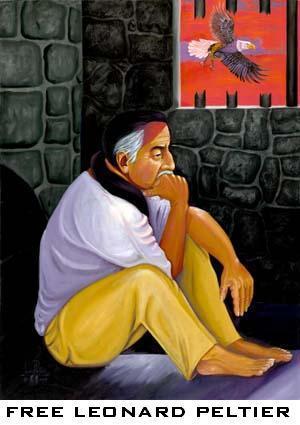
As for the DOJ speaking on doing right by "tribal justice": that's pretty hollow as long as Holder fails to open a civil rights investigation into the prosecution, conviction, and now - essentially - the condemnation of Lakota elder, American Indian Movement leader and political prisoner Leonard Peltier. How ironic that they pour all that money into the Rosebud reservation for "justice" - they've never seen justice from this country - while nothing but silence came from the White House regarding a pardon for Leonard. Leonard's friends and family articulated eloquently how he would fit back into the community in their appeal to the federal parole board this summer - he'd be no danger to the community. If anyone had a supportive place to go to from prison, it was him. It's his persistence in claiming his innocence that keeps him inside. That shouldn't give the state the right to keep punishing a man. It's long past time to get him back home.
We need to get them all back home...
-----------------
The Department of Justice is awarding $224 million to tribal communities to fund the renovation and construction of prisons and jails. (11/22/2009)
WASHINGTON — The Department of Justice is awarding
$224 million to tribal communities to fund the renovation and construction of prisons and jails.
The construction funding, which was announced by Associate Attorney General Tom Perrelli, is
part of more than $236 million in American Recovery and Reinvestment Act and fiscal year 2009 departmental public safety appropriations to criminal justice initiatives in tribal communities throughout the United States.
The funding package also includes
approximately $12 million as part of the Tribal Youth Program, which supports enhanced tribal efforts to prevent and control delinquency and improve the juvenile justice systems for American Indian and indigenous Alaskan youth. The provision of juvenile mental health services is a major focus of the program.
The funding is designed to allow tribes to explore community-based alternatives that help control and reduce problems of alcohol and substance abuse and related incarcerations to relieve jail-overcrowding pressures.
“None of these resources will matter if we do not direct them properly and at the issues that matter,” Perrelli says. “The department may be able to provide funding, but only by working together can we make sure tribal communities get what they need.”
The more than $224 million in construction funding will be administered by the Office of Justice Programs through the Correctional Facilities on Tribal Lands Program. The program, which takes account of detention bed needs and violent crime statistics in award decisions, provides resources to assist eligible American Indian tribes and Alaska native villages to construct or renovate correctional facilities on tribal lands.
In a speech to American Indian leaders, Perrelli said that money alone cannot fix the problems of tribal justice, while admitting that the federal government has not done an effective job with past funding initiatives.
“You cannot build a prison if there isn’t funds to staff it,” Perrelli says. “You cannot focus on detention without also looking at prevention and intervention programs that target tribal youth and help motivate them and turn their lives around.”
In recent months, Department of Justice officials joined tribal leadership and law enforcement experts for two working sessions leading up to October’s Tribal Nations Listening Conference in Minnesota, which was attended by Attorney General Eric Holder.
We want to engage substantively with our tribal leaders, to learn from their experiences, to listen to their insights, and to develop concrete initiatives that can make a real difference in the lives of Native Americans,” Perrelli says.
The conference forms part of an ongoing Justice Department initiative to increase engagement, coordination and action with American Indian communities on issues of tribal justice.
The renewed efforts to address crime issues comes at a time when tribal communities are increasingly plagued by high crime and rising domestic violence rates, expanding gang activity and unremitting levels of alcoholism and substance abuse.
The meetings are a step in the right direction, says Joe Shirley Jr., head of the Navajo Nation, which covers parts of Arizona, New Mexico and Utah.
The Department of Justice awarded tribal jurisdictions and reservations almost $90 million in ARRA funding for the construction of new adult and juvenile detention facilities in areas with high rates of violent crime and pressing bed space needs. More than $8 million is being directed to the renovation of existing detention facilities.
Justice officials awarded more than $116 million in federal stimulus monies to the construction of new single-tribe or regional multi-purpose justice centers and an additional $5.6 million for the construction of alternative sentencing facilities. The departmental funding to tribal communities also includes more than $4.4 million in technical and assistance funding for tribal correctional facilities.
In South Dakota, the Rosebud Sioux Tribe received a $25 million grant to construct an adult correctional facility with expanded capacity that provides greater support for cultural traditions in rehabilitating offenders.
The new facility will provide rehabilitative programs and services such as education, counseling, alcohol and suicide prevention programs, value-based cultural teachings and cultural preservation and faith-based programming.
The existing 66-bed facility, which is almost 30 years old and lacks an inmate custody and classification system, has been criticized for its outmoded layout and deteriorating condition that threaten the safety of inmates and staff.
The new facility will incorporate dedicated housing to segregate inmates with medical conditions, such as infectious disease, or special management issues.
“This funding will strengthen the efforts of the Rosebud Sioux Tribe to improve its tribal justice system and keep communities in Indian country safe,” says Stephanie Herseth Sandlin, U.S. representative (D-S.D.).
In Montana, the Chippewa Cree and Fort Peck tribes received more than $12 million each to build new jails to replace aging, outmoded, cramped and under-capacity facilities in their communities. The Confederated Salish and Kootenai tribes received $1.3 million for the renovation of an existing detention facility.
he Fort Peck tribe received $12.6 million to construct a new 100-bed jail. The existing facility, which is almost 30 years old and was built to accommodate 20 inmates, houses an average of almost 30 inmates.
The replacement facility could offer a range of re-entry, treatment and career programming.
The Chippewa Cree tribe received $12.3 million for a new 38,000-square-foot facility, which will incorporate the tribal police headquarters and separate 22-bed adult and 12-bed juvenile detention facilities. The existing jail and police facility is housed in a former fire station and can hold less than ten inmates.
The tribe also received almost $350,000 to improve its juvenile justice system and programs.
In New Mexico, the Ramah Navajo chapter receives $3.8 million to construct detention facilities for adult and juvenile offenders, while more than $5.6 million is being directed to the Eight Northern Indian Pueblos Peacekeepers to construct an alternative sentencing facility.
In Idaho, Shoshone-Bannock tribes received a $3.5 million grant to help complete construction work on a 66,200-square-foot justice center.
Once complete, the almost $20 million Fort Hall Justice Center will incorporate three courtrooms and separate detention areas to house up to 80 adult and 20 juvenile offenders.
In Arizona, more than $31.6 million will go to the Navajo Nation Public Safety Department for the construction of adult and juvenile correctional facilities, with more than $38.5 million allotted to a Navajo Nation justice center in Tuba City.
The award package also includes $450,000 for the Navajo Nation Judicial Branch, $350,000 for the pueblo of Acoma, and $250,000 for Pojoaque.
The pueblo of Nambe and Zuni received grants of $440,000 and more than $400,000, respectively, to provide educational, outreach, advocacy and victim support programs and services to increase awareness of sexual assault and domestic violence.
Construction Adult/Juvenile Detention Facility
Colorado Indian Tribes, Arizona - $4.5 million
Navajo Nation Department of Public Safety, Arizona - $31.6 million
Rosebud Sioux Tribe, South Dakota - $25.0 million
Fort Peck Assiniboine/Sioux, Montana - $12.6 million
Ramah Navajo Chapter, New Mexico - $3.8 million
Yakama Nation, Washington - $11.9 million
Construction Multi-Purpose Justice Center
Native Village of Kwinhagak, Alaska - $1.3 million
Pascua Yaqui Tribe, Arizona - $20.8 million
Navajo Nation Tuba City, Arizona - $38.5 million
Tule River Tribal Council, California - $3.0 million
Chippewa Cree Tribe, Montana - $12.3 million
Puyallup Tribe of Indians, Washington - $7.9 million
Eastern Band Cherokee Indians, North Carolina - $18.0 million
Shoshone-Bannock Tribes, Idaho - $3.5 million
Nisqually Tribe, Washington -$10.7 million
Existing Detention Facility Renovation
White Mountain Apache Tribe, Arizona - $900,000
Confederated Salish Kootenai, Montana - $1.3 million
Yankton Sioux Tribe, South Dakota $5.8 million
Confederated Tribes of Chehalis, Washington - $200,000
Alternative Sentencing Facility Construction
Eight Northern Indian Pueblos Council, New Mexico - $5.6 million
Training/Technical Assistance
Justice Solutions Group, New Jersey - $4.4 million
Source: Department of Justice
http://www.correctionalnews.com/ME2/Audiences/dirmod.asp?sid=&nm=&type=news&mod=News&mid=9A02E3B96F2A415ABC72CB5F516B4C10&tier=3&nid=E072950A43F04ADB88904675CD925CDD
This and other news about the financing of prisons can be found at www.realcostofprisons.org/blog/















 Posts
Posts