Took this important story off a Spacebook site. PHX Food Not Bombs will be participating in some fashion. Read on for more info...this is really troubling.
---------------GLOBAL SOLIDARITY WITH FOOD NOT BOMBS---------------
Arresting Food Not Bombs is Censorship! Support the Orlando Volunteers!
Global days of action May 18 - 24, 2011
"There has to be some kind of (police) action. At this point it seems to be a political statement on their part not a food give away issue."
SAN FRANCISCO POLICE SPOKESMAN JERRY SENKIR 1988
"They don't want to feed the hungry, they just want to make an anarchist type statement and we aren't going to allow it."
SAN FRANCISCO POLICE CAPTAN DENNIS MARTEL 1989
"I certainly hope that law abiding citizens that are not out to make mischief would adhere to the ordinance."
ORLANDO BUDDY DYER 2011
On April 12, 2011 the Eleventh Circuit Court of Appeals ruled that the City of Orlando could limit Food Not Bombs right to share information and food to the public to twice a year per park. Other Florida cities may follow Orlando's path. This ruling comes at a time when the message of Food Not Bombs is more important than ever. Poverty and hunger are increasing as military spending grows and public investment social services, education and healthcare are slashed. The city of Orlando could begin its arrests of Food Not Bombs volunteers as early as May 18, 2011, the first meal 30 days after the ruling. Food Not Bombs groups have been invited to share free food and literature under their banner that week in a global defiance of this order.
The authorities don't object so much to the groups feeding of the hungry. What worries government and corporate leaders is our message. The San Francisco police made this clear in 1988 when they offered to provide city buses to take the hungry out to an armory at Ocean Beach telling the media that they didn't object to our providing food and that the problem was that we were "making a political statement" and that was not allowed.
Global days of action May 18 - 24, 2011
"There has to be some kind of (police) action. At this point it seems to be a political statement on their part not a food give away issue."
SAN FRANCISCO POLICE SPOKESMAN JERRY SENKIR 1988
"They don't want to feed the hungry, they just want to make an anarchist type statement and we aren't going to allow it."
SAN FRANCISCO POLICE CAPTAN DENNIS MARTEL 1989
"I certainly hope that law abiding citizens that are not out to make mischief would adhere to the ordinance."
ORLANDO BUDDY DYER 2011
On April 12, 2011 the Eleventh Circuit Court of Appeals ruled that the City of Orlando could limit Food Not Bombs right to share information and food to the public to twice a year per park. Other Florida cities may follow Orlando's path. This ruling comes at a time when the message of Food Not Bombs is more important than ever. Poverty and hunger are increasing as military spending grows and public investment social services, education and healthcare are slashed. The city of Orlando could begin its arrests of Food Not Bombs volunteers as early as May 18, 2011, the first meal 30 days after the ruling. Food Not Bombs groups have been invited to share free food and literature under their banner that week in a global defiance of this order.
The authorities don't object so much to the groups feeding of the hungry. What worries government and corporate leaders is our message. The San Francisco police made this clear in 1988 when they offered to provide city buses to take the hungry out to an armory at Ocean Beach telling the media that they didn't object to our providing food and that the problem was that we were "making a political statement" and that was not allowed.
After 1,000 arrests the San Francisco Police used a more effective strategy. They figured out a way for the group to discontinue bringing literature and a banner to the meals. San Francisco Food Not Bombs slowly became invisible and they fed less and less people. People passing the meal assumed they were a well meaning church group. The discussions about national priorities ended. Instead of feeding two or three hundred people the group was sharing food with forty or fifty of the cities most needy people at a time when more people need food and the economy was in decline.
People that happened to know this meal was organized by Food Not Bombs naturally assumed this was the method that had inspired ten years of police repression and reproduced the food only meals in other cities around the United States. Those groups were sending the message that as long as we are providing food to the hungry our political and economic system is fine. Most people had no idea they were part of a global movement organized to change society so no one had to rely on a soup kitchen for food and that everyone would have the freedom to eat when and where they wished without having to worry about where their next meal would be coming from. The impact of sharing food, information and conversation with hundreds of people with the goal of inspiring social change and rebellion was absent.
When millions of Americans go hungry each day how can we spend half the federal budget on preparing for war? In the past year San Francisco Food Not Bombs is turning this image around. Encouraging this debate is easy. Collect stacks of literature from local organizations, print up some flyers about Food Not Bombs, place them in a bag or box and place your Food Not Bombs banner on top. Take this to the meal, set out the literature and hang the banner in a way where the most people possible can see it and start sharing your tasty vegan dishes. After two hours dozens of people, maybe hundreds will have contemplated the idea that we really can end hunger and poverty if only we redirected our resources from wasteful programs like the military. Repeat this every week and before long as happened in Iceland at our weekly Food Not Bombs action people will be marching to the parliament and inspiring change.
We first realized the power of sharing vegan meals and literature on March 26, 1991 when the first Food Not Bombs collective dressed as hobos and shared soup outside the stockholders meeting of the National Bank of Boston to protest their investment in Seabrook Nuclear Power Station. Over 50 people came to share food and express concern about the dangers of the nuclear industry. We were attempting to build popular support against the nuclear industry. We were seeking to stop the board of directors from investing their depositor's money on risky and dangerous projects. Projects that could lead to nuclear meltdowns, ecological collapse or as Reagan suggested, nuclear war. The Board of directors of the Bank of Boston also sat on the board of Babcock and Willcox, the company that was building Seabrook Nuclear Power station and many of them also sat on the board of the Public Service Company of New Hampshire who was buying the power station. These bankers also profited from the nuclear weapons industry. Their policy of lending themselves millions of dollars with little public oversight was reminiscent of the bank practices that caused the Great Depression in the 1930's.
We decided to make that point visible by dressing as hobos and setting up a soup line outside the annual stockholders meeting of the bank. I was a produce worker and discarded several cases of produce every morning so soup was an easy vehicle for our protest. As we prepared tour huge pot of soup we became concerned that there would not be enough people participating to represent a Depression era soup line so I went down to the Pine Street Inn and told the assembled homeless that we were planning a protest at noon outside the Federal Reserve Bank at South Station. They responded with excitement about the protest. Even so we were surprised when over 50 people showed to partake of the first Food Not Bombs meal.
We first realized the power of sharing vegan meals and literature on March 26, 1991 when the first Food Not Bombs collective dressed as hobos and shared soup outside the stockholders meeting of the National Bank of Boston to protest their investment in Seabrook Nuclear Power Station. Over 50 people came to share food and express concern about the dangers of the nuclear industry. We were attempting to build popular support against the nuclear industry. We were seeking to stop the board of directors from investing their depositor's money on risky and dangerous projects. Projects that could lead to nuclear meltdowns, ecological collapse or as Reagan suggested, nuclear war. The Board of directors of the Bank of Boston also sat on the board of Babcock and Willcox, the company that was building Seabrook Nuclear Power station and many of them also sat on the board of the Public Service Company of New Hampshire who was buying the power station. These bankers also profited from the nuclear weapons industry. Their policy of lending themselves millions of dollars with little public oversight was reminiscent of the bank practices that caused the Great Depression in the 1930's.
We decided to make that point visible by dressing as hobos and setting up a soup line outside the annual stockholders meeting of the bank. I was a produce worker and discarded several cases of produce every morning so soup was an easy vehicle for our protest. As we prepared tour huge pot of soup we became concerned that there would not be enough people participating to represent a Depression era soup line so I went down to the Pine Street Inn and told the assembled homeless that we were planning a protest at noon outside the Federal Reserve Bank at South Station. They responded with excitement about the protest. Even so we were surprised when over 50 people showed to partake of the first Food Not Bombs meal.
We set out literature including the details of how the board members of the bank also controlled companies like General Electric, Raytheon and other leaders in military contracts. We also shared literature from the War Resisters League showing that half the federal budget was spent on the military.Our banner and literature caught the attention of stockholders and business people passing our table and before long men in expensive suits were having serious conversations with people that often slept at the Pine Street Inn. People that never spoke to one another discovered that there wasn't much difference between them. Our literature inspired debate on the issues of military spending and the real security of housing, education, healthcare and food.
Thirty years later the world is facing the most lethal nuclear disaster since the atomic bombings of Japan. The Fukushima Daiichi nuclear power station is on the verge of melting down. The global economy is in crisis due to the policies of bankers investing for their own benefit. Experts might call it the "Great Recession" but for billions of people it feels more like a Great Depression is on the horizon. Bank executives lobbied for deregulation, sold bad mortgages, reaped the profits letting the economy collapse. Food prices are increasing at fastest pace in thirty years as speculators move to invest in commodities. At the same time the Supreme Court ruling in the Citizens United case claims that corporations have the First Amendment right to spend unlimited money to influence American politics while the Eleventh Circuit Court of Appeals ruled that Food Not Bombs is limited to express it's message to twice a year per park in Orlando. Food Not Bombs volunteers are defying the ruling and continue to share food and literature under the banner Food Not Bombs willing to risk arrest to defend the First Amendment right to express our message that food is a right and not a privilege and that real security could be achieved by diverting military spending towards human needs.
When the San Francisco police started arresting us in 1988 they told the media that they didn't have a problem with us feeding the hungry but that Food Not Bombs was trying to make a "political statement" and they wouldn't "allow that." The banner and literature were the first targets of the police during the nearly nine years of arrests and beatings in San Francisco. When it was clear that strategy was backfiring the police developed a more effective policy of sending informants to discourage the use of banners and literature. Having erased the political statement Food Not Bombs was free to share food and the chapter slowly devolved into the environment feeding less and less hungry, recovering less and less food and retaining fewer volunteers until it became an invisible "Nine Gallons" of soup as described in Susie Cagle's graphic novel.
Thirty years later the world is facing the most lethal nuclear disaster since the atomic bombings of Japan. The Fukushima Daiichi nuclear power station is on the verge of melting down. The global economy is in crisis due to the policies of bankers investing for their own benefit. Experts might call it the "Great Recession" but for billions of people it feels more like a Great Depression is on the horizon. Bank executives lobbied for deregulation, sold bad mortgages, reaped the profits letting the economy collapse. Food prices are increasing at fastest pace in thirty years as speculators move to invest in commodities. At the same time the Supreme Court ruling in the Citizens United case claims that corporations have the First Amendment right to spend unlimited money to influence American politics while the Eleventh Circuit Court of Appeals ruled that Food Not Bombs is limited to express it's message to twice a year per park in Orlando. Food Not Bombs volunteers are defying the ruling and continue to share food and literature under the banner Food Not Bombs willing to risk arrest to defend the First Amendment right to express our message that food is a right and not a privilege and that real security could be achieved by diverting military spending towards human needs.
When the San Francisco police started arresting us in 1988 they told the media that they didn't have a problem with us feeding the hungry but that Food Not Bombs was trying to make a "political statement" and they wouldn't "allow that." The banner and literature were the first targets of the police during the nearly nine years of arrests and beatings in San Francisco. When it was clear that strategy was backfiring the police developed a more effective policy of sending informants to discourage the use of banners and literature. Having erased the political statement Food Not Bombs was free to share food and the chapter slowly devolved into the environment feeding less and less hungry, recovering less and less food and retaining fewer volunteers until it became an invisible "Nine Gallons" of soup as described in Susie Cagle's graphic novel.
Church groups handed out their bible tracts and potential volunteers called discouraged that they had gone to United Nations Plaza but could not find Food Not Bombs. Those activists that were persistent and learned that it was Food Not Bombs started their local chapters based on their impression that the San Francisco group was he most significant chapter and reproduced the model sharing vegan meals without literature and a banner not realizing volunteers had suffered violent beatings, torture and faced long prison sentences defending the First Amendment Right to share literature under the banner Food Not Bombs. Food Not Bombs volunteers in San Francisco are working hard to make sure banners and literature are at every meal. Authorities will not silence their message. Their visible presence is sure to encourage more volunteers, food donations and attract more hungry to their meals. Their historic position in the Food Not Bombs world is sure to inspire a stronger more visible challenge to a militaristic United States as they influence the use of banners and literature at chapters all over the United States at this critical time.
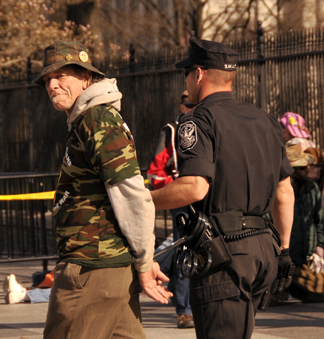
April 5, 2007 Orlando Food Not Bombs activists Eric Montanez, was arrested for sharing food with more then 24 people in violation of the cities "Large Group Feeding Permit" law. Eric was found innocent and a Federal judge ruled the law unconstitutional and a violation of our First Amendment right to Free Speech but on April 12, 2011 the Eleventh Circuit Court of Appeal ruled the city could restrict Food Not Bombs to sharing it's message and food to twice a year per park. The message that resources should be redirected from the military to basic human needs should be supported. The impact of showing volunteers are able to provide nutritious vegan meals to hundreds of hungry Americans while encouraging conversation on our national priorities should happen every day on every corner and park in every town and city in the United States not restricted to twice a year per park.
The United States is not alone in attempting to silence Food Not Bombs. The Belarus dictator Alexander Lukashenko is also ordering the arrest of our volunteers each week in Minsk attempting to silence efforts to develop a free and democratic future.
A young Tunisian produce worker Tarek al-Tayyib Muhammad Bouazizi set himself on fire on December 17, 2010 fed up by police abuse and high price of food sparking a global wave of uprisings. Those wealthy bankers are seeking to squeeze every last cent out of an increasingly desperate people. Hunger and cruelty of the super rich is sparking a global uprising. The billionaires are responding by murdering their people. The global revolt is spreading from Tunisia, Egypt, Oman, Libya, Bahrain, Yemen, Algeria to China, Korea and the United States. People are rising up from Wisconsin and Michigan to England, Iceland, Greece, Croatia, and France. Replacing failed social structures with a sustainable system maybe more difficult then over throwing governments.
April 5, 2007 Orlando Food Not Bombs activists Eric Montanez, was arrested for sharing food with more then 24 people in violation of the cities "Large Group Feeding Permit" law. Eric was found innocent and a Federal judge ruled the law unconstitutional and a violation of our First Amendment right to Free Speech but on April 12, 2011 the Eleventh Circuit Court of Appeal ruled the city could restrict Food Not Bombs to sharing it's message and food to twice a year per park. The message that resources should be redirected from the military to basic human needs should be supported. The impact of showing volunteers are able to provide nutritious vegan meals to hundreds of hungry Americans while encouraging conversation on our national priorities should happen every day on every corner and park in every town and city in the United States not restricted to twice a year per park.
The United States is not alone in attempting to silence Food Not Bombs. The Belarus dictator Alexander Lukashenko is also ordering the arrest of our volunteers each week in Minsk attempting to silence efforts to develop a free and democratic future.
A young Tunisian produce worker Tarek al-Tayyib Muhammad Bouazizi set himself on fire on December 17, 2010 fed up by police abuse and high price of food sparking a global wave of uprisings. Those wealthy bankers are seeking to squeeze every last cent out of an increasingly desperate people. Hunger and cruelty of the super rich is sparking a global uprising. The billionaires are responding by murdering their people. The global revolt is spreading from Tunisia, Egypt, Oman, Libya, Bahrain, Yemen, Algeria to China, Korea and the United States. People are rising up from Wisconsin and Michigan to England, Iceland, Greece, Croatia, and France. Replacing failed social structures with a sustainable system maybe more difficult then over throwing governments.
But still there is an urgent desire to bring democracy, dignity, basic necessities, if nothing else some sanity to our world. The richest 2 percent already own over half the world's wealth and resources. And they seem to want more even though nearly a billion people go hungry each day. Are we really prepared to allow our last penny to be delivered to the ruthless destroyers of our future?
As the Food Not Bombs faces repression in the United States we are witnessing unprecedented disasters stemming from the public's cooperation with a mad political and economic system. We let the billionaires lead us to this point. Too many of us bought their products and their philosophy. The owners of BP continue to live in spender after they commanded one of the world's worst oil gushers as do the Wall Street executives that plunged millions into unemployment, homelessness and hunger. These mad men claim ownership of billions of suffering animals farmed in factories, the genetics of our food seeds, acres of ancient forests, gallons of fresh water, oil, gas and minerals all treated as products to be sold to a world of consumers.
Now we are a world of consumers without money, shelter, food or dignity. Consuming war, radioactive fallout, near slavery and toxic "food." What near apocalyptic event or poverty inducing theft is in our future? While ladling soup outside stockholders meeting we were concerned that we could face a future of nuclear disasters, environmental catastrophes and a global economic collapse. We urged those visiting our first Food Not Bombs meal to join us in building resistance to the policies that could bring ruin to our world. Our literature and speech invited them to withhold their support of the "culture of death" and join us in transforming society.
Maybe by practicing democracy using consensus in our groups or sowing hope and a feeling of abundance with our sharing of vegan meals we would have some influence in our community. Thirty years later it is clear that our concerns were well founded and the need for change couldn't be more urgent. There has never been a time when encouraging dialog on the issue of redirecting military spending towards food, healthcare and education is more urgently needed. Defying the courts order to restrict our ability to reach the public with our message and feed as many people as possible is our obligation under the current conditions.
Back in 1981 we could not have seen was that our tiny theatrical soup line would be joined by thousands of others. Not only seeking to end their own painful hunger but to join us in our effort to stop the web of disastrous policies. Each crisis has inspired another wave of volunteers eager to participate with Food Not Bombs. Eager to take a stand and feed the hungry. Rushing to participate, having been forced into poverty or inspired to insurrection by the untenable conditions.
We are eager to welcome you to our table. There is enough for everyone if we withdraw our support for the system of exploitation and have the passion to implement a nurturing community where everyone's ideas are respected. Cultivate community and reap revolution. Cook for peace and transform the world with food not bombs.
Orlando Large Group Feeding Permit Law
Back in 1981 we could not have seen was that our tiny theatrical soup line would be joined by thousands of others. Not only seeking to end their own painful hunger but to join us in our effort to stop the web of disastrous policies. Each crisis has inspired another wave of volunteers eager to participate with Food Not Bombs. Eager to take a stand and feed the hungry. Rushing to participate, having been forced into poverty or inspired to insurrection by the untenable conditions.
We are eager to welcome you to our table. There is enough for everyone if we withdraw our support for the system of exploitation and have the passion to implement a nurturing community where everyone's ideas are respected. Cultivate community and reap revolution. Cook for peace and transform the world with food not bombs.
Orlando Large Group Feeding Permit Law
Except for activities of a governmental agency within the scope of its governmental authority, or unless specifically permitted to do so by a permit or approval issued pursuant to this Chapter or by City Council: (a) It is unlawful to knowingly sponsor, conduct, or participate in the distribution or service of food at a large group feeding at a park or park facility owned or controlled by the City of Orlando within the boundary of the Greater Downtown Park District without a Large Group Feeding Permit issued by the City Director of Families, Parks and Recreation or his/her designee. (b) It is unlawful to fail to produce and display the Large Group Feeding Permit during or after a large group feed- ing, while still on site, to a law enforcement officer upon de- mand. It is an affirmative defense to this violation if the offender can later produce, to the City Prosecutor or the Court, a Large Group Feeding Permit issued to him/her, or the group, which was valid at the time of the event. (c) The Director of Families, Parks and Recreation or his/her designee shall issue a Large Group Feeding Permit upon application and payment of the application fee as es- tablished by the City. Not more than two (2) Large Group Feeding Permits shall be issued to the same person, group, or organization for large group feedings for the same park in the GDPD in a twelve (12) consecutive month period. (d) Any applicant shall have the right to appeal the denial of a Large Group Feeding Permit pursuant to appeal procedure in Section 18A.15 with written notice to the Director of Families, Parks and Recreation and with a copy to the City Clerk.
FOOD NOT BOMBS GATHERING - Orlando Florida
Wednesday, May 18, 2011 - Orlando Food Not Bombs City Hall Action - Risk arrest sharing vegan meals and literature under the banner Food Not Bombs at 400 South Orange Avenue and the corner of South Street in Orlando, Florida
Friday, May 20, 2011- Opening show at the Banana Hammock in Orlando, Florida
Saturday, May 21st and Sunday, May 22, 2011 - Florida Food Not Bombs Gathering - Communications Workers of America Union Hall - Local 3108 - 2220 Edgewater Drive, Orlando, FL 32804 - All Food Not Bombs groups and activist groups are welcomed, Co hosted with One Struggle, and Direct action South Florida. We will be discussing how to build a stronger Food Not Bombs movement in Florida and how to build a stronger anti-capitalist movement in Florida
(Photo: Eric Montanez arrested sharing food and literature in Orlando, Florida)
http://www.foodnotbombs.ne

















 Posts
Posts