I hope you found your way here because you share a desire to abolish the prison industrial complex, or are at least curious about what prison abolition is. It took me a number of months of research and feedback from a couple of professors who are abolitionists to figure out what the movement was about, and to clarify what abolition meant to me.
I fell into this first through taking a class on capital punishment, taught by a former judge who had once helped author Arizona's post-Furman death penalty statutes. The weight of the evidence that capital punishment was so often applied in a racist, classist way (which not surprisingly catches the innocent) ultimately compelled him to change his position on the death penalty - something I found out only after the semester was over, as he didn't want to sway students by articulating his own position. He did a good job of just presenting evidence for both sides of the argument. Presenting both sides is not my intent here, however.
I understand the impulse for vengeance and retribution, and have heard the case that state executions still serve as a deterrent to potential murderers, but I don't know how any thoughtful American could examine the institution of capital punishment - I mean, really dig into Supreme Court cases (including dissents) and law journals - and not commit themselves to ending it.
At the same time I was getting deeper into my research (which focused primarily on the death penalty and the Bible Belt) I was taking a class on Social Movements and another class on Wealth Distribution and Inequality. From these I learned more about race and class in the broader criminal justice system, COINTELPro, political prisoners, and the PIC Abolition Movement. I not only read work by abolitionists such as Angela Davis, Joy James, and Ruth Wilson Gilmore, but I also read some of the works that seemed to originally radicalize some of them.
I considered whether or not I was really an abolitionist myself, or just a reformer. That question got into some deeply held beliefs and buried traumas that were necessary to confront before I could answer it. Bottom line, after I did all my research, is that the question I had to ask myself was whether I was just another white liberal who didn't condone (or actively work against) racism or classism, or if I was an anti-racist who fought against it in all its forms - beginning with racism's manifestation in me.
I came out an abolitionist, and signed up for a class on Prison Social Movements.
Most of us can agree, I think, that prisons are an extraordinarily expensive way to deal with manifestations of drug addiction, the consequences of poverty, and the fear of people who act on political or religious beliefs outside of the "mainstream" (white middle-class America). I suspect that those of us who abstain from "criminal activity" do so not because of what the state might do to us, but because we grew up believing it was morally wrong to steal, kill, cheat, and so on. Christian or not, most of us have some version of the Golden Rule in our conscience, and we strive to get through life without hurting others - an impossible task, given all the levels of hurt there are. But we try.
When one's ethical standards are compromised by trauma, mental illness, addiction, grief, desperate economic conditions, and fear we collectively respond with police to remove that person from our presence, instead of confronting them with a community norm on non-violence and proceed to exemplify it by helping them find other ways of meeting their needs, instead of subjecting them to the terrifying potentials of state violence.
For example,
Marcia Powell, a 48 year old mother diagnosed with manic depression and treated with psychotropic drugs was sentenced to 27 months in prison for prostitution. 27 months. That seems extreme, even with prior offenses and a history of addiction. What actually happened to her was worse.
I never would have known about Marcia and her prison sentence except that
she died this week after 4 hours in an outdoor, unshaded chain-link cage (like a dog pen) in midday desert heat. AZ corrections officials assert that the cage was solely being used as a temporary holding place for prisoners being transferred, implying that her involvement in a disturbance just necessitated segregation, perhaps for her own protection - and explicitly denying that she was caged under the Arizona sun as a form of discipline. According to a volunteer there, prisoners complain that
punishment is precisely what the cages are used for.
Arizona's prison policies actually allow the use of such outdoor cages (though not for discipline), so long as prisoners are provided water (shade is not required) and stay out no longer than 2 hours. Ultimately she died within 20 feet - within eyesight - of the air conditioned prison guards responsible for monitoring her through their window.
One of the linked articles did note that though she was diagnosed bi-polar she was on medications "used to treat schizophrenia". There's often an overlap of symptoms and treatment regimens for those illnesses. In any event,
such medications (psychotropics) almost always warn of an elevated risk of heat stroke. People being treated with these drugs shouldn't even be left in the sun for two hours. The fact that the Perryville prison complex incarcerates a number of folks with mental illness suggests medical malpractice on the part of a prescribing physician if he/she failed to advise against caging prisoners in the sun. This is basic pharmacy 101 - the link I provided to that info isn't even a medical site.
My first response to Marcia's death was outrage - I wanted those responsible from the guards on up to be prosecuted and punished for their "reckless disregard" for human life. I wanted them imprisoned for at least the 46 years that the leader of a local burglary ring got for stealing rich people's possessions (so far as I know he never assaulted them). Then I thought, if a new way of responding to violence doesn't come out of this, then what will it take for me to really change? What would justice for Marcia look like? And what would it mean to those responsible for her death and their families? And would it keep this from happening again?
Justice doesn't begin and end with prosecution and punishment. As convenient as it may be to see this incident as an aberration - like we thought Abu Ghraib was, until more evidence of torture emerged - it's not uncommon. And it's not all about the guards or prison administrators, I figured; it's about us, too.
What is it we do as a society that reduces those we select for removal, isolation, and confinement to subhuman status in the eyes of their keepers, and the minds of the rest of us. Every news article about this woman showed her dissheveled, terrified mug shot,
described her troubled life, identified that her kids (if they acknowledged her motherhood at all) are "lost" in the foster care system - their abandonment is presented almost as another of her long list of crimes, which presumably justify her incarceration and being subject to abuse.
Marcia's picture exposes her fear, poverty, confusion, despair, shame, and a host of missing teeth suggesting a history of victimization. Her eyes are windows to a soul who looks as if she's been trapped behind bars, walls, and locked doors most of her life; never really free - never really safe - whether on the inside or out. She sure wasn't free and safe selling herself for survival.
Sadly, we never did right by people with severe mental illness even before de-institutionalization. 40 years ago Marcia would have probably been getting neglected or abused in a state psychiatric facility instead of a prison. Maybe she was. We can learn from that era of de-institutionalization - if we don't do abolition right, then deviant and desperate people just go from one oppressive institution to another. That's called transinstitutionalization. We don't want to go back to what used to be called psychiatric hospitals.
So I asked myself what I could do to help get justice for Marcia, and for all those other folks - people's moms and dads and kids and siblings locked away - who suffer and die in the custody of the state. Rally outside the prison with mental health activists? Lobby local legislators on jail alternatives for the mentally ill? Demand the prosecution and incarceration of those responsible, so that they might know the feelings of helplessness, humiliation and dehumanization prisoners endure? So that they might be raped, beaten, drugged, murdered or - for their own protection - placed in solitary confinement for years and go mad?
In other words, does going from one bad option to another really set people free? And does inflicting the same kind of harm on Marcia's killers that the PIC inflicted on her constitute justice? And does not invoking the full force of the PIC against DOC employees mean that they're "getting away" with her murder? Won't it embolden other corrections officers and cops if there's no criminal charges filed for their extreme indifference to human life?
Or is there something, perhaps, that the community can do to find out how this happened, challenge the policies of the department of corrections, and hold the individuals involved responsible for coming up with solutions - alternatives to putting people in cages - and for pouring their blood, sweat and tears into making prison alternatives work. "Sentencing" them to the years of hard labor it takes to restore run down housing so people like Marcia can live in it is hardly typical "community service", because it's not just about hammers and nails - it's about zoning ordinances and business opposition and people worried about more crime and neighborhood resources being inadequate to support high needs individuals - whether they're 'criminals' or ordinary senior citizens.
Going through something like siting a supported housing program (which can take years of 60-hour work weeks) can change a person in a fundamentally more positive way than rotting in prison for manslaughter. It forces one to make personal sacrifices, to take a stand for social justice, and to interact with other social justice activists. That kind of work sure changed me. And I think it would be a better way to make amends to the community than putting Marcia's killers in prison. It's too late for them to make amends to her.
If they succeed, we will all be the better off for it, and they will have perhaps evolved beyond the point where they might abuse power like that again. By thinking outside the narrow confines of what we've been told is justice, we could not only eliminate the use of these cages and promote systemic life-saving reforms, but we could use the need for 'offenders' to make restitution and some kind of reconciliation by creating more safe places for the vulnerable people in our communities. Prison sentences may satisfy a certain amount of vengeance and make us think we're safe, but they were never designed to allow for restitution and reconciliation (even when judges order restitution, prisoners make pennies a day - they can't support their own children, much less compensate for the loss of someone's property, freedom, limb, or life.)
Before I heard about Marcia I had learned that there are impoverished city blocks in sections of New York on which the state spends 1 million dollars a year on keeping residents from those neighborhoods in prison. New York is but one state that spends more on incarcerating people of color than it does on educating them. I wondered what that money could do if invested directly in the community, and how things would look if the community took direct responsibility for creating alternatives to "criminal justice", like Neighborhood Watch groups that serve not to catch or surveille potential criminals, but that instead serve as back-up support for neighbors who have no food, families facing foreclosure, youth exploited by the drug and alcohol industries, former prisoners shut out of work and educational opportunities, latch-key children, and all those most vulnerable to becoming victims of both interpersonal and state violence - the young, the old, the homeless, the disabled, the poor, women, and people of color.
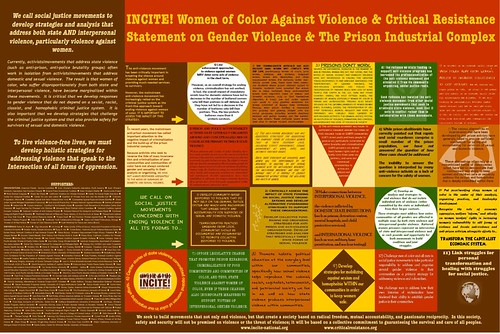
Abolition isn't just about closing prisons and turning molesters and murders out on the streets - I too would have a problem with that. It's about local control over public funds that improve public safety, implement options for reconciliation, restitution, and treatment for those who harm others, assure that basic needs (housing, food, safety, health care, etc.) for community members are met, educate all ages on non-violent conflict resolution approaches, and transform our seige mentality about crime into an understanding of the complexities of human needs and behavior and an earnest sense of responsibility to eradicate the physical, social, and ideological structures that perpetuate both individual and state violence in American society.
At least that's what PIC abolition means to me right now. I still have a lot to learn, and am aware I need to be changing my thought patterns and language when referring to parties and institutions affected by or constituting the prison industrial complex. Reading abolitionist literature helps - much of it is quite scholarly and sound. Critical Resistance (see links) has been a fabulous resource for developing an abolitionist consciousness and concrete tools. Many of the "books to prisoners" projects are organized by anarchists and other abolitionists, rather than libraries, and my correspondence with some of these groups has been quite eye-opening. I'm considering trying to form such a collective here in Tempe (hence my email, 'radicalreads'), which would serve not only as a mechanism for filling book requests from prisoners, but also as a way of gathering with like-minded people over our shared humanity with prisoners to figure out how our community can stop depending so much on cops with guns locking scary people up in cages.
So, if this is your calling too, I'd love to hear from you - my email is at the top of the page. In the meantime, I'll try to keep current on posts about Marcia Powell's life and death and where we go from here.
Peace.


















 Posts
Posts