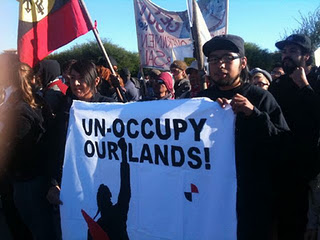
The Indigenous call-out in Arizona to resist ALEC
(November 2011)
Inside ALEC: Naked Contempt for the Press and Public in Scottsdale
by:
Beau Hodai, PRWatch
| Report
"Mr. Hodai had a history at the conference--not a very pleasant history. He was considered to be a persona non grata..."
-- Westin Kierland General Manager Bruce Lange to Olivia Ward of the Toronto Star.
ALEC's Corporate Connections


Evicting a Paying Hotel Guest Whom ALEC Did Not Want Nearby
-- Westin Kierland General Manager Bruce Lange to Olivia Ward of the Toronto Star.
Evicting the Press, Part 1: Meet Mr. Black
Scottsdale, Arizona--A suburb awash in money and golf courses, set
against the backdrop of the jagged mountains surrounding Phoenix.
I was sitting in a sports bar of the Westin Kierland Resort and Spa,
swapping journalism stories with Olivia Ward of the Toronto Star on one
of the bar's overstuffed leather couches. Over the course of an hour,
the bar filled with conventioneers from the American Legislative Exchange Council's 2011 States and Nation Policy Summit (SNPS). (A new story on Westin's connections to other ALEC corporations is available here.)
My assignment was to cover the 2011 SNPS, taking place at the resort
from November 29 through December 2. ALEC had refused to grant me media
credentials. Nevertheless, I was a paid guest at the resort.
Most of the ALEC members trickling into the bar were fresh from the
ALEC "Holiday Gala." As drinks were consumed and new rounds were ordered
by guys with ALEC badges, the place began to take on a distinct "Animal
House" vibe.
Ward and I were just about to head to our rooms for the night when I
saw Phil Black, director of Kierland's security team, approach two
uniformed police officers just outside the entrance to the bar. The cops
had arrived an hour earlier, glanced at Ward and me, then stationed
themselves by the door.
Black entered the bar and headed straight towards me. "Would you mind coming with me, sir?"
Once outside the bar, we were joined by the cops and I was shuffled up the stairs.
"What's this all about?" I asked with Black facing me; a cop to either side, just behind me.
"We understand that you've attempted to enter ALEC events and been asked to leave numerous times," said Black.
This was not true. I had been on my best behavior. And, I had known,
since my first meeting with Black the night before, that I was being
watched.
Police with a Photo Array of Personas Non Grata
The previous night, I had passed by some cops. When I glanced back I
caught one of the cops staring, a look of intense and painful
concentration on his face, at a sheet of paper. The paper displayed an
array of photos. As was later explained to me by a cop working the
resort, it was a photo array of personas non grata provided to the cops
via ALEC.
Moments later, after passing the cluster of cops, I was flagged down by
a man who asked me who I was, why I was in Scottsdale, where I was
from, what line of business I was in.
I gave vague answers and asked who he was.
"Oh, I'm with the hotel," said Black. "Have a nice stay."
Uniformed Police as Bouncers
The next night, I had wandered back into the ballroom where a swirling
galaxy of well-dressed lawmakers and lobbyists were hobnobbing, some
with neat single malts in hand. There was no indication posted anywhere
that this party was limited to ALEC members. Nevertheless, I had been
tailed through the ballroom by a cop. As I stepped outside for a smoke, I
heard a voice behind me.
"Sir, are you part of the delegation?" It was a uniformed police
officer later identified as Phoenix Police Department (PPD) Sergeant
Lowe. I explained that I was not a member of ALEC, but that I was a
guest at the resort. Lowe explained that the party was private and asked
me to return to resort common areas.
Making my way to the door, Lowe in tow, I was approached by two women with resort security.
"Hi ... you're the one on the motorcycle, right? You're with ALEC?
You're a guest at the resort? Just so you know, this is a private
function, so we just ask that all our regular guests stay in the main
area... Okay?"
No problem. I left.
"The ALEC People Don't Want You Here ..."
So, when Black accosted me at the bar the following night and claimed I
had been asked to leave numerous ALEC events at the hotel, I explained
that this was the extent of my one and only 'incident' and nodded to
Sgt. Lowe over my left shoulder. "Ask him," I said.
"Nevertheless," said Black. "The ALEC people don't want you here ...
and we understand that your reservations were made under false
pretenses."
I asked Black why--given the fact that I had not been accused of any
crime--I was surrounded by armed, uniformed cops. Were Phoenix police
usually engaged in evicting hotel guests who were suspected of having
made hotel reservations under supposedly "false pretenses?" Must be a
slow night....
And, how could a person even make a hotel reservation under false
pretenses, I asked. I had given the front desk my valid photo driver's
license and my credit card for incidental expenses. I was planning to
stay in the resort for two days and those two days had been paid for by
the Center for Media and Democracy (CMD).... "False pretenses?"
Black would not elaborate further, limiting his conversation only to
statements emphasizing the resort's urgent need for me to vacate the
premises immediately.
Black said that he would--with the help of these nice police officers--escort me up to my room and help me pack.
I was, as Sgt. Lowe explained, being "trespassed"--which meant that I
was being formally advised that I was not welcome on Kierland property.
If I returned, or refused to leave following this advisory, I would be
arrested and charged with criminal trespassing.
ALEC's Corporate Connections
ALEC bills itself as being the nation's largest bipartisan legislative
membership organization, dedicated to the advancement of "federalism"
and "Jeffersonian ideals."
The simple reality of ALEC is that the organization serves as an intermediary,
a conduit through which roughly 2,000 state legislators (the vast
majority of which are Republicans) are connected with legions of
lobbyists representing more than 300 global and national corporations.
Corporations pony up enough cash to help pay the travel, room, and
dining expenses of hundreds of state lawmakers at luxury resorts through
"scholarships"
facilitated by ALEC. After closed-door meetings between lobbyists and
politicians voting as equals on "model legislation," politicians often
return to their home state to introduce those bills covering almost
every area of law.
For ALEC’s winter meeting in sunny Arizona, corporate sponsors included dozens of global corporations, such as AT&T, Time Warner Cable, State Farm Insurance, Johnson and Johnson, the American Bail Coalition, Diageo, UPS, Exxon Mobil, American Petroleum Institute, Wal-Mart Stores, Inc. and AstraZeneca-- to name a few. ALEC’s operations are also underwritten by billionaires Charles and David Koch (who control Koch Industries, including "Koch Companies Public Sector").
ALEC has come under increased scrutiny in recent years in the media due
to its tremendous influence over dramatic changes to the law being
pushed in states across the country. Public awareness of ALEC jumped
dramatically this past summer after the In These Times investigation of
ALEC’s "Publicopoly" and the Center for Media and Democracy's detailed exposé of ALEC model bills, legislators, and lobbyists through ALECexposed.org, after a whistleblower came forward.
And, as a result of growing public malcontent with lawmaker
malleability in the face of corporate greed, lawmakers attending ALEC
events have been met ever more frequently by members of the public
voicing their displeasure with the organization’s role in facilitating
the cozy relationship between politicians and corporations.
The 2011 States and Nation Policy Summit was no exception to this trend.
Outside: Public Dissent Met with Pepper Spray
On November 30, the first full-fledged day of the conference, rows of
police in full riot gear stood along along Kierland's eastern gate,
providing a living buffer between the public and the guests at the posh
hotel. Helicopters swarmed above the resort. Flanking both entrances
were assembled a couple hundred protesters decrying undue corporate
influence over elected lawmakers. These protesters were from several
activist groups loosely united under the banner of "Occupy ALEC"--in
most part an offshoot of "Occupy Phoenix" and a group known as
"AZ-Resist."
Inside the resort ALEC conventioneers gathered for lunch and a speech by ALEC alum and Arizona Governor, Jan Brewer.
Brewer welcomed the conventioneers to Arizona, “the state too strong
for any union sponsored boycotts to bring down! And their presence is so
eloquently so in demonstrating.
They're out there ... they're out
there," said Brewer scornfully. "Anyway, thank you all for coming today.
And thank you to all you from the business community, I certainly thank
you for your private sector sponsorship."
Recently retired Louisiana State Representative and outgoing ALEC national chairman, Noble Ellington, claimed the protests showed ALEC was doing something right:
"It is just so exiting and I hope you feel the same way that ALEC is on
the move," drawled Ellington. "We've got things goin' our way and we're
bound to be doing something right, or we wouldn't have the helicopters
flying around and the demonstrators..."
Uproarious applause.
"Would you join with me in thanking Novartis for this luncheon today? They have been some really good friends to ALEC and we thank them so much..." said Ellington.
ALEC Director of Communications Kaitlyn Buss then sang the national anthem.
By the time Buss hit her high note, "For the land of the
Freeeeeeeeee...," Phoenix police officers were treating protesters
outside to the second round of pepper spray of the day.
Betsy Schuler, a former school teacher, was pepper sprayed as officers
were moving barricades into the crowd. Schuler said an officer reached
over the barricade and started pepper spraying the non-violent
protesters. Schuler got a face full of the stuff. The officer, recalled
Schuler, stood behind police barricades, smiling smugly.
Schuler was a part of a delegation of Unitarian Universalists who had joined the protests as peacekeepers.
According to Phoenix Police Department spokesman Sgt. Trent Crump, the
first of a series of confrontations between the police and the
protesters had occurred a few hours earlier that morning.
According to Bret "Buddha" Cary, a small business owner and an
organizer with Occupy Phoenix, a group of anarchists had brought a large
black canvas banner ("Shut Down ALEC") supported by a framework.
The anarchist moved toward the front of the protests and put the banner between the police and the protesters.
At first, police tried to push the banner back with their own
barricade. Eventually, an officer reached over the police barricade and
grabbed hold of the banner, tearing it apart. The cop then began
throwing pieces of the banner back at the protesters.
A protester screamed, "No! No! No!" as pepper spray was sent out in bright orange streams to the crowd.
Cary and others tried to obtain the name of the officer who had reached
over the barricade and grabbed the banner but the officer would not
divulge his name and retreated to Westin grounds, smiling smugly at the
protesters from a distance. Following the incident, Cary filed a
complaint with PPD internal affairs. He has received no response to his
complaint.
Inside: Public Dissent Met with Laughter
By the time Arizona House Majority Whip and ALEC Public Sector Chair, Rep. Debbie Lesko, kicked off her remarks on the Novartis stage, several protesters had been placed under arrest and loaded into paddy wagons.
"We have some critics--we saw a few of them outside--because a group
recently wrote a large report criticizing ALEC," said Lesko ("ALEC in Arizona:
The Voice of Corporate Special Interests in the Halls of Arizona’s
Legislature," by Common Cause and People for the American Way). "And so,
what better way is there to explain Arizona's involvement in ALEC by
reading right from that very report?! So, here we go..."
"'Arizona has one of the highest concentrations of ALEC legislators of any state in the United States.'"
Uproarious applause.
"'At least 50 of the 90 legislators now serving in the legislature are ALEC members....'"
More uproarious applause.
"Yay Arizona," said Lesko. "Two-thirds of the Republican leadership in
the Arizona House and Senate are ALEC members and the last three Arizona
Senate presidents--including the current one--all served in ALEC
roles."
Lesko did not mention that Senate President Russell Pearce
had just been thrown out of office in a special recall election. Pearce
had been criticized for pushing through the controversial SB 1070
immigration bill, for sitting on the ALEC Public Safety and Elections Task Force alongside Corrections Corporation of America
(CCA), the nation's foremost operator of private immigrant detention
and prison facilities, the scandal surrounding the Fiesta Bowl and his
ties to special interest lobbyists, among other things.
"Way to go Arizona!" shouted Lesko.
Uproarious applause.
Earlier that morning, Ezra Kaplan, a college student and Arizona
resident, was one of those arrested and charged with criminal trespass.
Kaplan was working as part of the media chain for the Occupy ALEC protest.
Arrested while Trying to Film, Taunted by Infiltrator
“There were several gentlemen sitting on the ground, kind of locking
arms in peaceful protest. At one point, two officers decided to pick up a
metal barricade and slant it down on top of [the seated protesters],
pushing them to the ground, trying to get them to move," said Kaplan.
Kaplan entered the area between the banner and the police line and to capture this brutality on film.
Kaplan was taking pictures as police suddenly moved their barrier
toward protester banners. Kaplan was caught between the two lines.
"I was basically standing there, with my hands above my head,
peacefully and calmly talking to the officers, telling them 'I'm trying
to get out,'" said Kaplan.
Kaplan says he was pushed to the ground by police "with a knee on my
head and a knee on my neck," and cuffed by no less than three officers.
As he was laying on the ground with officers on his back nonsensically
shouting, "Stop resisting!" he looked up and saw a man in plain clothes.
"Yeah, stop resisting, Ezra," the man taunted.
Kaplan was at a loss as to how this man knew his name. His name had not
yet been taken by police, and he had not yet been booked for any
alleged crime. (According to Kaplan, the police took his camera and
continue to hold his camera as "evidence.")
Police spokesman Crump later said police action had been directly
informed by real-time intelligence obtained from plainclothes PPD
personnel interspersed through the crowd.
Crump claims these
plainclothes officers reported that protesters were engaging in “illegal
activity” behind the banner:
"They were doing things like shaking paint cans, and they were using
poles to stick them under the pedestrian walkway gate that we put up.
And they were trying to do that hiding behind those banners. And so
those banners were pulled down when they tried to [push police
barriers]. And that is when pepper spray was deployed at those who were
the ones engaging in aggressive behavior."
Protesters have uniformly stated that the crowd had no poles or sticks
until after police reduced their banners to a mass of rubble (consisting
mainly of poles and sticks).
According to Crump, the Phoenix Police Department has made over 100
arrests and expended nearly $250,000 in overtime pay to officers since
the outset of Occupy Phoenix and related protests in mid October.
Native Americans and Others Protest ALEC State Co-Chair Salt River Project

photo credit: Censored News
On December 2, an additional 12 protesters were arrested by Tempe police on trespassing charges during a related protest at Salt River Project (SRP) offices in Tempe, Arizona.
SRP Manager of State Government Relations Russell Smoldon
serves on ALEC’s corporate board and is the ALEC Arizona private sector
chair, tasked with extracting donations from lobbyists and their
clients to pay for “scholarships” for ALEC legislators.
From the Novartis stage at the ALEC luncheon, Smoldon lobbied his fellow lobbyists:
"[Gov. Brewer is] the author of a new book. And every time I speak, I
am required to put in this plug," said Smoldon. "Her new book is
entitled, 'Scorpions for Breakfast.' If you go to
JanPAC.com--J-A-N-P-A-C-dot-com--you can contribute to the governor's
PAC, which will do great things for America. And, for a $100
contribution, you will get an autographed copy of the book from the
governor."
Evicting the Press, Part 2: Rejoining Mr. Black's Inquisition
Hodai: "Surely you can see this is an odd time to be kicking someone out..."
Black: "That's one person's opinion. This is a 24-hour business."
Hodai: "That's a hell of a statement."
I was, by no means, the only reporter in attendance at the ALEC conference to face near arrest or harassment by police.
Almost Arresting a Reporter After He Interviewed Protesters?
Bob Ortega, of the Arizona Republic, stepped outside the Westin's
eastern gate on the morning of November 30 to scope out the ALEC
occupation. Ortega was one of the few reporters to be credentialed by
ALEC for coverage of the conference.
Following the incident where the police tore down the protesters’
banner, Ortega attempted to return to the conference. He was stopped by
police in riot gear, pepper spray in hand, at the Westin gate.
The cops told Ortega that he could not enter the grounds. Ortega showed
them his ALEC-issued press credentials, identified himself and
identified the paper he represented.
"I don't care who you are, turn around and leave or you're going to be arrested," retorted one of the officers.
Ortega persisted in arguing his point, explaining that he had
permission from both ALEC and Kierland security to attend the
conference-- at which point a cop grabbed him by the arm from behind.
"Okay, you've been warned," said the cop, who commenced to march Ortega off to a waiting paddy wagon.
Ortega narrowly escaped arrest by convincing one of the cops to check
with hotel security before sending him off to Maricopa County Jail.
Renting a Real Cop?
This brings us to the interesting arrangement between PPD, Kierland and ALEC.
A few days before the conference, ALEC Senior Director of Membership
and Meetings Chas Cirame sent out an advisory to conference attendees
stating that, due to planned protests at the event, ALEC would be hiring
additional security personnel to protect conference attendees. Cirame
advised attendees to wear their ALEC identification badges at all times
at the resort.
I had been on the lookout for additional security to see what firm of
private spooks ALEC would employ. I had no idea ALEC had actually rented
themselves real cops.
As was explained by Black during my eviction: all of these PPD officers
on the Westin’s grounds--uniformed and armed--were actually off-duty
and being paid, as one cop put it, "really well," to help ALEC and
Westin keep undesirables out of the hair of conference attendees.
These were true 'rent-a-cops'-- the best money could buy.
Badgering a Reporter about a Talk over Drinks?
While Sgt. Lowe, another cop and Black supervised me packing in my
room, two other officers harangued Ward outside the bar, wearing PPD
uniforms but not disclosing that their services were rented for the
night.
"Do you know this man? Do you know this man," a rented cop demanded of Ward, referring to me.
"Do you know this man? Do you know this man???" he continued.
Channeling the persona of her British mother, Ward let loose a fusillade of indignation:
"What do you mean? How dare you ask me such a question?! Are you
putting me up on some sort of morality charge?! I am a Canadian citizen.
Are you telling me that in the Westin hotel, I am not allowed to sit
with a man to whom I am not married?!? I have continually attended
meetings [at the conference] where I have been told that this is the
land of the free and that Arizona is one of the free-est states in the
union. So, what is going on here? Why are you asking me these
questions?!"
"So, you know this man?" said the cop.
The officers eventually abandoned this cutting-edge line of interrogation and told Ward was told she was "free to go."
Claiming a Reporter "Presented a Threat?"
Ward later received somewhat more cogent answers to her questions from the resort’s General Manager Bruce Lange:
"Mr. Hodai was considered to be a persona non grata from the conference," Lange told Ward ("America's Secret Political Power,"
Toronto Star, December 17, 2011). "Not by the hotel, not by the police.
... He clearly presented a threat to the conference, based on his
history."
Lange did not elaborate as to what "history" he was referring to.
Lange could not be reached for comment.
When asked why Ward had been interrogated by police under contract with
the Westin during my eviction, Kierland Director of Communications
Stephanie Dowling parried with this spin:
"Our main objective, our goal with anything--and we certainly
understand everyone's concerns in this situation--is to protect our
property and our guests, regardless of what organization they represent.
That includes our friends from the media and everyone else. The safety
and security of our guests is our number one priority--so, if there was
any reason, or any situation that might have affected that--that would
drive [hotel security's] reasoning behind asking someone to leave."
When asked what threat to the "safety and security" of conference
attendees a reporter like me posed, Dowling declined to discuss the
matter further, stating that the hotel would never compromise the
privacy of a guest by discussing that guest's eviction with the press.
Hodai: "Well, I tell you what: I am that guest and I give you
permission to speak to me, as a member of the press, about what
happened."
Dowling: "Well, I do really appreciate you calling..."
It should be noted that Black later flatly denied he had ever said ALEC did not want me on the premises.
Evicting a Paying Hotel Guest Whom ALEC Did Not Want Nearby
According to Dowling, the argument that my reservation had been made
under "false pretenses" stemmed from the fact that my reservation had
initially been made under a different name. The Center for Media and
Democracy had openly reserved a room at the Westin for its Executive
Director, Lisa Graves, reserved with a CMD credit card. This reservation
was later openly changed (by Westin personnel, at the request of CMD)
to my name and pre-paid by CMD. There was nothing false or misleading
about this process.
According to Dowling, the reservation was also problematic because it had been made as part of the "ALEC block."
CMD had clicked through to the hotel through an open reservation portal
from the ALEC website. The portal did not require ALEC membership or
ALEC approval and was open to anyone.
According to Dowling, during the conference ALEC personnel reviewed the
hotel reservation roster and identified me as being "not part of the
conference.” Dowling asserted that according to ALEC, CMD had falsely
claimed to be a member of ALEC at the time the reservation made. CMD
unequivocally denies this assertion and notes that it made no such
statements to any Westin personnel.
A Mere "Miscommunication?"
"I don't know where the miscommunication came from. I do know that that
was the information that we were given by ALEC," said Dowling.
When asked if it is standard Westin practice to throw paid guests out
on the street in the middle of the night due to "miscommunications,"
Dowling asserted that Westin would never do such a thing without good
cause and without alternative accommodations offered.
No such accommodations were offered in my case--unless those other accommodations were at the Maricopa County Jail.
And, just as the Westin has been unable to elaborate on what "safety"
threat I posed to the ALEC conference, at least some of the cops
involved in the eviction seemed to know that the situation was absurd.
They knew I had committed no crime. These were just guys working on
their off time, looking to take home a little more pay.
This was not true of Sgt. Lowe. He was committed to the notion I posed
an imminent threat to the safety of the conference, not that I was being
booted and threatened with arrest because I was a journalist who had
caused some discomfort to the powers of the hour due to my past
reporting on ALEC.
You've Been "Trespassed"
As I was being escorted from my room to the curb, Lowe asked for my
ID--purportedly to file a report detailing how I had been "trespassed."
(Lowe never filed any such report with PPD. The only report detailing
the activities of off-duty law enforcement in relation to this incident
are maintained by Westin. Westin declined to disclose any portion of
these reports.)
Lowe said it struck him as odd that I would carry an audio recorder. He
said individuals in law enforcement carried recorders, "such as I am
recording this entire conversation with you," showing me a little silver
recorder tucked into his utility belt.
Lowe went on to assert that the only non-law enforcement people he knew
of who carried audio recorders were those who were expecting trouble.
I explained that reporters routinely carry recorders--that this was not a violation of law.
"Do you, by any chance have journalistic credentials," asked Lowe.
ALEC had refused to credential me, despite my long-standing work as a reporter.
"Most folks who claim to be journalists, if they stumble on a story are
actually able to say 'hey, I have media credentials,'" explained Lowe.
"If they are carrying a recorder, they are carrying credentials at the
same time. You see my dilemma?"
I did not see his dilemma.
"My dilemma is believing your story," Lowe retorted. "You understand that?!"
He was getting red.
Outside, I waited for Graves to pick me up at the curb, where she too
would be threatened while attempting to take photos of the evicting
officers. Waiting with me were Lowe, three other rented cops, along with
Black and two members of his resort security team. Seven Westin
Kierland security personnel in all--at least four of them with guns--all
working at the behest of ALEC, all for one reporter. I was flattered.
















 Posts
Posts