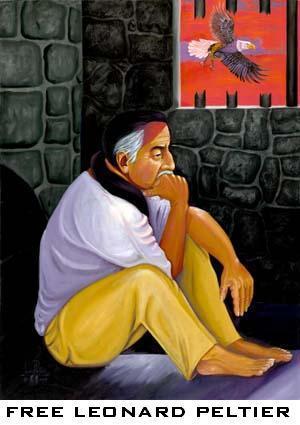
Remember our Sisters in Jails, Prisons, and
International Women's Day, March 8, 2010.
Celebrate Women's Resistance!
This is a great (and long) article from the Revolutionary Communist Party about Nina Simone, one of our greatest contemporary resisters, written in the aftermath of her death. It seems appropriate for both International Woman’s Day and a few other things coming up this month.
Nina died in the spring of 2003, which I remember so clearly because the previous six weeks of radio (I had no TV) was nothing but war. As I heard her music soulfully come through NPR that day, I became conscious that was I was hearing was most clearly the truth - which I hadn't heard much of from any media then. I realized this woman was not just a visionary and musician; she was a revolutionary. I suspected it must have cheered her to see the unified global resistance to the war rise up before she died.
A number of years later I encountered Nina's music again - this time in a justice studies class at ASU on social movements. Our professor almost always had a great clip of protest music she played as we settled in for the class session, and Nina was one of her favorites. The Civil Rights Movement yielded to Black Power, which was tempered - not crushed - by the rabid repression and violence that liberation movement groups were met with by police organizations. Nina had a song for it every step of the way.
Nina spent the last years of her life in exile from America, as our government was determined to persecute her for her activism by prosecuting her on tax evasion if she returned. Exile is an extreme punishment we don't talk a lot about, and when we do we're usually referring to throwing someone out of a country or community after at least a showing of some kind of due process - not secretly burying them in the darkest recesses of control units and Supermaxes. Exile is what happens to the incarcerated automatically, though, which is a traumatic separation from their family, community, and daily lives, thrusting them into a world they can't possibly have prepared for that is organized and maintained entirely on the premise that anyone who fails to comply with state agents will be subjected to anything from ridicule and humiliation to massive violence. Some will also have endured the added trauma of prolonged, unrelenting isolation and invisibility. (And that just relates to what they are empowered by law to do to us under certain circumstances.)
Nina had an affinity for slaves and prisoners; she was able to make the connections pretty easily; she knew her history. Slaves and prisoners have been subjected to the most intense mechanisms of state domination and control - done at great expense not because they are irrelevant, but because they help Power control the masses by demonstrating how devastating the loss of one's liberty is through civil sanctions (enslaved by court ordered forfeitures, trapped in a low-paying, unstable job market, immobilized by crushing poverty and debt) and criminalization (with its permanent records, mandatory minimums, aggressive probation officers, attendant demonization, and post-release prohibitions from public resources).
Anyway, this summary of Nina's life also sets the stage for a lot of our issues with the prison industrial complex and militarized police state we have today...
------------------
by Michael Slate
Revolutionary Worker #1202, June 8, 2003, posted at rwor.org
Nina Simone died on April 21 at her home in the South of France. Her ashes have been spread across a handful of African countries, and the world is sad for her loss but a much richer place for having her among us.
I remember the first time I ever heard Nina Simone. I was 17 and living in a segregated neighborhood between
By 1968, I had learned some things and I had friends from the Black and Puerto Rican hoods. On the night that Martin Luther King Jr. was assassinated I was parked with my girlfriend outside of her house. I had the car radio tuned in to WDAS, at that time a major Soul station in the city. It was sometime after midnight when the DJ popped on I Wish I Knew How It Would Feel To Be Free . Everything stopped for me. My girlfriend hit another button on the radio. I looked at her hard and then reached over and brought back WDAS and Nina Simone. She stared at me and sneered, "Please don't tell me you're a n*gger lover." That was the last time I ever saw Beth. But it was the beginning of a long relationship with the music of Nina Simone.
"I wish I knew how
It would feel to be free
I wish I could break
all the chains holding me
I wish I could say
all the things that I should say
Say 'em loud, say 'em clear
For the whole round world to hear
I wish I could share
all the love that's in my heart
Remove all the bars
that keep us apart
I wish you could know
what it means to be me
Then you'd see and agree
That every man should be free."
Fifteen years later, a couple of friends were getting married in
FROM BACH TO NINA
Nina Simone was born Eunice Waymon on Februarry 21, 1933 in Tryon,
(pick up the rest of the article here: http://revcom.us/a/1202/ninasimone.htm )















 Posts
Posts